
| Yom Kippur |

| Messianic Education Trust | |||||
|
|
|
|
|||
Vayikra/Leviticus 16:32 And the priest shall make atonement who has been anointed or whose hand has been filled to serve instead of his father
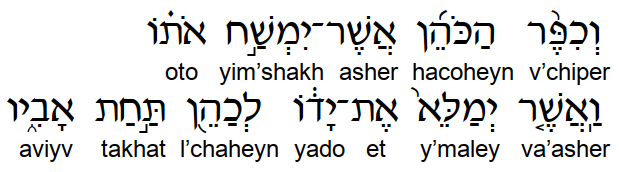
View whole verse and interlinear translation ...
Our Torah reading for the day of Yom Kippur is the whole of chapter 16 of Vayikra, at the start of parashat Acharei Mot. The whole of the ritual is given as instruction to Aharon, Moshe's older brother, who had just been inaugurated as the Cohen Gadol, the High Priest: "Aharon is to offer" (Vayikra 16:6), "Aharon shall take" (v. 7), "Aharon shall bring forward" (v. 9), "Aharon shall lay both his hands" (v. 21), etc. Our text, coming almost at the end of the passage, suddenly changes, as the WhoIsI(Right, Rashbam) explains: "Up until now we understand the passage to be specifically about Aharon. Here we learn that once Aharon is gone, the service of the Day of Atonement is to be performed by the priest who is anointed in his stead." Each High Priest, being human, has only the normal span of years so will eventually die; Aharon - the first High Priest - being no exception. There must be some form of succession so that there is always a High Priest. Tanakh tells us that Elazar, Aharon's son became High Priest when Aharon died, and that Pinchas, Elazar's son, became High Priest in turn.
Israel must have a High Priest. The Sages are clear that "the whole
service of the Day of Atonement is legitimate only when performed by him"
(b. Yoma 73a), so if there is to be a Yom Kippur ritual,
there has to be a High Priest to perform it. But who shall it be? Although
Who Is ...
Rashi: Rabbi Shlomo Yitzchaki (1040-1105 CE), French rabbi who wrote commentaries on the Torah, the Prophets and the Talmud, lived in Troyes where he founded a yeshiva in 1067; focuses on the plain meaning (p'shat) of the text, although sometimes quite cryptic in his brevity
Rashi tells us that "if the Cohen Gadol's son can fill
his father's place, he takes precedence over any other man to succeed his
father," Rabbi
Who Is ...
Hirsch: Rabbi Samson Raphael Hirsch (1808-1888 CE), German rabbi, author and educator; staunch opponent of the Reform movement in Germany and one of the fathers of Orthodox Judaism
Hirsch suggests that it is not always
necessarily so: "It is clear that the right of a son to inherit his father's
position and office is not as absolute or unconditional as his right to
inherit his land and property. It is dependent on the fitness and ability of
the heir. ... If he lacks the necessary qualities, then another has to be
chosen in his stead. And it is the worthiness of character rather than
knowledge or wisdom which gives the casting vote in such choice." If the son
is not suitable - perhaps he is disabled in some way or has an alcohol
problem - then the priests would choose another more suitable
candidate.
How does a priest become High Priest once he has been approved or designated by his peers? Our text contains two methods: by being anointed or by having his hand filled; in the early days, both. The latter is an idiom to describe the process of ordination that involves being dressed in the official garments of the High Priest, which only the High Priest could wear. If you are wearing the clothes, you are the High Priest! The anointing process was modelled on the anointing of Aharon, involving blood and the anointing oil being touched to the lobe of his right ear and the big toe on his right foot, before oil was poured on his head. However, the Sages suggest that the anointing oil was lost to Israel from the reign of Josiah as king of Judah onwards (b. Yoma 52b), so that the designated High Priest wore the garments but was not anointed. The Artscroll translation of our text translates "whose hand has been filled" as "who has been given the authority" as a recognition of this: he is given the authority by being given the clothes.
A third way to become High Priest appears in
What Is ...
Targum Onkelos: An early (1st-2nd Century CE) translation/paraphrase of the Torah into Aramaic; attributed to a Roman convert to Judaism, Onkelos; used in Babylonian synagogues during the Talmudic era
Targum Onkelos, where the Hebrew phrase
יְמַלֵּא אֶת־יָדוֹ is replaced by the Aramaic
יְקָרֵב יָת קֻרְבָּנֵיהּ - "who offered sacrifices". If the Yom
Kippur sacrifices were offered and accepted by HaShem, then that
signifies that He has accepted the person who brings the sacrifices as High
Priest. How did the people know that the Yom Kippur sacrifices had
been accepted? Because, following the text, "Come, let us reach an
understanding, says the L-RD. Be your sins like crimson, they can turn
snow-white; be they red as dyed wool, they can become like fleece" (Isaiah
1:18, NJPS), the Sages of the Talmud record that the
scarlet thread tied to the door of the temple court would turn white after
the High Priest has performed the Yom Kippur ritual: "as soon as the
he-goat reached the wilderness, it turned white" (b. Yoma 67a).
"If it turned white the people used to rejoice, and if it did not turn white
they were sad" (b. Rosh HaShanah 31b).
Now let's come forward to the year of Yeshua's crucifixion and resurrection. We know that the position of High Priest had become compromised. Instead of being a life-time inherited position - passed down from father to son, or chosen by the priests from among the family of the old High Priest on the basis of merit and character - the position was appointed by the Roman administration one year at a time. In practice, this meant that the position was given each year to the person or family who was prepared to pay the highest fee to the administration. This is why the gospels can tell us of Anas and Ciaphas, both of whom were or had been High Priest for one or more years. The priesthood in those days was dominated by a group of aristocrats known as the Sadducees, because they were all descendants of Tzadok, High Priest in the time of David. The agreement between Torah and practice in the appointment of High Priest was therefore at best tenuous, at worst, largely ignored.
Yeshua, on the other hand, is worthy; His character and behaviour exactly match G-d's righteousness and standards in every way - He was "without sin" (Hebrews 4:15). Although of priestly descent - through Mary, his mother, cousin to Elizabeth the wife of Zechariah (Luke 1:36) - he did not inherit the priesthood through his adopted father Joseph, who was from the tribe of David. Instead He was "designated by G-d a high priest after the order of Melchizedek" (Hebrews 5:10, ESV) - an order that pre-dated the appointment of Aharon and the Levites. Yeshua never wore the High Priest's garments, although He was anointed several times during His life; he became High Priest by performing His sacrifice on the cross. G-d showed His approval and acceptance of Yeshua's sacrifice by the tearing apart of the curtain between the Holy Place and the Holy of Holies in the Temple and an earthquake at the time of the His death (Matthew 27:51) and - three days later - by raising Him from the dead, accompanied by another earthquake and angelic appearances.
As Yeshua was appointed and accepted as High Priest by G-d Himself,
and now "always lives to make intercession" (Hebrews 7:25) for His
people who draw near to Him in faith, the role of High Priest has never
become vacant. The Sages of the Talmud allude to that too, when they
also record that "for forty years before the destruction of the Temple the
thread of scarlet never turned white but it remained red" (b. Rosh
HaShanah 31b). No earthly appointment could supersede Yeshua and for
forty years after the resurrection until the Temple was destroyed by the
Romans in 70 CE,
The Name ...
HaShem: literally, Hebrew for 'The Name' - an allusion used to avoid pronouncing the Tetragrammaton, the so-called 'ineffable' name of G–d
HaShem was telling the Jewish people: "It
doesn't work this way any more!" The human high priests before Yeshua needed
to repeat the Yom Kippur ritual each year - "a reminder of sins
every year" (Hebrews 10:3, ESV) - because their sacrifices only
covered over the sins of Israel until Yeshua came. But Yeshua "has no
need, like those high priests, to offer sacrifices daily, first for his own
sins and then for those of the people, since He did this once for all when He
offered up Himself" (7:27, ESV). The cross never needs to be
repeated; although only done once, it is effective for all sin for all time
for those who turn to Yeshua!
Each Yom Kippur we, the followers of Yeshua from the Jewish people and from the nations, look forward to His promised return according to the Scriptures: "having been offered once to bear the sins of many, [He] will appear a second time, not to deal with sin but to save those who are eagerly waiting for Him" (9:28, ESV). It is time to celebrate this Yom Kippur as, after praying for both the Jewish people and for the nations of the world to recognise who Yeshua is and turn to Him, we rejoice that the signs of His return grow ever more clear each year. Should believers in Yeshua still keep Yom Kippur at all? Yes, we should; it is one of HaShem's appointed times, His sacred appointments with His people and while some things will change once Yeshua does return, the Torah is very clear that the annual festival cycle is given for all generations. The day is certainly an opportunity to pray and repent, to make sure that our individual accounts with G-d are absolutely clear. But more than that, it is a day of solidarity with the Jewish world as we stand, together with them, to anticipate what G-d is yet going to do and cry out that Messiah may come soon.
Finally - somewhat counter-intuitively in the context of contemporary Jewish observance - it is a day of rejoicing, a day of singing and dancing, knowing that G-d is - and has been since that day in the Garden when the first man and woman sinned by disobeying His orders - in search of man and has already taken every possible step to make a way back so that we may reconnect with our Father, our Maker and our Redeemer and accept His invitation to reconciliation and a place at His table. He is still calling out for all to hear, "Adam, where are you?"
Further Study: Isaiah 53:11-12; 1 Peter 3:18; Revelation 5:9
Application:
Make sure that you rejoice before Yeshua this Yom Kippur, calling on
His name and exulting in what He has done for you. As you rejoice, pray that
many - both Jew and Gentile - will yet come to know and acknowledge Him in
these last days before He returns. May we whose names are already written in
the Lamb's book of life work with Him to faithfully spread the news and share
His invitation so that many may be added, snatched from the fire even at the
last moment.
© Jonathan Allen, 2024
Your turn - what do you think of the ideas in this drash ?
Messianic Trust Home Page
Join Weekly Email
More Weekly Drashot
Last Week
Support the work of producing this weekly commentary

Next Week
Last Year - 5778
Scripture Index