

|
Yitro (Ex 18:1 - 20:23) |

| Messianic Education Trust | ||||||
|
|
Always Being Ready
|
|
||||
Shemot/Exodus 18:9 And Yitro rejoiced about all the good that the L-rd had done for Israel, that He had rescued him from the hand of Egypt.
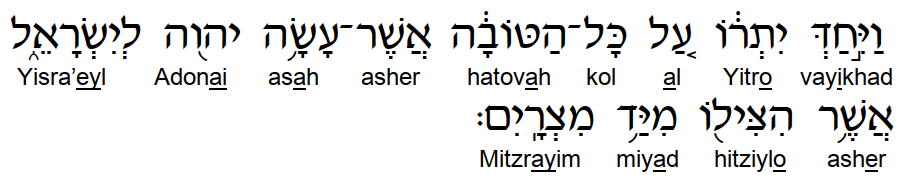
View whole verse and interlinear translation ...
There is considerable linguistic debate over the opening word in our
text: וַיִּחַדּ. While the root חדה, "to rejoice"
does exist, it is very unusual, being used only three times in
Tanakh.1Drazin and Wagner, commenting
on the way
What Is ...
Targum Onkelos: An early (1st-2nd Century CE) translation/paraphrase of the Torah into Aramaic; attributed to a Roman convert to Judaism, Onkelos; used in Babylonian synagogues during the Talmudic era
Targum Onkelos has changed it to
וַחֲדִי, "and he rejoiced", from the root חדי,
"to be happy, rejoice"2, observe that "The Hebrew
וַיִּחַדְּ is a verb of uncertain meaning."
Who Is ...
Rashi: Rabbi Shlomo Yitzchaki (1040-1105 CE), French rabbi who wrote commentaries on the Torah, the Prophets and the Talmud, lived in Troyes where he founded a yeshiva in 1067; focuses on the plain meaning (p'shat) of the text, although sometimes quite cryptic in his brevity
Rashi,
Ibn_Ezra, Rashbam and others accept Onkelos'
translation, but others differ. The Samaritan Pentateuch offers "he was
amazed", as does the
What Is ...
Septuagint: Also known simply as LXX, the Septuagint is a translation of the whole of the Hebrew Scriptures into Greek, probably done during the 1st century BCE by the Jewish community in Alexandria to have the Scriptures in their "first" tongue; the quality is mixed - some parts, such as the Torah, were in frequent use and are quite well rendered, in other less used parts the translation is rather patchy and shows signs of haste; it was widely deprecated by the early rabbis
Septuagint (NETS) whose text
reads evxe, from the root evxi, "to
confuse, amaze, astound".3 Brevard Childs suggests this "implies
a Hebrew root חרד, to tremble or be afraid, or
חתת, to be confused."4 The
Who Is ...
Ba'al HaTurim: Rabbi Yaakov ben Asher (1269-1343 CE), born in Cologne, Germany; lived for 40 years in and around Toledo, Spain; died en route to Israel; his commentary to the Chumash is based upon an abridgement of the Ramban, including Rashi, Rashbam and Ibn Ezra; it includes many references to gematria and textual novelties
Baal HaTurim claims that "Yitro unified his heart - reading
וַיִּחַדְּ as if it were vowelised וַיַּחַד (from the
root יחד) - in the service of the One G-d and became a Jew".
This in turn would imply the root יהד, as used in "many of
the people of the land מִתְיַהֲדִים professed to
be Jews" (Esther 8:17, NJPS).
Many of the classical Jewish commentators embrace Yitro's
expressions of joy, some going as far as to claim that this is proof of his
conversion of faith to worshipping and acknowledging HaShem alone. Others
observe that the phrase בָּרוּךְ יהוה, which Yitro is about to
say in verse 10 - "Blessed be the L-RD" (Shemot 18:10, NJPS) -
is only used three times in Torah, all three times spoken by
non-Israelites, and use that as a sign of his genuine pleasure and rejoicing
in the testimony that Moshe has shared with him. Rabbi
Who Is ...
Hirsch: Rabbi Samson Raphael Hirsch (1808-1888 CE), German rabbi, author and educator; staunch opponent of the Reform movement in Germany and one of the fathers of Orthodox Judaism
Hirsch
alone casts some doubt over that, suggesting a measure of duplicity or
hypocrisy in Yitro's apparent behaviour: "While the other expressions for joy
שׂמח and שׁישׁ designate the inner feelings of
gladness, חדה seems to express the outward signs of joy, to
show signs of joy rather than to feel them."
Over what was Yitro rejoicing? The start of the narrative block -
"Yitro priest of Midian, Moshe's father-in-law, heard all that G-d had
done for Moshe and for Israel His people, how the L-RD had brought Israel out
from Egypt" (18:1, NJPS) - tells us that before he brought Moshe's
wife Tzippora and two sons out to him in the desert, he had already heard of
the miraculous exit from Egypt, the dividing of the Reed Sea and the war with
Amalek. Terence Fretheim says that "the word had spread like wildfire, from
oasis to oasis, until it reached Moshe's family."5 Rashi cites
the words כָּל־הַטּוֹבָה, "all the good", from the text and says
that this is "the goodness of the manna and the well [of water that
accompanied them] and the Torah."
Who Is ...
Gersonides: Rabbi Levi ben Gershom, Gersonides or Ralbag (1288-1344 CE); famous rabbi, philosopher, mathematician and astronomer/astrologer; born at Bagnols in Languedock, France; wrote a commentary on the Torah and a parallel to Maimonides' Guide For The Perplexed
Gersonides comments on
Yitro's attitude: "He did not rejoice over what had happened from the
perspective that is was bad for the Egyptians, only from the perspective that
it was good for Israel" and the
Who Is ...
Sforno: Rabbi Ovadiah Sforno (1470-1550 CE), Italian rabbi, philosopher and physician; born in Cesena, he went to Rome to study medicine; left in 1525 and after some years of travel, settled in Bologna where he founded a yeshiva which he conducted until his death
Sforno adds, "He did not
rejoice over the destruction of Egypt, as would befit one who is zealous for
the honour of his maker, similar to, "The righteous man will rejoice when
he sees revenge" (Psalm 58:11, NJPS). He rejoiced for the good
that befell Israel as would one who feels compassion for the tears of the
oppressed."
Perhaps we can go further by looking at the last verb in our text: הִצִּילוֹ - the Hifil 3ms affix form of the root נצל, "to take away or deliver". Here it ends with a 3ms object pronoun, referring to Israel and, in the Hifil stem has the meaning "to save, to rescue, to deliver" (Davidson): He [that is, HaShem] delivered him [Israel]. Reading the section more closely, we can see that same verb is also used in both the verses on either side of our text. In the verse before, Moshe explains to Yitro how "the L-RD had delivered them" (Shemot 18:8); in the following verse Yitro uses it twice: "Blessed be the L-RD ... who delivered you from the hand of Egyptians and from the hand of Pharaoh, and who delivered the people from under the hand of the Egyptians" (v. 10). That's a remarkable concentration of the root נצל: four times in just three verses, as Yitro echoes Moshe's words and vocabulary. Brueggemann writes that "Yitro's speech is a litany of נצל, whereby he joins in celebration of the G-d who can override the power of the empire, giving new life and new possibility to the slave community that has no power of its own. Yitro thus becomes a voice for the celebrative faith of Israel."6 As Brevard Childs puts it: "He rejoices with Moshe because of what Yahweh has done for Israel and offers Him praise in the language of Israel's faith."7
Later, we will see from both Moshe's prescription of liturgy for first fruits - "You shall then recite as follows before the L-RD your G-d: ... The L-RD freed us from Egypt by a mighty hand, by an outstretched arm and awesome power, and by signs and portents" (D'varim 26:5,8, NJPS) - and Joshua voicing HaShem speaking to the Israelites, "And I sent Moses and Aaron, and I plagued Egypt with what I did in the midst of it, and afterward I brought you out. Then I brought your fathers out of Egypt" (Joshua 24:5-6, ESV), that repetition is a key way of remembering and passing on history, tradition and faith. Fretheim points out that "[Yitro's] use of much of Moshe's own language testifies to the basic way in which the faith is transmitted from generation to generation."8 Reading on the verses following out text, we can see that "Yitro did more than just reflect spontaneous joy." He responded in a way that "follows the pattern which the Psalmist outlines for the faithful of Israel to praise G-d."9 Rav Sha'ul instructs Timothy to work in exactly this way in his outreach and discipleship: "what you have heard from me in the presence of many witnesses entrust to faithful men who will be able to teach others also" (2 Timothy 2:2, ESV) - neither adding or taking away from the story, repeating the key words; passing on the story and teaching faithfully.
With all that said, our text reports that Yitro - who, yes, is Moshe's father-in-law, but is also the priest of Midian - rejoiced over the exciting news he had just heard of what HaShem has been doing for Moshe and for the Children of Israel. This is not a traditional story or a long past part of an origin myth; this - straight from Moshe's mouth to Yitro's ear - is a real-time factual report of HaShem interacting with His people, confounding their enemies, proving Himself to be the Almighty, the Most High G-d. As a religious man, a religious professional, Yitro recognises Moshe's testimony for what it is: a credible eye-witness report of a real divinity doing real things, corroborated by over 600,000 people who were there at the time and saw it happen with their own eyes. This is something that Yitro hasn't seen in a long time! It made a big impact on all the surrounding nations; Moshe prophetically knew this immediately after the Israelites crossed the sea - "The peoples hear, they tremble; Agony grips the dwellers in Philistia. Now are the clans of Edom dismayed; The tribes of Moab -- trembling grips them; All the dwellers in Canaan are aghast" (Shemot 15:14-15, NJPS) - and it was the opening of Rahab's confession to the spies: "all the inhabitants of the land are quaking before you. For we have heard how the L-RD dried up the waters of the Sea of Reeds for you when you left Egypt, and what you did to Sihon and Og, the two Amorite kings across the Jordan, whom you doomed" (Joshua 2:9-10, NJPS).
Throughout His ministry, Yeshua performed many miracles to demonstrate the proximity and reality of the kingdom of G-d. While these were received enthusiastically by the people, who hung on His every word and followed Him around in crowds, right from the start the Jewish leadership were much less enamoured by His signs and teaching. Perhaps one of the most significant signs and one that attracted the most direct opposition was the raising of Lazarus. Although he had been dead for three days, Yeshua called him alive out of his tomb and the people marvelled. John tells us that "Many of the Jews therefore, who had come with Mary and had seen what He did, believed in Him" (John 11:45, ESV); they were rejoicing. Others, shocked by what they had just witnessed, reported to the Jewish leaders what they had seen. Let's give them the benefit of the doubt and suggest that at least some of them were puzzled about what had happened and sought clarification and assurance from their leaders. Be that as it may, the leaders took a very oppositional stance: "the chief priests and the Pharisees gathered the Council and said, 'What are we to do? For this man performs many signs. If we let Him go on like this, everyone will believe in Him, and the Romans will come and take away both our place and our nation'" (vv. 47-48, ESV). Following the words of Caiaphas, the high priest, "from that day on they made plans to put Him to death" (v. 53, ESV). They did not rejoice at what HaShem was doing!
Our question has to be: are we always ready to rejoice at what HaShem does? Will we see what He is doing - around us, in our midst, in new and exciting (well, at any rate, different or unexpected) ways - and rejoice because He is at work among His people, calling and challenging them to grasp the kingdom of G-d in all its power and glory - or turn up our noses and complain that HaShem doesn't behave like that? Can we, when reversals - at a human level - come, say with Job, "the L-RD has given, and the L-RD has taken away; blessed be the name of the L-RD" (Job 1:21, NJPS)? Rav Sha'ul not only could but did, urging the Philippians, "Rejoice in the Lord always; again I will say, Rejoice" (Philippians 4:4, ESV) and the Thessalonians, "Rejoice always, pray without ceasing, give thanks in all circumstances; for this is the will of G-d in Messiah Yeshua for you" (1 Thessalonians 5:16-18, ESV). Although discernment is always necessary, testing everything for its consistency with Scripture, our challenge is to look for, recognise and embrace the new shoots of growth in our day and work with the Spirit to nurture and bless what He is doing in these days. Are you up for that?
1. - David J. A. Clines (ed.) The Concise Dictionary of Classical Hebrew, (Sheffield: Sheffield Phoenix Press, 2009), page 108.
2. - Michael Sokoloff, A Dictionary of Palestinian Aramaic, 2nd Ed., (Ramat-Gan, Israel: Bar Ilan University Press, 2002), page 472.
3. - Liddell and Scott, An Intermediate Greek Lexicon, (Oxford, OUP, 1889), page 274.
4. - Brevard S. Childs, The Book of Exodus: A Critical, Theological Commentary, The Old Testament Library, (Louisville, KY: Westminster John Knox Press, 2004), page 320.
5. - Terence E. Fretheim, Exodus, Interpretation, (Louisville, KY: Westminster John Knox Press, 2010), page 195.
6. - Walter Brueggemann, "Exodus", in The New Interpreter's Bible Commentary Vol I, edited by Leander E. Keck, (Nashville, TN: Abingdon Press, 2015), page 393.
7. - Childs, 329.
8. - Fretheim, 196.
9. - Childs, 328.
Further Study: Isaiah 43:19-21; Luke 10:19-20; Romans 5:2-5; 2 Corinthians 5:17
Application: Where is the new growth happening in your congregation? How is the Spirit moving to bring life into your group, into your world? Ask Yeshua to show you, to open your eyes and open the door for you to join in. Remember, the question isn't "Why?"; the question is "What can I do to help?"
Buy your own copy of the Drash Book for Exodus/Shemot now at Amazon US or Amazon UK.
© Jonathan Allen, 2026
| Messianic Trust Home Page | Join Weekly Email | More Weekly Drashot |
| Last Week |
Support the work of producing this weekly commentary
|
Next Week |
| Last Year - 5785 | Scripture Index |
|
Your turn - what do you think of the ideas in this drash ? Like most print and online magazines, we reserve the right to edit or publish only those comments we feel are edifying in tone and content. |