

|
Yitro (Ex 18:1 - 20:23) |

| Messianic Education Trust | ||||||
|
|
Living in Exile
|
|
||||
Shemot/Exodus 18:8 And Moshe related to his father-in-law all that Adonai had done to Pharaoh and to Egypt on account of Israel; all the trouble that had found them on the way; and that the L-rd had rescued them.
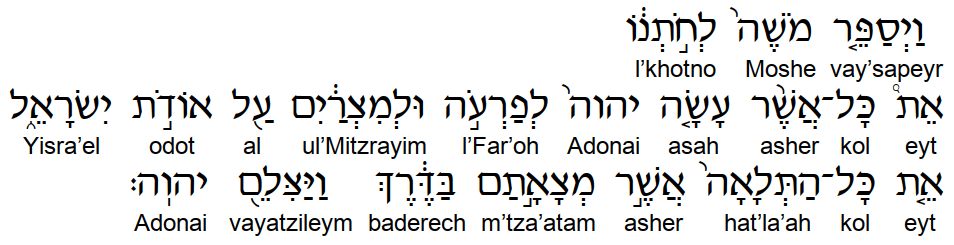
View whole verse and interlinear translation ...
Moshe's father-in-law, Yitro the priest of Midian, has come to Moshe and the Israelites at their wilderness camp at the base of Mt. Sinai. While it is true that he brings him his wife, Tzipporah, and his two sons, Gershom and Eliezer, thus re-uniting their family - maybe that was his ostensible 'cover' for the journey - perhaps we can see a more significant motive for the visit in our text. The chapter opens with the narrator telling us that "Yitro ... heard all that G-d had done for Moshe and for Israel His people, how the L-RD had brought Israel out from Egypt" (Shemot 18:1, NJPS), but this could have been at best only a second-hand report. As a religious man, a religious professional, Yitro's curiosity was aroused; as a seeker after truth, he needed to get a first-hand report - he needed to hear it from the horse's mouth. In order to hear and understand, in order to be able to sense or feel the manifestation and purpose of G-d in what he had heard, Yitro needed to hear the story first-hand, from an eye-witness who had been there and seen everything happening. The story was so big, he needed to experience it in person. Like Thomas who said, "Unless I see in His hands the mark of the nails, and place my finger into the mark of the nails, and place my hand into His side, I will never believe" (John 20:20, ESV), Yitro needed to hear from a reliable witness. For Thomas, it was Yeshua Himself; for Yitro, Moshe was his son-in-law.
When Yitro arrives at the camp and is greeted by Moshe, who has gone out to meet him, after doing the public formalities of bowing to each other, kissing each other's cheeks and enquiring about each other's peace, they go into the privacy of Moshe's tent. "Tell me all about it," we can imagine Yitro saying. "Tell me everything that happened and don't miss out one single thing. I must have the whole nine yards." At the same time, Moshe is positively bursting to tell Yitro the whole story. This is the first opportunity he has had to tell anyone who wasn't there and to re-live the excitement and amazement as he sees it reflected in Yitro's face. Brevard Childs notes that "the story exudes the genuine enthusiasm of Moshe as he tells [Yitro] the story of the deliverance starting with the plagues and brings him through the trials of the wilderness before they reached the safety of the mountain."1
We should start with the opening word of our text, the verb
וַיְסַפֵּר - the Pi'el 3ms prefix form of the root
ספר with a vav-conversive. In the Qal stem,
ספר means "to write, number, count" - the Hebrew word for a
scribe is סֹפֵר, "the one writing" - but in the Pi'el
stem it takes on the idea of recounting or relating. We might have expected
the Torah to use the verb נגד, which commonly means
"to declare, show, tell, announce, proclaim", but by using
ספר, it emphasises the reliability and accuracy of Moshe's
story. Moshe tells Yitro what he will later write: the definitive account of
the Exodus. As the Psalmist will later say, "my tongue is like the pen of
a ready scribe" (Psalm 45:1, ESV). Significantly,
ספר appears in
The Name ...
HaShem: literally, Hebrew for 'The Name' - an allusion used to avoid pronouncing the Tetragrammaton, the so-called 'ineffable' name of G–d
HaShem's words that Moshe
voiced to Pharaoh: "For this purpose I have raised you up, to show you My
power, and in order סַפֵּר [Pi'el infinitive] to declare My name
in all the earth" (Shemot 9:16). Terence Fretheim reports that "the word
'declare' was used in 9:16 to refer to the basic divine purposes in these
events. This is the first reported instance of the carrying out of that
purpose."2
Moshe's account starts with the time in Egypt: the years of slavery,
the ten signs or plagues and the Israelite departure. Then he moves on to
the troubles or difficulties that they had encountered. At this point the
Jewish commentators appear uncertain about exactly which troubles these were.
The
What Is ...
The Mekhilta: The earliest known halakhic midrash or commentary on (parts of) the book of Exodus; formally named for Rabbi Ishmael and therefore set around 100-135CE, it was redacted some years after his time; quoted many times in the Bavli Talmud as "Rabbi Ishmael taught ..."
Mekhilta mentions "at the Sea of Suf and the war with
Amalek." Ovadia
Who Is ...
Sforno: Rabbi Ovadiah Sforno (1470-1550 CE), Italian rabbi, philosopher and physician; born in Cesena, he went to Rome to study medicine; left in 1525 and after some years of travel, settled in Bologna where he founded a yeshiva which he conducted until his death
Sforno lists "hunger, thirst and the war
against Amalek", while the
Who Is ...
The Rashbam: Rabbi Samuel ben Asher (1085-1174 CE), a grandson of Rashi; lived in Northern France; worked from the plain meaning of the Hebrew text even when this contradicted established rabbinic interpretaton
Rashbam has "Pharaoh's pursuit, and
the water, manna and meat that the Holy One had given them."
Who Is ...
Abraham Ibn Ezra: (1089-1167 CE), born in Tudela, Spain; died in the South of France after wandering all around the shores of the Mediterranean and England; a philosopher, astronomer, doctor, poet and linguist; wrote a Hebrew grammar and a commentary on the Bible
Ibn Ezra says, "the pursuit by the Egyptians and the encounter
with Amalek." Umberto Cassuto, a modern commentator, pulls these together to
include, "the pursuit of the Egyptians, the division of the Sea of Reeds, the
lack of water, the dearth of food and the war with Amalek."3 The
Torah doesn't tell us what Moshe said at this point, but the Mekhilta
firmly points out that "from all these, G-d had delivered them."
Those are the last two words of our text:וַיַּצִּלֵם יהוה, "and HaShem rescued or delivered them." The verb וַיַּצִּלֵם - the Hifil 3ms prefix form of the root נצל, with a vav-conversive - is important because it also forms a key part of Yitro's response to Moshe's story. Yitro will repeat it no less than three times in the next two verses: "Yitro rejoiced over all the kindness that the L-RD had shown Israel when He delivered them from the Egyptians. "Blessed be the L-RD," Yitro said, "who delivered you from the Egyptians and from Pharaoh, and who delivered the people from under the hand of the Egyptians" (Shemot 18:9-10, NJPS). Walter Brueggemann comments that "[Yitro] joins in celebration of the G-d who can override the power of the empire, giving new life and new possibility to the slave community that has no power of its own."4
The act of blessing G-d itself attracts comment from the Mekhilta: "Rabbi Pappias said: This passage expresses a reproach of the Israelites. For, behold there were six hundred thousand people and not one of them rose to bless G-d until Yitro came and blessed G-d as it is written ..." (Amalek, 3). Peter Enns wryly observes that "although neither the Egyptians nor the Amalekites get it, Yitro, the Midianite, has learned the lesson of the Exodus: 'The L-rd is greater than all other gods.'"5 But what is blessing? What does it mean and what does it look like? Thomas Dozeman replies that "the act of blessing Yahweh is a cultic form of praise ... in the song of thanksgiving - "Blessed is the L-RD, my rock, who trains my hands for battle, my fingers for warfare; my faithful one, my fortress, my haven and my deliverer, my shield, in whom I take shelter, who makes peoples subject to me" (Psalm 144:1-2, NJPS) - and in the hymn: "O house of Israel, bless the L-RD; O house of Aaron, bless the L-RD; O house of Levi, bless the L-RD; you who fear the L-RD, bless the L-RD. Blessed is the L-RD from Zion, He who dwells in Jerusalem. Hallelujah" (Psalm 135:19-21, NJPS)."6
Sharing with the Corinthians about his own experiences - "In my many travels I have been exposed to danger from rivers, danger from robbers, danger from my own people, danger from Gentiles, danger in the city, danger in the desert, danger at sea, danger from false brothers. I have toiled and endured hardship, often not had enough sleep, been hungry and thirsty, frequently gone without food, been cold and naked" (2 Corinthians 11:26-27, CJB) - Rav Sha'ul paints a fairly tough picture of life on his mission trips around the Roman empire. Beaten, lashed, stoned and shipwrecked - almost every imaginable trouble has come his way. It's enough to put anyone right off wanting to become a follower of Yeshua, but in his next breath, Sha'ul goes on to bless G-d: "G-d the Father of the Lord Yeshua - blessed be He forever - knows that I am not lying!" (v. 31, CJB). He recounts the troubles quite freely, almost proudly, to demonstrate that G-d has sustained him through everything in order that G-d may be blessed and His name spread throughout the nations: "For the sake of Messiah, then, I am content with weaknesses, insults, hardships, persecutions, and calamities. For when I am weak, then I am strong" (12:10, ESV). As Brueggemann explains, "this telling and hearing become the core activity of the early church in Acts, whereby those who have not witnessed the saving events come to share in their reality and their power."7
Indeed, Sha'ul will write to the congregations in Rome, whom he had never met, to assure them of the truth: "Who shall separate us from the love of Messiah? Shall tribulation, or distress, or persecution, or famine, or nakedness, or danger, or sword? ... No, in all these things we are more than conquerors through Him who loved us. For I am sure that neither death nor life, nor angels nor rulers, nor things present nor things to come, nor powers, nor height nor depth, nor anything else in all creation, will be able to separate us from the love of G-d in Messiah Yeshua our Lord" (Romans 8:35,37-39, ESV). Why then, as exiles, do we share together the hardships of this present life as witnesses to our Master, King Yeshua? Is it so that others can pray for us and we for them? Perhaps, in small part - prayer is important. But no, we share so that others may see, may rejoice in G-d's goodness and faithfulness to support, carry and comfort us through these troubles. We share our story so that we may all bless G-d and give Him the glory for what He does for His people - including us - every day.
1. - Brevard S. Childs, The Book of Exodus: A Critical, Theological Commentary, The Old Testament Library, (Louisville, KY: Westminster John Knox Press, 2004), page 328.
2. - Terence E. Fretheim, Exodus, Interpretation, (Louisville, KY: Westminster John Knox Press, 2010), page 196.
3. - Umberto Cassuto, A Commentary on the Book of Exodus, (Magnes Press, Jerusalem, 1983), page 215.
4. - Walter Brueggemann, "Exodus", in The New Interpreter's Bible Commentary Vol I, edited by Leander E. Keck, (Nashville, TN: Abingdon Press, 2015), page 393.
5. - Peter Enns, Exodus, The NIV Application Commentary, (Grand Rapids, MI: Zondervan, 2000), page 369.
6. - Thomas B. Dozeman, Exodus, Eerdmans Critical Commentaries, (Grand Rapids, MI: Eerdmanns, 2009), page 403.
7. - Brueggemann, 394.
Further Study: Acts 4:23-31; James 1:2-4
Application: It is easy to complain about the challenges and difficulties we face trying to share the good news of the Kingdom of G-d with others. Instead, however, James tells us to "Count it all joy, my brothers, when you meet trials of various kinds" (James 1:2, ESV) for that is how we are perfected. Let us raise our voices and bless G-d that He has counted us worthy to suffer for His name and to share in His glory reflected in Messiah Yeshua.
Comment - '14:04 15Feb25' Bill Fourie: I agree, it is important to recount our trials and affliction as it encourages others. Yitro's praise was certainly an indictment to Israel.
Buy your own copy of the Drash Book for Exodus/Shemot now at Amazon US or Amazon UK.
© Jonathan Allen, 2025
| Messianic Trust Home Page | Join Weekly Email | More Weekly Drashot |
| Last Week |
Support the work of producing this weekly commentary
|
Next Week |
| Last Year - 5784 | Scripture Index | Next Year - 5786 |
|
Your turn - what do you think of the ideas in this drash ? Like most print and online magazines, we reserve the right to edit or publish only those comments we feel are edifying in tone and content. |