

|
Vayishlach (Gen 32:4 - 36:42) |

| Messianic Education Trust | ||||||
|
|
|
|
||||
B'resheet/Genesis 36:40 These are the names of the chieftains of Esau according to their families, according to their places, by their names ...

View whole verse and interlinear translation ...
The late Rabbi Lord Jonathan Sacks  - whose
third yarhzeit was just over three weeks ago on Cheshvan 20, November
4 this year - provides the starting point for our thoughts. He said that he
imagined Yitz'khak telling Rivkah, "Of course I know that it will be Ya'akov
and not Esau who will continue the covenant. But I have two quite different
blessings in mind, one for each our of sons. I will give Esau a blessing of
wealth and power ... I will give Ya'akov the blessing G-d gave to Avraham and
to me, the blessing of children and the promised
land."1 The whole of the last aliyah of parashat
Vayishlach, as the
Who Is ...
Abravanel: Don Isaac Abravanel (1437-1508 CE), Statesman and biblical commentator; born in Lisbon, died in Venice; wrote commentaries on the whole of the Hebrew Scriptures
Abravanel points out, "demonstrates the
fulfillment of the promise made to him in that 'Yet by your sword you
shall live' (B'resheet 27:40, NJPS)". The words of Esau's father
that Esau will have a land to call his own and a progeny to inherit it, are
hereby proven. Drazin and Wagner report that the
chieftains listed in the three verses following our text "still had
recognisable lands in the post-Mosaic period."
How are the chieftains identified? The
Who Is ...
Bekhor Shor: Joseph ben Isaac Bekhor Shor; a twelfth century French tosafist, commentator and poet; he lived in Orleans and was a pupil of the Rashbam and Rabbenu Tam; wrote a commentary to the Torah and made contributions to the Talmud commentaries; followed the p'shat method of interpretation in the style of Rashi, to the extent of rationalising many miracles
Bekhor Shor
suggests that "All these are the names of cities; but sometimes the name of
the man and the name of the city are the same." The Hebrew text starts by
telling us that the following list of eleven names - "Timna, Alvah,
Jetheth, Oholibamah, Elah, Pinon, Kenaz, Teman, Mibzar, Magdiel, and Iram"
(36:40-43, NJPS) - are the names of the men, then gives three
qualifiers to say how they are listed. The first is
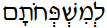 , according to their family or clan. The
word comes from an unused root
 , perhaps
meaning to join or associate, and is found in the fs noun
 , a family, extended family, household or
clan. The word in our text is the fp noun with a 3mp possessive ending,
'their': "their families". The chieftains are known by the people they
govern or look after, their clan or kinsmen.
Coming from the root  , to arise
or rise up, the common noun
 is a place,
room or space; by extension, also a home or a town. The second qualifier,
then, is
 , according to their places or
the region where they were located. All the people in one area are likely to
be related in one degree or another and come under the authority and
guardianship of one chieftain. The
Who Is ...
Sforno: Rabbi Ovadiah Sforno (1470-1550 CE), Italian rabbi, philosopher and physician; born in Cesena, he went to Rome to study medicine; left in 1525 and after some years of travel, settled in Bologna where he founded a yeshiva which he conducted until his death
Sforno points to this word
and says that this "implies that they were not sufficiently important or
distinguished to be called by their names, only by their regions."
Nahum Sarna comments that "this list is apparently arranged
by localities that are identical with the clan names. The list may reflect
administrative arrangements." He points out, for example, that in verse 41,
the name 'Elah' is "most likely Elath (now Eilat) on the Gulf of Aqaba.
According to D'varim 2:8, this place marked the southernmost boundary of
Edom."
Lastly, we have  , by their
names. The
Who Is ...
The Radak: Rabbi David Kimḥi (1160-1235 CE), rabbi, biblical commentator, philosopher and grammarian; born in Narbonne, France; best known for his commentaries on the Prophets, he also wrote a philosphical commentary on Bresheet that makes extensive use of the Targum of Jonathan ben Uzziel; influenced by a strong supporter of Ibn Ezra and Maimonides
Radak tells us that "these are the eleven chieftains
who ruled after the eight kings", while
Who Is ...
Rashi: Rabbi Shlomo Yitzchaki (1040-1105 CE), French rabbi who wrote commentaries on the Torah, the Prophets and the Talmud, lived in Troyes where he founded a yeshiva in 1067; focuses on the plain meaning (p'shat) of the text, although sometimes quite cryptic in his brevity
Rashi says that they
are "called by the names of their countries after the monarchy was
discontinued." The same list appears in 1 Chronicles 1:51-54, after the
death of king Hadad. Whereas a king would have had a centralised point of
authority, located in the place where he lived, the clans dwelt in their own
areas with their own chieftain. Verse 43 tells us that they live in
ancestral landholdings,  , the land of
their holdings, a nice little flourish that probably reflects the use of the
same root -
 , to seize, hold, catch - in
the text describing Esau's birth with his brother's hand holding on to
 his heel. Now, so to speak, the boot
is on the other foot!
Esau, his name, his origin and his development, are clearly a
B'resheet phenomenon. While they appear throughout Tanakh -
refusing to let Israel pass through their territory in the Exodus narrative,
rejoicing at Israel's destruction and exile by the Babylonians - they are no
longer the subject of comment or narrative focus. Yet, the memory of Esau
and his descendants, the people of Edom, remains. As Walter Brueggemann
notes, "it is not rejected or closed. The Bible chooses to follow the Jacob
line. But that makes the Esau story no less legitimate. We are required by
this carefully placed text to recognise the larger vision of Genesis. The
memory has not been purged or revised to exclude the other."2
Esau receives his blessing - the land of Seir, conveniently cleared before
him by
The Name ...
HaShem: literally, Hebrew for 'The Name' - an allusion used to avoid pronouncing the Tetragrammaton, the so-called 'ineffable' name of G–d
HaShem - generations before Ya'akov's descendants, the
people of Israel, will be able to claim theirs. In spite of Edom's less than
generous attitude towards Israel in the future, HaShem nevertheless honours
the blessing given by Yitz'khak because He is faithful. When all is said and
done, Esau is still Avraham's grandson and a promise was given that Avraham's
seed would contain kings and nations. Rivkah was promised that "two
nations are in your womb; two separate peoples shall issue from your body"
(B'resheet 25:23, NJPS). These promises need to be - and are -
kept by the G-d who keeps covenant.
Probably somewhat unexpectedly to his audience, Moshe tells the Israelites that are about to enter the Land: "You shall not abhor an Edomite, for he is your brother. You shall not abhor an Egyptian, because you were a sojourner in his land" (D'varim 23:7, ESV). How could this be? Within living memory, Israel had been released from slavery in Egypt and Edom refused Israel passage through their Land. HaShem's generosity towards these two people groups shows that He has a larger vision and a greater area of concern than the Israelites were, of themselves, considering. As Brueggemann explains, "this awareness has important implication for the faith community in the context of the human community. While G-d has a particular and precious relation to this chosen community, it is not the L-rd's only commitment. In other ways and on other grounds, these others are also held in His care and kept in His promise." Moshe's instructions lead naturally to Yeshua's comment - "And I have other sheep that are not of this fold. I must bring them also, and they will listen to my voice. So there will be one flock, one shepherd" (John 10:16, ESV) - that must have seemed similarly unexpected to His audience.
G-d's promises, both to Israel - "a Redeemer will come to Zion, to those in Ya'akov who turn from transgression" (Isaiah 59:20, ESV) - and to the nations, "It is too light a thing that you should be My servant to raise up the tribes of Jacob and to bring back the preserved of Israel; I will make you as a light for the nations, that My salvation may reach to the end of the earth" (49:6, ESV), needed to be kept. They could only be kept by G-d Himself, as the prophet voiced: "I looked, but there was no one to help; I was appalled, but there was no one to uphold; so My own arm brought Me salvation" (63:5, ESV). He did this in Yeshua; Yeshua was faithful with the faithfulness of G-d, to fulfil G-d's promises both to Israel and to the nations so that "in Him we might become the righteousness of God" (2 Corinthians 5:21, ESV). Rav Sha'ul tells us that "when the fullness of time had come, G-d sent forth His Son, born of woman, born under the law, to redeem those who were under the law" (Galatians 4:4-5, ESV) and the disciples testified that "we have seen and testify that the Father has sent His Son to be the Saviour of the world" (1 John 4:14, ESV). Each of these is a promise kept.
Yeshua allowed Himself to be crucified on the cross - "No one takes My life from Me, but I lay it down of My own accord" (John 10:18) - to take our sin, in spite of our sin. Sha'ul explains that "while we were still sinners, Messiah died for us" (Romans 5:8). Yeshua's faithfulness reflected G-d's love for us: "G-d, being rich in mercy, because of the great love with which He loved us, even when we were dead in our trespasses, made us alive together with Messiah ... and raised us up with Him and seated us with Him in the heavenly places" (Ephesians 2:4-5). This was His great demonstration, His example that He calls us to follow, showing His faithfulness by our faithfulness as we give His love consistently to the world around us. This is the great challenge for today: how can we anticipate G-d's blessing for others - perhaps, even and most particularly, those who have wronged us - by emulating Yeshua's faithfulness towards them?
Like Esau, who received the blessing of seed and land because G-d was faithful to His word, we ourselves have been blessed with an imperishable inheritance - "where neither moth nor rust destroys and where thieves do not break in and steal" (Matthew 6:20, ESV) - and a share in the kingdom of G-d because Yeshua is faithful to His word: "For this is the will of My Father, that everyone who looks on the Son and believes in Him should have eternal life, and I will raise him up on the last day" (John 6:40, ESV). Like Esau, this was not because of who we are or because of anything we have done; it is because of G-d's love and grace towards us in Messiah Yeshua!
1. - Rabbi Lord Jonathan Sacks, Lessons in Leadership: A Weekly Reading of the Jewish Bible, (Jerusalem, Maggid Books, 2015), Parashat Toldot, page 28.
2. - Walter Brueggemann, Genesis, Interpretation, (Atlanta, GA: John Knox Press, 1982), page 286.
Further Study: Isaiah 59:20-21; John 4:39-42; Romans 11:26-27
Application: Application: How can you show Yeshua's faithfulness to the people around you - possibly even at great cost - in order that they may see Yeshua with their own eyes and believe? Get together with Yeshua today and ask Him to show you how to let the Spirit guide and move you into that place of grace where miracles become possible and G-d's love is shed abroad.
Buy your own copy of the Drash Book for Genesis/B'resheet now at Amazon US or Amazon UK.
© Jonathan Allen, 2023
| Messianic Trust Home Page | Join Weekly Email | More Weekly Drashot |
| Last Week |
Support the work of producing this weekly commentary
|
Next Week |
| Last Year - 5783 | Scripture Index | Next Year - 5785 |
|
Your turn - what do you think of the ideas in this drash ? Like most print and online magazines, we reserve the right to edit or publish only those comments we feel are edifying in tone and content. |