

|
Vayechi (Gen 47:28 - 50:26) |

| Messianic Education Trust | ||||||
|
|
Always Being Ready
|
|
||||
B'resheet/Genesis 50:25 And Yosef made the sons of Israel swear, saying, G-d will surely remember you and you shall take my bones up from here.
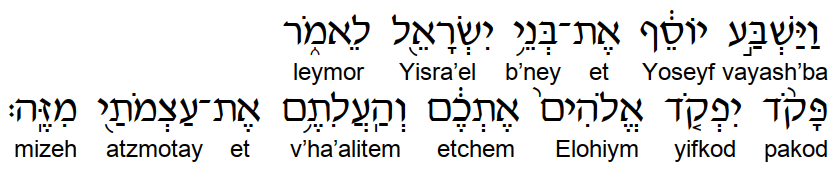
View whole verse and interlinear translation ...
The patriarch Yosef is aware that his life is shortly to end. He
has reached the age of one hundred and ten, considered the perfect age for a
pharaoh or senior civil servant who has been completely successful in his
life's work. During his lifetime - not without its turbulent moments - Yosef
has been instrumental, under
The Name ...
HaShem: literally, Hebrew for 'The Name' - an allusion used to avoid pronouncing the Tetragrammaton, the so-called 'ineffable' name of G–d
HaShem's hand, in rescuing his
family from famine in the land of Canaan and bringing them to Egypt where
they are already on the way to becoming a nation: "Israel settled in the
country of Egypt, in the region of Goshen; they acquired holdings in it, and
were fertile and increased greatly" (B'resheet 47:27, NJPS). Yosef
has also served Pharaoh faithfully as an Egyptian, managing the country and -
during years of famine - reducing the entire Egyptian population, save the
religious professionals, to slavery to Pharaoh; all the land of Egypt is now
owned by Pharaoh and farmed for him by his tenant-slave farmers. Yosef's
father Ya'akov has died and been taken back to the land of Canaan for burial,
to lie beside Leah and his fathers in the Machpelah cave.
Yosef's ambiguous word choices here are interesting. He prefaces
the oath itself - "You shall take my bones up from here" - with the assertion
that G-d would be leading the people back to the land He had promised to give
them: the land of Canaan. Looking closely at the text, the first ambiguity
is בְּנֵי יִשְׂרָאֵל, the sons of Israel. It is improbable that
Yosef is speaking just to his eleven brothers - apart from Benjamin, they are
all older than him by some years, so are unlikely still to be alive - but he
might be speaking to his nephews, the next generation heads of the eleven
families. More likely, he is speaking to the whole extended family of his
father, here called by the name Israel to reflect the change from a family to
a people, and probably including his own sons who were adopted to be Hebrews
rather than Egyptians by Ya'akov in Yosef's place as peers with his eleven
brothers. Rabbi
Who Is ...
Hirsch: Rabbi Samson Raphael Hirsch (1808-1888 CE), German rabbi, author and educator; staunch opponent of the Reform movement in Germany and one of the fathers of Orthodox Judaism
Hirsch agrees: "He did not make them swear as
his brothers, but as B'nei Yisrael, accordingly to include the coming
generations."
Secondly, Yosef uses the verb HebrewBodyTexT(פָקַד) to articulate what G-d is going to do: פָּקֹד יִפְקֹד. The sense of certainty - G-d will surely remember you - is generated by a Qal infinitive absolute followed immediately by a Qal 3ms prefix form, literally "to remember He will remember". But the root פָקַד has one of the widest ranges of meaning among the verbs represented in biblical Hebrew: from 'visit', 'punish' and 'remember', to 'appoint', 'attend' and 'muster'; even 'count', 'examine' or 'charge' (Davidson). Why, when the root זָכַר, to remember, was available to him, did Yosef choose the ambiguous פָקַד? Because the blend of meanings - "G-d will certainly visit you" (ESV), "G-d will certainly remember you" (CJB), "G-d will take care of you" (NASB) - is important to explain the level of involvement and intimacy in G-d's coming actions. He will not simply snap His fingers from afar or speak the word from a distance; He will be daily involved with His people and will personally, through the agency of Moshe, rescue His people from slavery and take them out of captivity and exile in Egypt in order to return them to the land He is giving them: home. On the way, He will show His power over all the Egyptian gods and reduce Pharaoh to nothing by a devastating series of plagues and signs.
Lastly, the oath itself - "and you shall bring up my bones from
here" - tells us that to the end, although he probably also recognised that
"the present conditions are unfavourable" (Sarna) for him to be
interred immediately in Canaan as his father was, Yosef maintained his faith
in HaShem and His promises. He was not going to get left behind in Egypt
when everyone else went up to the Land. The Ramban points out how
multi-generational Yosef's vision was: "Seeing that his brothers were aged,
he made their sons and all of his father's household swear that everyone
would make his sons take this same oath up until the time of the redemption.
For they all knew about the exile." From the Hebrew text, for both
אֶתכֶם, "G-d will surely visit you" and
וְהַעֲלִתֶם, "and you shall take up", 'you' is plural,
Who Is ...
Bekhor Shor: Joseph ben Isaac Bekhor Shor; a twelfth century French tosafist, commentator and poet; he lived in Orleans and was a pupil of the Rashbam and Rabbenu Tam; wrote a commentary to the Torah and made contributions to the Talmud commentaries; followed the p'shat method of interpretation in the style of Rashi, to the extent of rationalising many miracles
Bekhor Shor surmises that "Yosef knew that all the tribes would
go back up to the land." The promise of Yosef's oath will be fulfilled by
Moshe - "Moshe took with him the bones of Yosef" (Shemot 13:19) - and
Joshua: "The bones of Yosef, which the Israelites had brought up from
Egypt, were buried at Shechem" (Joshua 24:32, NJPS).
However, the
Who Is ...
Ba'al HaTurim: Rabbi Yaakov ben Asher (1269-1343 CE), born in Cologne, Germany; lived for 40 years in and around Toledo, Spain; died en route to Israel; his commentary to the Chumash is based upon an abridgement of the Ramban, including Rashi, Rashbam and Ibn Ezra; it includes many references to gematria and textual novelties
Baal HaTurim claims that Yosef "adjured
them not to seek redemption before the ultimate end of exile. For Yosef knew
the time of the ultimate end, for Ya'akov had revealed it to him." In the
Midrash, the rabbis deduce that the sign of the redemption would be
that the redeemer would speak with the phrase "פָּקֹד פָּקַדְתִּי I
have surely remembered/visited". When Aharon came and spoke that phrase,
recounting what HaShem had said to Moshe at the Bush, the people recognised
it and believed him: "When they heard that the L-RD had remembered the
Israelites and that He had seen their plight, they bowed low in homage"
(Shemot 4:31, NJPS) (Shemot Rabbah 15.3). When Yosef used
these words in our text, He was prophetically warning the people to wait for
the sign and not attempt to escape from Egypt by themselves before HaShem was
ready to take them out. Interestingly, Zechariah also had to wait - "you
will be silent and unable to speak until the day that these things take
place, because you did not believe my words, which will be fulfilled in their
time" (Luke 1:20, ESV) - and then used the same root word when
John was born: "Blessed be the L-rd G-d of Israel, for He has visited and
redeemed His people" (v. 68, ESV).
While Nahum Sarna plays down Yosef's request not to be left behind in Egypt, Rabbi Hirsch is more positive: "this duty and these bones on which they were to perform it, were a pledge for the confidence with which they were to await the return to Canaan." Richard Elliott Friedman phrases his translation of our text this way: "G-d will take account of you, and you'll bring up my bones from here", laying emphasis on Yosef's conviction. Terence Fretheim is more expansive: "When Yosef is at the point of death, he extends to his brothers both a promise and a charge. Ya'akov had never spoken the promise to his sons, except on his deathbed to Yosef: 'I am about to die; but G-d will be with you and bring you back to the land of your fathers' (B'resheet 48:21). He assures them that G-d will surely visit them in Egypt and bring them out of the land of Egypt and into the land of Canaan, the land promised to their ancestors in the previous chapters. Egypt was not to be their permanent home."1 Yosef's choice of temporary burial in a coffin in Egypt, followed by permanent interment in the Land was a deliberate act of self-sacrifice and solidarity: "When we go, we're all going; we're going together, not some earlier and some later." His faith in the return - going home - kept them all together.
What about the visit? What is it about? Walter Brueggemann tells us that "the visit of G-d is an exile-ending intrusion. That is the hope of the sixth-century exiles in Babylon. Yosef knew that the way of his people would be like his own way with G-d - visited, interrupted, intruded upon - according to G-d's dream. In G-d's way and in G-d's time, that visit is Israel's source of hope. An unvisited history is no history at all. But Yosef knows that Israel's history is visited in powerful and irresistible ways."2 Yosef's words are (in essence) are no different from Isaiah's words to the Judean exiles in Babylon: G-d's promise is sure: we are going home. Both were given some hundreds of years before the event, so stored up faith in the minds of the people - remember, faith is "faith is the assurance of things hoped for, the conviction of things not seen" (Hebrews 11:1) - a hope, a conviction that although it was not yet, in the fullness of time it would be. Yeshua's promise - backed up and demonstrated by His own resurrection - is just as sure: "For this is the will of My Father, that everyone who looks on the Son and believes in Him should have eternal life, and I will raise him up on the last day" (John 6:40, ESV). The Father's promise, given by Yeshua, is just the same: "We are going home. Don't get left behind!"
In our days of exile we need to constantly remind and encourage each other of this truth: we're going home. This period of exile will - one way or the other - soon be over. In his book, Cadences of Home, Brueggemann urges us all to share, to study and to rejoice in frequent rehearsal of texts that remind us of G-d's promises of a homecoming, when Yeshua returns and He takes His bride to be "at home" with Him. "Exile did not lead Jews in the Old Testament to abandon faith or to settle for abdicating despair, nor to retreat to privatistic religion. On the contrary, exile evoked the most brilliant literature and the most daring theological articulation in the Old Testament." We need to be constantly "grounded in a sense and sureness of news about G-d that circumstances cannot undermine or negate."3 That news is the ever-present reminder that "brings good news, who publishes peace, who brings good news of happiness, who publishes salvation, who says to Zion, 'Your G-d reigns'" (Isaiah 52:7, ESV). These words must always be on our lips as we encourage each other, "all the more as you see the Day drawing near" (Hebrews 10:25, ESV). Let's says it together right now: Our G-d reigns!
1. - Terence Fretheim, "Genesis" in The New Interpreter's Bible Commentary, Vol I, edited by Leander E. Keck, (Nashville, TN: Abingdon Press, 2015), page 276.
2. - Walter Brueggemann, Genesis, Interpretation, (Atlanta, GA: John Knox Press, 1982), page 379.
3. - Walter Brueggemann, Cadences of Home, (Louisville, KY: Westminster John Knox, 1997), page 3.
Further Study: Nahum 1:15; Romans 10:14-15
Application: How can you encourage your fellow disciples today? Instead of the gloom and darkness of the society in which we live, speak out and proclaim to one another the marvellous promises of G-d and His overpowering goodness to "those who are called according to His purpose" (Romans 8:28). Make your voice heard above the din and clamour of news bulletins and trashy advertisements; and who knows who may overhear!
Comment - 11:11 05Jan24 Janet Gray: I much appreciated these thoughts in themselves and more so as I had already felt to pray this morning: Jeremiah 32:37-42; Bereshit 32:10-12. Katonti mi chol chasadiim ... Thank You Heavenly Father that we can hear Your voice and receive Your encouragement.
Buy your own copy of the Drash Book for Genesis/B'resheet now at Amazon US or Amazon UK.
© Jonathan Allen, 2025
| Messianic Trust Home Page | Join Weekly Email | More Weekly Drashot |
| Last Week |
Support the work of producing this weekly commentary
|
Next Week |
| Last Year - 5784 | Scripture Index | Next Year - 5786 |
|
Your turn - what do you think of the ideas in this drash ? Like most print and online magazines, we reserve the right to edit or publish only those comments we feel are edifying in tone and content. |