

|
Vayechi (Gen 47:28 - 50:26) |

| Messianic Education Trust | ||||||
|
|
|
|
||||
B'resheet/Genesis 50:24 And Yosef said to his brothers, "I am dying, but G-d will certainly visit you ...

View whole verse and interlinear translation ...
Here are Yosef's last recorded words in the Torah, containing
a strong echo of his father Ya'akov's last words to him: "I am about to
die; but G-d will be with you and bring you back to the land of your fathers"
(B'resheet 48:21, NJPS). While Ya'akov gives an assurance of
HaShem's continuing presence with Yosef - using the verb
 , to be - Yosef uses the verb
 , to visit, when he speaks to his brothers.
This generates an idea of distance:
The Name ...
HaShem: literally, Hebrew for 'The Name' - an allusion used to avoid pronouncing the Tetragrammaton, the so-called 'ineffable' name of G–d
HaShem - while not
abandoning His people - will be slightly further away or remote from them for
a season and will then have to approach or come closer in order to 'visit'
them. We should notice that Yosef uses the infinitive absolute construction
here for emphasis -  , the Qal
infinitive absolute,
 , the Qal 1cs
prefix, of the same root, - "to visit, He
will visit", commonly translated with such emphatic adverbs as 'surely' or
'certainly', so here: "He will certainly visit you". Make no mistake about
it!
Nahum Sarna rings an alarm bell when he reports that "this
reassuring profession of faith, made fifty four years after Ya'akov's death,
betrays a serious deterioration in the situation of the Israelites in Egypt
in the intervening period." Although the exile in Egypt was to go on for a
lot longer yet, already the privileged position of Israel, settled in one of
the nicer and more fertile areas in the land of Egypt and protected by the
throne, was becoming uncomfortable. Eyebrows were being raised, questions
were being asked and mutterings - all off the record, of course, since Yosef
was still Grand Vizier until he died - were being heard in some quarters.
Sarna shrewdly comments that "the measure of its impact is its
use as the rallying cry when Moshe first appears as the national saviour."
Then HaShem tells Moshe, "Go and assemble the elders of Israel and say to
them: the L-RD, the G-d of your fathers, the G-d of Avraham, Yitz'khak and
Ya'akov, has appeared to me and said, 'I have taken note of you and of what
is being done to you in Egypt" (Shemot 3:16, NJPS). Although
there translated "I have taken note", that Hebrew text uses the same
infinitive absolute construction: 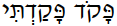 - the
Qal infinitive absolute followed by the Qal 1cs affix - also "I
have observed" (ESV) or "I have been paying close attention"
(CJB).
Rabbi
Who Is ...
Hirsch: Rabbi Samson Raphael Hirsch (1808-1888 CE), German rabbi, author and educator; staunch opponent of the Reform movement in Germany and one of the fathers of Orthodox Judaism
Hirsch too picks up on the two word emphasis,
 : "these two little words became the ray of
light that kept the hopes of coming dawn awake for his descendants through
the dark centuries that lay ahead." Although things would get much worse -
forced slavery building Pharaoh's storage cities - HaShem has not forgotten
or abandoned His people. The time would come; it would most certainly come.
But, Hirsch warns, "as the time will come when it will be necessary for G-d
to visit you, you must expect that in the meantime He will not do so." It
won't happen until it happens. We can almost hear Rav Sha'ul explaining to
the disciples in Thessalonica, "Let no one deceive you in any way. For
that day will not come, unless the rebellion comes first, and the man of
lawlessness is revealed, the son of destruction, who opposes and exalts
himself against every so-called god or object of worship, so that he takes
his seat in the temple of G-d, proclaiming himself to be G-d" (2
Thessalonians 2:3-4, ESV). Back to Hirsch who links this to the
Jewish journey through history: "This gives us altogether the conception of
the Jewish Galut, both of the earlier and latter times. By the words
'He will visit you' they were prepared for the trouble that then came, but
also the delivery from it which was promised."
Bruce Waltke is a close reader of Scripture. Commenting that "the
book [of Genesis] ends with the expectation of G-d's visitation", he points
out that "the Hebrew here, which reads 'to visit', connotes that G-d will
change fortunes: 'The L-RD took note of Sarah as He had promised, and the
L-RD did for Sarah as He had spoken' (B'resheet 21:1,
NJPS)."1 There's that word again! This verse uses a
plain Qal affix, , 'took note of' -
also translated 'dealt with' (NRSV), 'remembered' (CJB) and
'was gracious to' (NIV). Waltke notes Shemot 3:16 that we have
already talked about above, then adds "So the people believed; and when
they heard that the L-RD was concerned about the sons of Israel and that He
had seen their affliction, then they bowed low and worshiped" (Shemot 4:31,
NASB); this also uses a plain Qal affix,
, 'was concerned about' - also rendered as
'visited' (ESV), 'given heed to' (NRSV) and 'taken note of'
(NJPS). But this significance is not confined to the Torah
alone.
Our old friend Walter Brueggemann observes that "only at death has
Yosef come to understand fully who he is. The last words of Yosef are neither
reminiscences nor grudges. They are hopes."2 This chimes
with Leon Kass who writes, "Yosef, though living a full life, acknowledges in
the end that not he but G-d is the true saviour of his father's house. G-d,
remembering His promises, will lead the exodus 'out of this land' and will
bring them to the land promised to the patriarchs."3 Brueggemann
has found another instance of the root in
Jeremiah's letter to the exiles in Babylon: "For thus said the L-RD: When
Babylon's seventy years are over, I will take note of you, and I will fulfill
to you My promise of favour -- to bring you back to this place" (Jeremiah
29:10, NJPS), which uses a Qal prefix
 , "I will take note" - also translated as
'visit' (ESV, NRSV) and 'remember' (CJB). Yosef and
Jeremiah - although hundreds of years apart in the history of G-d's people -
have the same idea. Yosef's "use of the word 'visit' is the same word as
Jeremiah to the exiles. The visit of G-d is an exile-ending
intrusion."4
When Sarah had died and Avraham was getting old, his major concern was to find a suitable wife for his son Yitz'khak, "Go to the land of my birth and get a wife for my son Yitz'khak" (B'resheet 24:4, NJPS); above all, not a Canaanite wife. When Yitz'khak thought that he was dying, he sent his son Ya'akov to get a wife from Rivka's family in Paddan-Aram: "You shall not take a wife from among the Canaanite women" (28:1, NJPS). In Ya'akov's last words to his sons, he blessed Judah and Yosef: "The scepter shall not depart from Judah, Nor the ruler's staff from between his feet; so that tribute shall come to him and the homage of peoples be his ... May [blessings] rest on the head of Yosef, on the brow of the elect of his brothers" (49:10,26 NJPS). Gordon Wenham perceives that "like Avraham, Yitz'khak and Ya'akov when they died, Yosef's last concern was the fulfillment of the promise. Yosef predicts 'G-d will definitely visit you'."5 As Brueggemann puts it: "It is the last, best hope of Yosef. Yosef knew that the way of his people would be like his own way with G-d - visited, interrupted, intruded upon - according to G-d's dream. In G-d's way and in G-d's time, that visit is Israel's source of hope. An unvisited history is no history at all. But Yosef knows that Israel's history is visited in powerful and irresistible ways."6
Each of the fathers, the first patriarchs, dies concerned to fulfil the promise and the command of G-d. Yosef says, "I am dying: and this marks the end of the Pharaonic age of blessing." Jeremiah makes sure the first wave of exiles in Babylon know that "Judah is dying: and this marks the end of the human dynasty of David." We, in these days, need to hear these words and recognise that the Spirit is - and has been for some years now - telling us that "Christendom is dying: and this marks the end of the age of state-approved and tolerated, public expressions of faith, big churches, denominations and organised religion." In each case, there is no obvious successor, no human leader to organise and corral G-d's people together. It was not HaShem's intention that there should be; a time of exile was coming that would chasten and bring growth in a way that times of blessing cannot do. G-d would not abandon His people and those who are determined to find, connect with and serve Him will always be rewarded with His presence and provision. Yosef's words articulate the promise: it is G-d who will certainly visit you, take care of you, remember you.
Speaking like a clarion to our times, Rav Sha'ul warns us about the opinion-makers in society, the drivers of political correctness: "The coming of the lawless one is by the activity of Satan with all power and false signs and wonders, and with all wicked deception for those who are perishing, because they refused to love the truth and so be saved. Therefore G-d sends them a strong delusion, so that they may believe what is false, in order that all may be condemned who did not believe the truth but had pleasure in unrighteousness" (2 Thessalonians 2:9-12, ESV). Messiah Yeshua alone, anchored and grounded in the word of G-d and interpreted by the Spirit and the prophets, is the rock of our hope, the fortress for our salvation and the promised deliverer of our souls. In these days, G-d is fulfilling prophecy; the words, "He shall set up an ensign for the nations, and shall assemble the outcasts of Israel, and gather together the dispersed of Judah from the four corners of the earth" (Isaiah 11:12, KJV). Yeshua is that banner; His name is the only "name under heaven that has been given among men, by which we must be saved" (Acts 4:12, NASB). Make sure you don't miss the boat and get left behind!
1. - Bruce K. Waltke with Cathi J. Fredricks, Genesis: A Commentary, (Grand Rapids, MI: Zondervan, 2001), page 627.
2. - Walter Brueggemann, Genesis, Interpretation, (Atlanta, GA: John Knox Press, 1982), page 379.
3. - Leon R. Kass, The Beginning of Wisdom: Reading Genesis, (Chicago, IL: Chicago University Press, 2003), page 658.
4. - Brueggemann, 379.
5. - Gordon Wenham, Genesis 16-50, Word Biblical Commentary, (Nashville, TN: Thomas Nelson, 1994), page 491.
6. - Brueggemann, 379.
Further Study: Zephaniah 2:5-7; Romans 1:28-32; Hebrews 11:22
Application: Have you been visited, interrupted and transformed by G-d? Have you heard the voice of the Spirit alerting you to the coming days of change and exile? Are you ready to greet Messiah Yeshua, the King of Israel when He returns? We may be dying, but He will certainly visit us and soon!
Buy your own copy of the Drash Book for Genesis/B'resheet now at Amazon US or Amazon UK.
© Jonathan Allen, 2024
| Messianic Trust Home Page | Join Weekly Email | More Weekly Drashot |
| Last Week |
Support the work of producing this weekly commentary
|
Next Week |
| Last Year - 5783 | Scripture Index | Next Year - 5785 |
|
Your turn - what do you think of the ideas in this drash ? Like most print and online magazines, we reserve the right to edit or publish only those comments we feel are edifying in tone and content. |