

|
Vayakhel (Ex 35:1 - 38:20) |

| Messianic Education Trust | ||||||
|
|
Always Being Ready
|
|
||||
Shemot/Exodus 35:2 Six days work shall be done, but on the seventh day it shall be to you a holy shabbat of shabbats to the L-rd
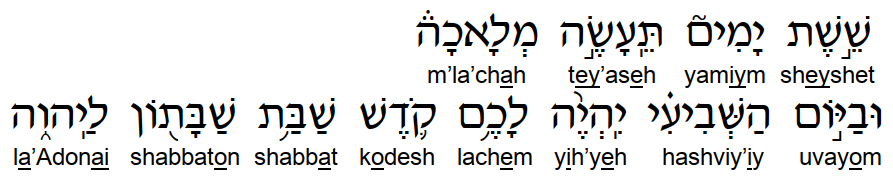
View whole verse and interlinear translation ...
ParashatVayakhel, starting the account of the construction of the Tabernacle, begins with a reminder of the Shabbat regulations given in almost identical words at the close of the instructions to make the Tabernacle just before the incident of the Calf took place: "Six days shall work be done, but the seventh day is a Sabbath of solemn rest, holy to the L-RD" (Shemot 31:15, NJPS). What is the significance of placing these two Shabbat texts next to the instructions for building the Tabernacle - why are they juxtaposed in this way: one after, the other before?
Our answer starts with the relative importance of observing
Shabbat and building the Tabernacle. The proposal is made that since
The Name ...
HaShem: literally, Hebrew for 'The Name' - an allusion used to avoid pronouncing the Tetragrammaton, the so-called 'ineffable' name of G–d
HaShem has commanded the Tabernacle to be constructed, so
that He may dwell among His people, this is holy work creating holy space and
should take priority over Shabbat, since that happens every week and
there will be plenty of time to catch up once the Tabernacle is built and in
service.
Who Is ...
Rashi: Rabbi Shlomo Yitzchaki (1040-1105 CE), French rabbi who wrote commentaries on the Torah, the Prophets and the Talmud, lived in Troyes where he founded a yeshiva in 1067; focuses on the plain meaning (p'shat) of the text, although sometimes quite cryptic in his brevity
Rashi replies that "Moshe first told them the
prohibition of working on Shabbat before the commandment of the
construction of the Tabernacle, to say that the work of the Tabernacle does
not override the Shabbat."
Who Is ...
Abraham Ibn Ezra: (1089-1167 CE), born in Tudela, Spain; died in the South of France after wandering all around the shores of the Mediterranean and England; a philosopher, astronomer, doctor, poet and linguist; wrote a Hebrew grammar and a commentary on the Bible
Ibn Ezra agrees, explaining that
"G-d has indeed commanded that you make a Tabernacle, but you must make it
only on six days of the week." The
Who Is ...
Sforno: Rabbi Ovadiah Sforno (1470-1550 CE), Italian rabbi, philosopher and physician; born in Cesena, he went to Rome to study medicine; left in 1525 and after some years of travel, settled in Bologna where he founded a yeshiva which he conducted until his death
Sforno emphasises the
importance of not working - "And you shall not do any work even the work of
the Sanctuary" - while the
Who Is ...
Bekhor Shor: Joseph ben Isaac Bekhor Shor; a twelfth century French tosafist, commentator and poet; he lived in Orleans and was a pupil of the Rashbam and Rabbenu Tam; wrote a commentary to the Torah and made contributions to the Talmud commentaries; followed the p'shat method of interpretation in the style of Rashi, to the extent of rationalising many miracles
Bekhor Shor makes sure that "even
the holy work of building the Tabernacle" is prohibited.
But, the popular argument might run, the priests maintain the
service of the cult throughout Shabbat, even adding the additional
Shabbat offerings to the normal daily offerings. If they are working
on Shabbat, as commanded by HaShem Himself, surely preparations for
those services - including, in this case, building the Tabernacle where those
offerings will be brought - is acceptable? No, the
What Is ...
The Mekhilta: The earliest known halakhic midrash or commentary on (parts of) the book of Exodus; formally named for Rabbi Ishmael and therefore set around 100-135CE, it was redacted some years after his time; quoted many times in the Bavli Talmud as "Rabbi Ishmael taught ..."
Mekhilta
declares, "even though the Temple service itself is allowed to set aside the
laws of Shabbat, preparations for Shabbat or the Temple service
may not be done Shabbat but must be done during the six working days
(Tractate Shabbata, 2). Hence the Jewish world's emphasis on
preparing food for Shabbat throughout the week, particular on Fridays
- known as Preparation Day - so that no work need be done to gather or
prepare food during Shabbat, even the last meal of the day on
Shabbat each week.
Richard Elliott Friedman introduces the next step in our answer, telling us that "Now, as Israel begins to construct the Tabernacle, the most holy space on earth, they are reminded of the importance of the sanctification of time as well." How can this be - and how do we sanctify time anyway? Abraham Joshua Heschel explains how that works: "Shabbat is entirely independent of the month and unrelated to the moon. Its date is not determined by any event in nature, such as the new moon, but by the act of creation. Thus the essence of Shabbat is completely detached from the world of space. The meaning of Shabbat is to celebrate time rather than space; on Shabbat we try to become attuned to holiness in time."1 When we make kiddish at the start of Shabbat, we are making a declaration: that this is now holy time - a state which is then brought to an end by making the kiddish blessing again during Havdalah as Shabbat comes to an end.
So it's actually not about space at all, but about time - then why are the Israelites commanded to build the Tabernacle? Jonathan Sacks provides an answer: "G-d is saying, 'I am going to give the Jewish people two sanctuaries, not one. The first is the Tabernacle, a sanctuary in space, in place. The second is the Sabbath, a sanctuary in time.' G-d knew that the day would come when Jews would suffer exile and dispersion. 'Even so,"'says G-d, 'however dispersed you are, you will still have a sanctuary. It will exist not in space, but in time. That sanctuary is called the Sabbath. It will happen not because you are together physically in one place, but because spiritually you will be together at the same time.'"2
Leon Kass picks up the same idea - "More important than building this beautiful sacred space for the L-rd is their internal devotion to His sacred time, now theirs as well. Honouring the rhythm of Creation has become the framework not only for creating the Tabernacle but also for their very lives"3 - enabling Aviva Zornberg to point out that "creative work, which is the very process of the Mishkan, is now included in the Shabbat prohibition." Noticing the use of the verb עשׂה, "to do" or "to make" in the verse we use as part of traditional Shabbat liturgy - "The Children of Israel shall keep the Shabbat, לַעֲשׂוֹת to do/make the Shabbat throughout the ages as a covenant for all time" (Shemot 31:16) - she affirms that "this non-work is now the condition for a different creativity, 'to make the Sabbath.'"4 There is a sense, then, that every time we keep Shabbat, we create Shabbat afresh, for each generation, for ever. The prophet sees a glimpse of this when he voices HaShem saying that in the new heaven and new earth that HaShem will create, "new moon after new moon, and sabbath after sabbath, all flesh shall come to worship Me" (Isaiah 66:23, NJPS). We will still be celebrating Shabbat in the Olam Haba!
Just as the making of Shabbat is to take precedence over the making of the Tabernacle, so it is also to take precedence over important agricultural work: "Six days you shall work, but on the seventh day you shall cease from labour; you shall cease from labour even at ploughing time and harvest time" (Shemot 34:21, NJPS). In the same way that we must rest from Tabernacle building - "Evidently, the Mishkan work holds such an obsessive power that emphatic limits have to be placed on it"FootnoteRef(5) - so we must also rest from our ordinary work-a-day labours even during high-pressure weather-critical work such as bringing in the harvest before the rain falls and ruins the grain. Walter Brueggemann rightly observes that "this community is preoccupied with Shabbat as the quintessential mark of obedience, for in Shabbat, life is willingly handed back to Yahweh in grateful rest."6 If HaShem wants shabbat to be kept, then He will hold the harvest or provide for His people in some other way.
What do we do today, though, when there is no Tabernacle nor instructions to build one and when the vast majority of us are completely divorced from the land and the agricultural cycle. Shabbat is still to be kept, the day set apart from our normal week-day work or activities for reading, study, worship and resting. However compelling the task may be, we must always be ready to rest and make sure that we get the work/life balance right. That's a foundational well-being criterion. But what about rest on Shabbat? Does driving an hour or more each way to go to services, there to spend an hour or two leading the service, preaching or managing a crêche-full of little people, look like rest? The old Orthodox pattern of everyone living within short walking distance of shul certainly had something going for it! Yeshua's teaching that "the Shabbat was made for man, not man for the Shabbat. So the Son of Man is lord even of the Shabbat" (Mark 2:27-28, ESV) is so important. Shabbat is a gift that we are given, not an obligation we are required to service.
Nevertheless, it often takes some significant level of intentionality to make Shabbat happen; as people we are easily distracted or become subject to the pressure of work or other people's expectations. The writer to the Hebrews reminds us, "there remains a Sabbath rest for the people of G-d, for whoever has entered G-d's rest has also rested from his works as G-d did from His. Let us therefore strive to enter that rest, so that no one may fall by the same sort of disobedience" (Hebrews 4:9-11, ESV). We must strive to make sure that we do actually get there and don't get swept up in work that masquerades as a vocation!
With all that said, we have to understand the fundamental principle that goes far beyond the specific application of Shabbat. However valuable or anointed the work that we are doing might be, we must always be ready to put it down - usually only temporarily, although sometimes permanently - to respond to the Spirit bringing new direction and purpose into our lives. Shabbat is one regular, weekly example of a temporary hold: we put down our weekday work, our technology, our income earning, in order to rest and set the day apart for HaShem. Taking annual leave or a sabbatical season from our occupation is a less frequent and longer duration pause. Career changes, entering or leaving ministry, taking on or putting down the role of caring for another person - these may well be permanent and perhaps life-long alterations in our life patterns to which the Spirit calls us. Where are you going today?
1. - Abraham Joshua Heschel, The Sabbath, (New York, NY: Farrar, Strauss and Giroux, 2005), page 10.
2. - Rabbi Lord Jonathan Sacks, The Koren Humash, Conrad Morris Edition, (Jerusalem, Koren Publishers, 2025), page 611.
3. - Leon R. Kass, Founding G-d's Nation - Reading Exodus (New Haven, Yale University Press, 2021), page 576.
4. - Aviva Zornberg, The Particulars of Rapture: Reflections on Exodus, (New York, NY: Doubleday, 2001), page 463.
5. - Zornberg, page 464.
6. - Walter Brueggemann, "Exodus", in The New Interpreter's Bible Commentary Vol I, edited by Leander E. Keck, (Nashville, TN: Abingdon Press, 2015), page 495.
Further Study: Isaiah 56:2-7; Amos 7:1-15; Matthew 12:10-13; Acts 18:1-4
Application: While due caution and discernment must be employed, procrastination when it is clear that the Spirit has spoken amounts to disobedience. What do you hear the Spirit calling you to do in these times to prepare for the return of Yeshua?
Buy your own copy of the Drash Book for Exodus/Shemot now at Amazon US or Amazon UK.
© Jonathan Allen, 2026
| Messianic Trust Home Page | Join Weekly Email | More Weekly Drashot |
| Last Week |
Support the work of producing this weekly commentary
|
Next Week |
| Last Year - 5785 | Scripture Index |
|
Your turn - what do you think of the ideas in this drash ? Like most print and online magazines, we reserve the right to edit or publish only those comments we feel are edifying in tone and content. |