

|
Vayakhel (Ex 35:1 - 38:20) |

| Messianic Education Trust | ||||||
|
|
Living in Exile
|
|
||||
Shemot/Exodus 38:7 And he inserted the staves into the rings on the sides of the altar with which to lift it; hollow he made it, of boards.
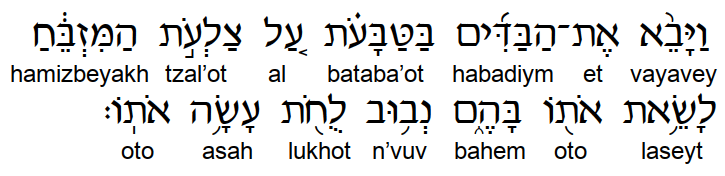
View whole verse and interlinear translation ...
Betzalel, from the tribe of Judah, and Oholiav, from the tribe of Dan, have been placed in charge of the whole work of building the Tabernacle. Divinely gifted and enabled in every kind of craftsmanship and artisanry, we are told that they led the team of "all the skilled persons whom the L-RD has endowed with skill and ability to perform expertly all the tasks connected with the service of the sanctuary [to] carry out all that the L-RD has commanded" (Shemot 36:1, NJPS). Although Betzalel and Oholiav did some of most intricate work themselves and tutored the other already skilled workmen, their primary role was coordination and supervision. Perhaps that is why the account of the construction of the Tabernacle in this parasha almost always says, "וַיַּעַשׂ and he made", without attributing any particular item to an individual metal-worker, weaver, carpenter or embroiderer, or to a group of workers; they did the work, but he inspected it, he signed it off as finished. Betzalel and - to a slightly lesser extent, since he was the assistant - Oholiav took responsibility for the work; it was done on their watch, to their standards and in their name.
Our text is part of the construction narrative of the bronze altar, also known as the outer altar because it sat outside the entrance to the Tabernacle, upon which a fire was continually to burn and where all the sacrifices and offerings were made by the priests on behalf of the people and the community. The corresponding part of instructions for its manufacture occur earlier in parashat T'rumah: "The poles shall be inserted into the rings, so that the poles remain on the two sides of the altar when it is carried. Make it hollow, of boards" (27:7-8, NJPS). Such a large piece of furniture, five cubits square and three cubits high - in new money that's approximately 7'6" square by 4'6" high - encased with bronze and with a bronze grating around it, couldn't possibly have been solid or the Levites would never have been able to carry it, let alone on poles! Maintenance too, replacing parts that had become burnt due to the fire on top of the alter, would have been impossible with a solid block of wood, even if a composite of several large pieces. A hollow frame of boards נְבוּב לֻחֹת was essential.
A question that is often asked is why - having spent so many words describing the work that was to be done - the Torah then gives us such a detailed account, which will continue in the next parasha as well, of the work that has now been done. Part of the answer has to be the raw materials audit that Betzalel and Oholiav will later present to Moshe, once the construction is complete: you gave us all these ingredients and we have made all these things. More importantly, however, is the design audit. The critical phrase comes at the end of the instructions cited above "... As you were shown on the mountain, so shall they be made" (27:8, NJPS). This is the third time the phrase is used: after the details of the furniture in the Tabernacle, the construction of the Tabernacle itself, and the bronze altar. The first is the most specific: "וּרְאֵה וַעֲשֵׂה And see and make according to their pattern that you were shown on the mountain" (25:40). Obedience, listening in the voice, is one of the key attributes that HaShem is looking for in His people.
The book of Joshua makes a case-study of particular obedience. A
frequent refrain is typified by this verse: "Just as the L-RD had
commanded His servant Moshe, so Moshe had charged Joshua, and so Joshua did;
he left nothing undone of all that the L-RD had commanded Moshe" (Joshua
11:15, NJPS). Joshua, who while Moshe had been alive had been his
personal attendant and servant, is careful to follow all Moshe's instructions
and make sure that Israel obeys
The Name ...
HaShem: literally, Hebrew for 'The Name' - an allusion used to avoid pronouncing the Tetragrammaton, the so-called 'ineffable' name of G–d
HaShem in the conquest of the
Land. After the Land had been taken and subdued, it was to be divided among
the tribes of Israel: "Just as the L-RD had commanded Moshe, so the
Israelites did when they apportioned the land" (14:5, NJPS). Each
of the tribes then allocated a number of cities to the Levites, who otherwise
had no inheritance: "The Israelites assigned those towns with their
pastures by lot to the Levites -- as the L-RD had commanded through Moshe"
(21:8, NJPS). At the end of the campaign, Joshua summons the
leaders of Reuben, Gad and Manasseh and says to them, "You have observed
all that Moshe the servant of the L-RD commanded you, and have obeyed me in
everything that I commanded you" (22:2, NJPS).
Unsurprisingly, we find Yeshua being obedient to the Father. He tells the Jewish leaders, "the Son can do nothing of His own accord, but only what he sees the Father doing. For whatever the Father does, that the Son does likewise" (John 5:19, ESV). Twice more John reports Yeshua claiming full obedience to the father. Teaching in the Temple, we hear Him say, "I do nothing on My own authority, but speak just as the Father taught Me" (8:28, ESV), claiming that He is speaking and teaching only as the Father directs. During the days between His triumphal entry into Jerusalem and aware that His time is very short, He cries out, "I have not spoken on My own authority, but the Father who sent Me has Himself given Me a commandment -- what to say and what to speak" (12:49, ESV), making it very plain that His teaching and His ministry are being driven by the Father. Yeshua's position of obedience to the Father has been recognised before by the statement of the centurion in the Galil who asserts, "For I too am a man under authority, with soldiers under me. And I say to one, 'Go,' and he goes, and to another, 'Come,' and he comes, and to my servant, 'Do this,' and he does it" (Matthew 8:9, ESV).
Yeshua teaches His disciples before His crucifixion and resurrection that even the Holy Spirit operates under authority: "When the Spirit of truth comes, He will guide you into all the truth, for He will not speak on His own authority, but whatever He hears He will speak, and He will declare to you the things that are to come" (John 16:13, ESV). The Spirit will speak only the words of G-d that He hears the Father speaking. This is important because as Yeshua's disciples and agents in this age, we are filled with this same Spirit who - at the command of the Father - reminds us of Yeshua's words and teachings and alerts us to what is going on around us so that we can be united and of one heart and mind in order to resist the enemy of our souls. The Spirit will not tell us untruths, for He is truth and He speaks only at the direction of the Father to encourage and direct the people of G-d in these days.
As exiles and ambassadors for Yeshua and the kingdom of G-d in this world, we too are under authority. We have every freedom to boldly proclaim the kingdom and the King, to declare His righteousness and to urge others to accept G-d's invitation, declaring His goodness and exposing the evil that is currently at loose in the world. We have no freedom to innovate, to negotiate, or to vary the terms of the invitation. We must be faithful to make sure that we have fully presented the good news of the kingdom. Believing in Yeshua is freely available to everyone; John tells us that "whoever believes in Him should not perish but have eternal life" (John 3:16). Rav Sha'ul is very clear that, "the wages of sin is death, but the free gift of G-d is eternal life in Messiah Yeshua our Lord" (Romans 6:23, ESV). At the same time, Yeshua is clear that it costs everything to be His disciple. He tells the crowd bluntly, "Any one of you who does not renounce all that he has cannot be My disciple" (Luke 14:33, ESV), and then asks them, "Which of you, desiring to build a tower, does not first sit down and count the cost, whether he has enough to complete it?" (v. 28, ESV). This is the message of parable about the merchant of pearls who, "on finding one pearl of great value, went and sold all that he had and bought it" (Matthew 13:46, ESV).
In like manner, just as we must proclaim the message of kingdom clearly and completely, our lives must be obedient to the words of the Master. Sha'ul reminds us that "each of us will give an account of himself to G-d" (Romans 14:12, ESV). Whether we believe in Yeshua or not, the writer to the Hebrews is adamant that "no creature is hidden from His sight, but all are naked and exposed to the eyes of Him to whom we must give account" (Hebrew 4:13, ESV). To drop back into our starting text, Betzalel and Oholiav were charged with making the bronze altar according to the pattern Moshe had been shown. To do that they inspected everything, took it all to pieces and checked every part to make sure that it was properly and exactly made. The boards had to be of the right length and thickness, so that nothing stuck out or made an unsightly bulge in the bronze cover; the rings had to be positioned at the right height, one on each corner, and be fastened securely so that the poles could carry the weight of the altar without tearing.
Being an exile is a potentially dangerous position that can leave us exposed and isolated. Disciples need to be in regular contact with others who can help them to stay in good standing with Yeshua. Simply talking about life, sharing difficulties and praying for each other is a means of staying safe and under the authority of the Holy Spirit. We need good relationship with those who speak the same language as we do, so that we don't forget our mother tongue. We must not lose our taste for the things of the kingdom by supping exclusively with the world. Sometimes, too, we need a friend who will ask the hard questions to make sure that we haven't drifted out of alignment - like a board slipping on the altar - so that we don't puncture a hole in our covering. We need often to hear the cadences of home - the tunes, sounds and conversations of the kingdom of G-d - so that we remember where we belong and where we are going, so that in the day-to-day experience of exile all around us, we don't lose our calling and direction. Make sure you call home soon!
Further Study: Psalm 25:5; 2 Corinthians 5:6-10; Hebrews 13:16-18
Application: Do your rings and staves fit together neatly, lying smoothly against the side of the altar? Are you growing and developing according to the pattern shown on the mountain, growing in holiness, developing like Yeshua? Ask the Master Surveyor to cast His eye over your trim and point out anything that needs changing today.
Buy your own copy of the Drash Book for Exodus/Shemot now at Amazon US or Amazon UK.
© Jonathan Allen, 2025
| Messianic Trust Home Page | Join Weekly Email | More Weekly Drashot |
| Last Week |
Support the work of producing this weekly commentary
|
Next Week |
| Last Year - 5784 | Scripture Index | Next Year - 5786 |
|
Your turn - what do you think of the ideas in this drash ? Like most print and online magazines, we reserve the right to edit or publish only those comments we feel are edifying in tone and content. |