

|
Va'etchanan (Deut 3:23 - 7:11) |

| Messianic Education Trust | ||||||
|
|
Always Being Ready
|
|
||||
D'varim/Deuteronomy 3:28 And command Joshua and strengthen him and encourage him, for he will cross over before this people and he will cause them to inherit the land that you will see.
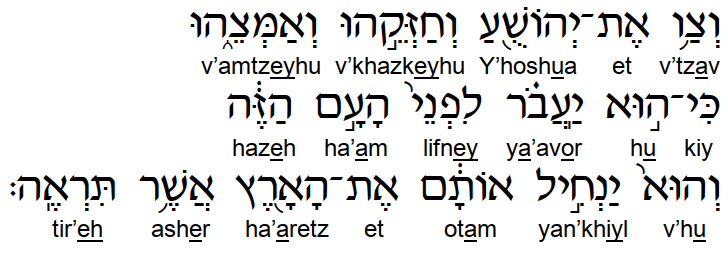
View whole verse and interlinear translation ...
Imagine Moshe's distress as he recounts this to the people. He has
to admit that
The Name ...
HaShem: literally, Hebrew for 'The Name' - an allusion used to avoid pronouncing the Tetragrammaton, the so-called 'ineffable' name of G–d
HaShem has just given him - him, Moshe, the
faithful leader who pleaded with HaShem to forgive the people not once but
twice and who offered to be written out of the Torah rather than the
people being destroyed - a final and negative answer about entering the Land.
Moshe had, he reports, pleaded with HaShem, "Let me, I pray, cross over
and see the good land on the other side of the Jordan, that good hill
country, and the Lebanon" (D'varim 3:25, NJPS), but HaShem has
given him a very firm and uncompromising response: "Enough! Never speak
to Me of this matter again!" (v. 26, NJPS). The Hebrew is sharp:
רַב־לָךְ, almost as if to say, "Enough of your cheek!" as if
Moshe is overstepping the mark, intruding upon HaShem's prerogative.
Chutzpah is all very well, but this is too far!
Robert Alter points out that these two short words pointedly echo the רַב־לָכֶם of HaShem speaking to the people at Sinai (1:6) and at Horeb (2:3) to pull them out of holding pattern and back to their journey.1 But then HaShem softens His tone slightly and offers the concession that Moshe may go up Mt. Pisgah and look out across the Land even though he may not enter it. Then, almost in the same breath as it were, follows our text: Moshe is to give everything he can to Joshua who will go and do what Moshe cannot. "It is not time for Moshe to grasp after more life," says Jonathan Sacks, "It is time to climb the mountain and survey what he has achieved."FootNote(2)
The first word of our text, וְצַו - the Pi'el
ms imperative of the root צוה, to command, with a simple
vav conjunction, 'and' - is usually translated as a straightforward
instruction, but Rabbi
Who Is ...
Hirsch: Rabbi Samson Raphael Hirsch (1808-1888 CE), German rabbi, author and educator; staunch opponent of the Reform movement in Germany and one of the fathers of Orthodox Judaism
Hirsch reminds us that
צוה is "a specific term used for giving the duties to be
undertaken by somebody who is being appointed to an office," so could here be
translated as "charge him with the duties of his office" as the new leader of
the people Israel. The two following verbs, then, become part of the
sequence of tasks - "charge him, strengthen him, encourage him" - that Moshe
must do for Joshua before he steps up into the role. The ancient Sages
comment that "charging always implies zeal, as is said, 'Then Moshe called
Joshua and said to him in the sight of all Israel: "Be strong and resolute"'
(31:7, NJPS), strong in Torah and resolute in good deeds"
(
What Is ...
Sifrei: An early composite midrash/commentary on B'Midbar and D'varim; probably composed around the time of the Mishna (200CE); known and referenced in the Talmud; the B'Midbar portion from the school of R. Simeon, the D'varim portion from that of R. Akiva
Sifrei 28).
Who Is ...
Rashi: Rabbi Shlomo Yitzchaki (1040-1105 CE), French rabbi who wrote commentaries on the Torah, the Prophets and the Talmud, lived in Troyes where he founded a yeshiva in 1067; focuses on the plain meaning (p'shat) of the text, although sometimes quite cryptic in his brevity
Rashi adds that Moshe should
"strengthen and encourage him with your words, so that his heart should not
become weak."
Perhaps we should ask why Joshua needs these instructions. Hasn't
Moshe already told him what to do just a few verses before: "I also
charged Joshua at that time, saying, 'You have seen with your own eyes all
that the L-RD your G-d has done to these two kings; so shall the L-RD do to
all the kingdoms into which you shall cross over. Do not fear them, for it
is the L-RD your G-d who will battle for you'" (vv. 21-22, NJPS)?
Don
Who Is ...
Abravanel: Don Isaac Abravanel (1437-1508 CE), Statesman and biblical commentator; born in Lisbon, died in Venice; wrote commentaries on the whole of the Hebrew Scriptures
Abravanel explain that these comments were "just
preliminary and more for Israel than for Joshua himself, since at that time
Moshe thought that he himself would still be with them when they crossed
over." However, the text itself answers the question. The word
כִּי - for, that, when, because - introduces the two reason
clauses, each starting with the demonstrative pronoun הוּא,
"he, that one": he will cross over before the people, that is, he will lead
them over the Jordan; and he will cause them to inherit the land, he will
lead the process of conquest and occupation before finally supervising the
allocation of the land to the people.
Ronald Clements points to the almost seismic change that is about to happen when Moshe dies and reports that "Joshua's role is significantly different, and his task is to ensure that the commands and instructions of Moshe are faithfully carried out." Moshe is the seer, the prophet, the visionary leader who brings HaShem's words to the people; Joshua, though a great leader, is none of those things. "He is the administrator of a new order: that of living in accordance with the law the Moshe had revealed to the people."3 This is a delicate but critical task, demanding both physical resilience and great spiritual tenacity as the closing chapters of Joshua - with yet another covenant making ceremony - make clear. Daniel Block rightly observes that "Joshua's confidence could not be based on his personal experience, qualifications, or training, but had to be based on G-d, and on G-d alone."4
But that is all in the future; the matter on hand is HaShem's instructions to commission Joshua - which will actually happen in chapter 31. As Peter Craigie points out, this is "a task for which Moshe himself would require great strength and graciousness, for it was not easy to pass on the office of command to a younger and less experienced man."5 Part of the task involves realising that Joshua will do what Moshe cannot do, what Moshe wanted and expected to do, what he had been working towards for the past forty years. Although Moshe knew that he could not live for ever, he wanted to come over the Jordan, to watch Joshua militarily lead the conquest and oversee the allocation of the Land, being a part of fulfilling HaShem's promises hinted at in the instructions for the sabbatical year - "You shall do the same with your vineyards and your olive groves" (Shemot 23:11, NJPS) - that the rebels Dathan and Aviram accused him of failing to deliver (B'Midbar 16:13-14). Moshe is out of gas, past his "best before" date; although he "was a hundred and twenty years old when he died; his eyes were undimmed and his vigor unabated" (D'varim 34:7, NJPS), he is part of the exit generation and cannot enter the Land.
Succession planning is something that many leaders fail to do adequately. For some, they cannot believe they they will ever get to the point of not leading; for others it is so future that they postpone it until the time is closer at hand; for yet others they are are far too busy leading and coping with the issues of today to be able to spare more than acknowledgement in principle to the matter. Yet succession planning, even from day one in a new leadership role, is a critical task that both gives direction for the role and enables everyone to relax because it creates stability and continuity. Did I say leaders? Yes, of course, but remember that parents are also leaders and many leaders are found in business, industry and commerce. An accountant I knew many years ago said that you should never go into a new situation without planning your exit strategy. We are all involved in succession planning in our lives.
Yeshua did this throughout the gospel years. He worked with the disciples, taught the disciples, trusted and empowered the disciples - "He called the twelve together and gave them power and authority over all demons and to cure diseases, and He sent them out to proclaim the kingdom of G-d and to heal" (Luke 9:1-2, ESV) - told them that He would be going away, "See, we are going up to Jerusalem, and the Son of Man will be delivered over to the chief priests and the scribes, and they will condemn Him to death and deliver Him over to the Gentiles. And they will mock Him and spit on Him, and flog Him and kill Him. And after three days He will rise" (Mark 10:33-34, ESV), and that they would continue the work: "Truly, truly, I say to you, whoever believes in me will also do the works that I do; and greater works than these will he do, because I am going to the Father" (John 14:12, ESV). Just like Moshe, who asked HaShem, "Let the L-RD, Source of the breath of all flesh, appoint someone over the community who shall go out before them and come in before them, and who shall take them out and bring them in, so that the L-RD's community may not be like sheep that have no shepherd" (B'Midbar 27:16-17, NJPS), Yeshua recognised the need of the people: "When He went ashore He saw a great crowd, and He had compassion on them, because they were like sheep without a shepherd. And He began to teach them many things" (Mark 6:34, ESV).
Whether we are leaders or among the led - and most people are, in practice, both - we need to be involved in and working out what happens next. Parents need to make wills to arrange the legal distribution of their assets when they die; ministers need to plan with the elders of their congregations what happens if they die, when they retire or move on to their next job; house-group leaders need to be raising up new leaders to lead the second group when they multiply. At any point when we realise - because of age, ill-health, financial turmoil, family changes or whatever - that we may not achieve our life-goal or vision, we need to find someone in whom we can invest, into whom we can pour our vision and passion, who can pick up the baton and run with it so that the work of kingdom never fails. And we must always be ready to encourage and cheer on the next generation, giving them everything that we have and helping them to take it to the next level even if they, in turn, will need to pass it on to others to see the task completed.
1. - Robert Alter, The Five Books of Moses, (New York, Norton, 2004), page 629.
2. - Rabbi Lord Jonathan Sacks, The Koren Humash, Conrad Morris Edition, (Jerusalem, Koren Publishers, 2025), page 1161.
3. - Ronald E. Clements, "Deuteronomy" in The New Interpreter's Bible Commentary Vol I, edited by Leander E. Keck, (Nashville, TN: Abingdon Press, 2015), page 880.
4. - Daniel I. Block, Deuteronomy, The NIV Application Commentary, (Grand Rapids, MI: Zondervan, 2012), page 108.
5. - P. C. Craigie, The Book of Deuteronomy, NICOT, (Grand Rapids, MI: Eerdmans, 1976), page 128.
Further Study: Matthew 9:35-38; 1 Peter 2:25
Application: Do you have anyone on your horizon in whom you are investing and preparing to take the baton you haveand run the next stage of the race of the kingdom? Ask Yeshua, by His Spirit to direct you in finding your successor in that endeavour and start cheering them on.
Buy your own copy of the Drash Book for Deuteronomy/D'varim now at Amazon US or Amazon UK.
© Jonathan Allen, 2026
| Messianic Trust Home Page | Join Weekly Email | More Weekly Drashot |
| Last Week |
Support the work of producing this weekly commentary
|
Next Week |
| Last Year - 5785 | Scripture Index |
|
Your turn - what do you think of the ideas in this drash ? Like most print and online magazines, we reserve the right to edit or publish only those comments we feel are edifying in tone and content. |