

|
Va'etchanan (Deut 3:23 - 7:11) |

| Messianic Education Trust | ||||||
|
|
|
|
||||
D'varim/Deuteronomy 7:6 For you are a holy people to the L-rd your G-d; the L-rd your G-d has chosen you to be - for Him - a treasured people from all the peoples that are on the face of the earth.
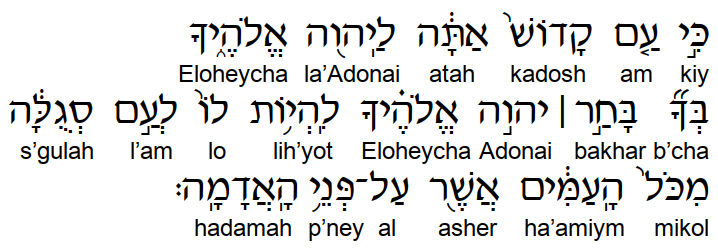
View whole verse and interlinear translation ...
Here we have one the clearest presentations of Israel's calling -
some would say 'election' - as
The Name ...
HaShem: literally, Hebrew for 'The Name' - an allusion used to avoid pronouncing the Tetragrammaton, the so-called 'ineffable' name of G–d
HaShem's chosen people. A
critical question we have to ask today, in the light of HaShem's choice to
call Gentiles to be a grafted-in part of His people - a choice ratified by
the Jerusalem Council in Acts 15 - is whether it can also be be read,
contrary to mainstream Jewish tradition and opinion, as applying to all of
G-d's people called in Messiah Yeshua? We'll look in more detail at that in
a minute, but let's start with a look at the Hebrew text and what it tells
us.
Context-wise, this verse follows very explicit instructions for how the Israelites are to deal with the peoples currently squatting in the Land when they, shortly, cross the Jordan and - under Joshua's leadership and HaShem's detailed direction - go about taking possession of the Land that has long been promised to them as sworn to each of the patriarchs is turn, starting with Avraham. These instructions are viewed with a measure of embarrassment in many circles today; they are certainly not considered politically correct by modern standards. The aim or practice of mass slaughter, destruction or expulsion of a people group - particularly for religious reasons - would be condemned, in almost all civilised contexts, as ethnic cleansing or genocide today. The instructions come in three parts: to completely kill and destroy all the people (7:2); not to intermarry with the people (7:3); to obliterate all signs, traces and practices of their religions (7:5). This adds up to what might be referred to as an absolutely "scorched earth" policy!
After an opening כִּי - 'for' or 'because' - Moshe
uses the adjective קָדוֹשׁ. This is usually translated as
'holy' or 'consecrated', 'sanctified' or 'set apart'. The word has an
interesting form מְקֻדֶשֶׁת (Pu'al, participle, fs) which
is used in talmudic Hebrew to describe a woman who has been betrothed. This
expresses the idea that when a man betroths a woman she becomes "forbidden to
others like something consecrated" (b. Kiddushin 2b).
Jeffrey Tigay explains that "due to Israel's privileged
status, because it is consecrated to the L-rd, it must shun all activities
that are incompatible with that relationship." The
Who Is ...
Sforno: Rabbi Ovadiah Sforno (1470-1550 CE), Italian rabbi, philosopher and physician; born in Cesena, he went to Rome to study medicine; left in 1525 and after some years of travel, settled in Bologna where he founded a yeshiva which he conducted until his death
Sforno uses
the instruction not to intermarry with the people of the Land as an example
of incompatible behaviour: "It is not fitting to profane your holiness by
marrying women who serve strange gods, thereby giving birth to disqualified
offspring, as it says, 'Judah has profaned what is holy to the L-RD --
what He desires -- and espoused daughters of alien gods' (Malachi 2:11,
NJPS)."
We can see a worked application of our text when Ezra - the priest who led a party of returning exiles back from Babylon to the province of Judah - is told that "the people of Israel and the priests and Levites have not separated themselves from the peoples of the land ... they have taken their daughters as wives for themselves and for their sons, so that the holy seed has become intermingled with the peoples of the land; and it is the officers and prefects who have taken the lead in this trespass" (Ezra 9:1-2, NJPS). He tears his garments and pulls hair from his head and his beard before leading the returned exiles in a prayer of confession that no sooner have G-d's people been shown His mercy by being allowed to return to the Land and rebuild the Temple than they have profaned His Name and violated His commandments by "by intermarrying with these peoples who follow such abhorrent practices" (v. 14, NJPS). Ezra vocalises his expectation of HaShem's displeasure by asking Him, "Will You not rage against us till we are destroyed without remnant or survivor?" (ibid, NJPS). The Talmud reports that "Rabbi Hama, son of Rabbi Hanina, says: When the Holy One, Blessed be He, rests His Divine Presence, He rests it only upon families of unflawed lineage among Israel" (b. Kiddushin 70b).
Before moving on, we need to compare our text with HaShem's first promise of holiness: "If you will obey Me faithfully and keep My covenant, you shall be My treasured possession among all the peoples. Indeed, all the earth is Mine, but you shall be to Me a kingdom of priests and a holy nation" (Shemot 19:5-6, NJPS). According to Michael Fishbane, the earlier passage "presents Israel's conditional holiness whereas the latter stresses the unconditional nature of Israel's sanctity."1 Put another way, Tigay suggests that Shemot "describes Israel's consecration as its reward for keeping the covenant," while D'varim cites it "as a source of its obligations to G-d." Combining these two tells us that Israel has been declared to be holy - unconditionally and irrevocably - by HaShem and that, as a consequence of being His holy people, they are now required to live in a holy way, in a way that displays His holiness. In our text, say Israel Drazin and Stanley Wagner, "the Israelites are reminded that much is expected of them. 'Chosen' means given a responsibility."
The next token to consider is the word סְגֻלָּה. The
Hebrew root סָגַל is not used in Tanakh, but the Aramaic
equivalent - סִגֵּל - has the meaning "to gain or acquire".
This gives the idea of סְגֻלָּה being a valuable possession or
acquisition. Perhaps for that reason,
What Is ...
Targum Onkelos: An early (1st-2nd Century CE) translation/paraphrase of the Torah into Aramaic; attributed to a Roman convert to Judaism, Onkelos; used in Babylonian synagogues during the Talmudic era
Targum Onkelos changes
the Hebrew סְגֻלָּה, "something treasured, a special possession",
to Aramaic חַבִּיב, "beloved". Martin Buber offers the picture
of "a possession which is withdrawn from general family property because one
individual has a special relation to it and a special claim on
it."2
Who Is ...
Abraham Ibn Ezra: (1089-1167 CE), born in Tudela, Spain; died in the South of France after wandering all around the shores of the Mediterranean and England; a philosopher, astronomer, doctor, poet and linguist; wrote a Hebrew grammar and a commentary on the Bible
Ibn Ezra offers the idea that "the Hebrew
word implies a 'treasure' so desirable that nothing like it can be found
elsewhere," pointing to the use of the word in the phrase "treasures of
kings and provinces" (Ecclesiastes 2.8, NJPS).
Tigay explains: "the owner's personal stake in his
סְגֻלָּה gives it the connotation of something cherished, like
'treasure'. Although G-d owns all things, He cherishes Israel because of His
personal stake in her." However, Richard Elliott Friedman
adds the rider that "the term 'treasured' for Israel only applies if they
listen and fulfil their covenant."
Returning to the concept of choice - "The L-rd your G-d has chosen you ... from all the peoples on the face of the earth" - we need to remind ourselves that, at this stage, Israel was the only people devoted to HaShem. The prophet will later confirm this, "You alone have I singled out of all the families of the earth", as he explains why - among all the nations - it is only Israel who is held to the standard of the Torah: "That is why I will call you to account for all your iniquities" (Amos 3:2, NJPS). As Friedman observes, "being chosen has many sides: it is inspiring, uplifting, a burden, a challenge, a threat and an opportunity." Not, perhaps, an easy role or an unconditional blessing! Christopher Wright comments that "the stress is on Israel's distinctiveness in the midst of many other nations. They were to be 'holy to Yahweh,' i.e., set apart, different, belonging exclusively to Him, but with the warm colouring of the last word, s'gullah."3 Later, however, Yeshua will tell His disciples, "You did not choose Me, but I chose you" (John 15:15, NASB) and Rav Sha'ul will tell the congregations in Thesssalonica, "G-d has chosen you from the beginning for salvation through sanctification by the Spirit and faith in the truth" (2 Thessalonians 2:13, NASB). How does this work?
Perhaps the most significant appreciation of our text turns on the last phrase, "from all the peoples on the face of the earth". How are we to understand the word 'from'? Rabbinic Judaism sees it as both national and exclusive: it denotes Israel as a people, chosen or set apart "as opposed to" or "rather than" any other of the nations or people groups on earth. It can, on the other hand, be taken as individual and inclusive: the people of G-d are called together, drawn or selected from but still identified as all the nations and people groups on earth. Therefore, as believers in Messiah Yeshua, we - Jews and Gentiles, drawn from but still participating in, every nation around the world - are called to be distinct from all the other people in our host nations. While constantly welcoming and inviting others to accept G-d's invitation to be reconciled with Him and become - like us - a part of His kingdom, we must not profane His holiness by participating in or seeming to condone wrong relationships or any other form of religion, superstition or idolatry. We show that we are His treasured possession by honoring Him in all that we say or do and being fiercely and intractably loyal to Him alone. That is how we are holy - consecrated to the exclusion of all others - to Him in these days.
1. - Michael Fishbane, Biblical Interpretation in Ancient Israel, (Clarendon, Oxford, 1988), page 122.
2. - Martin Buber, Moses (London: East and West Library, 1947), page 105.
3. - Christopher J. H. Wright, Deuteronomy (Grand Rapids, MI: Baker, 2012), page 111.
Further Study: 2 Corinthians 6:14-18; Colossians 3:5-11; 1 Peter 2:9-12
Application: How can you show, without using words, that you belong to Yeshua? How can you make your chosenness inviting and compelling to others so that they will want to be a part of the kingdom as well? How do we respond to His choice of us by choosing Him in our every day lives?
Comment - 09:09 11Aug24 Ann Pangbourne: Great food for thought. Thank you.
Comment - 13:01 16Aug24 Kelila Hunter: Another wonderful teaching and explanation.
Buy your own copy of the Drash Book for Deuteronomy/D'varim now at Amazon US or Amazon UK.
© Jonathan Allen, 2024
| Messianic Trust Home Page | Join Weekly Email | More Weekly Drashot |
| Last Week |
Support the work of producing this weekly commentary
|
Next Week |
| Last Year - 5783 | Scripture Index | Next Year - 5785 |
|
Your turn - what do you think of the ideas in this drash ? Like most print and online magazines, we reserve the right to edit or publish only those comments we feel are edifying in tone and content. |