

|
Va'era (Ex 6:2 - 9:35) |

| Messianic Education Trust | ||||||
|
|
Living in Exile
|
|
||||
Shemot/Exodus 6:5 And also, I Myself have heard the groan of the Children of Israel - that the Egyptians are enslaving them - and I have remembered My covenant.
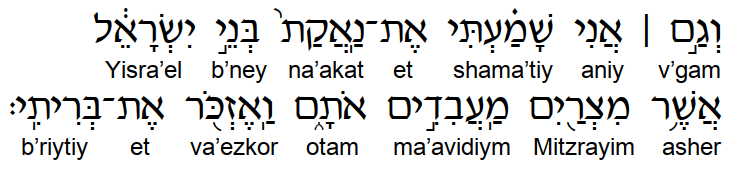
View whole verse and interlinear translation ...
This verse is the partner of the one that comes immediately before:
"I also established My covenant with them, to give them the land of
Canaan, the land in which they lived as sojourners" (Shemot 6:4,
NJPS). The two verses are linked by both starting
וְגַם, "and also" or "moreover". Cassuto asserts that they
"point to two parallel statements: on the one hand, I have established My
covenant, and on the other, I have heard. For these two reasons I
have arisen and I have remembered My covenant - I have resolved to put
it into effect now."1
The Name ...
HaShem: literally, Hebrew for 'The Name' - an allusion used to avoid pronouncing the Tetragrammaton, the so-called 'ineffable' name of G–d
HaShem is now talking to
Moshe, telling him what the narrator has already told the reader: "G-d
heard their moaning, and G-d remembered His covenant with Avraham and
Yitz'khak and Ya'akov" (2:24, NJPS). At the same time, because
these verses follow the identity statement "אֲנִי יהוהI am
Adonai" (6:2), Brevard Childs explains, "now G-d reveals Himself to Moshe
as YHVH who remembers His covenant and who moves to bring His promise to
completion."2
Who Is ...
Rashi: Rabbi Shlomo Yitzchaki (1040-1105 CE), French rabbi who wrote commentaries on the Torah, the Prophets and the Talmud, lived in Troyes where he founded a yeshiva in 1067; focuses on the plain meaning (p'shat) of the text, although sometimes quite cryptic in his brevity
Rashi paraphrases HaShem's words to
say: "Just as I instituted and established the covenant, it is incumbent upon
Me to fulfil that covenant."
Starting at the beginning of the verse, the phrase
אֲנִי שָׁמַעְתִּי, aniy shama'tiy - the 1cs subject pronoun
followed by the Qal 1cs affix form of the root שָׁמַע, to
hear or listen - that we translate as "I myself have heard", is picked up by
Ovadiah
Who Is ...
Sforno: Rabbi Ovadiah Sforno (1470-1550 CE), Italian rabbi, philosopher and physician; born in Cesena, he went to Rome to study medicine; left in 1525 and after some years of travel, settled in Bologna where he founded a yeshiva which he conducted until his death
Sforno, who puts this explanation in HaShem's mouth:
"the third cause of their redemption is that I have heard their groaning and
prayers in their distress." Groaning? The fs noun נַאֲקַה,
here in its construct form נַאֲקַת, is derived from the root
נָאַק, to groan or lament.
What Is ...
Targum Onkelos: An early (1st-2nd Century CE) translation/paraphrase of the Torah into Aramaic; attributed to a Roman convert to Judaism, Onkelos; used in Babylonian synagogues during the Talmudic era
Targum Onkelos
doesn't think that 'groaning' is a very dignified word for the Children of
Israel, so changes it to the Aramaic קְבֵילַת, a complaint:
"I have heard the complaint of the Children of Israel". The Children
of Israel are groaning because the Egyptians are ma’avidiym,
ma'avidiym - the Hifil mp participle of the root
עָבַד, to serve - enslaving them.
Nahum Sarna focuses on the key action word וַאֶזְכֹּר, va'ezkor - the Qal 1cs prefix form of the root זָכַר, zachar, to remember, recollect, call to mind - in the last phrase of our text, here rendered, "and I will remember". Sarna points out that "the Hebrew root זָכַר connotes much more than the recall of things past. It means, rather, to be mindful, to pay head, signifying a sharp focusing of attention upon someone or something. It embraces concern and involvement and is active not passive, so that it eventuates in action." The Sages tell us that, 'Looking upon leads to remembering and remembering leads to action" (b. Menachot 43b). HaShem had seen; HaShem had heard; and now HaShem remembers and determines to act. The Sforno adds, "because of all this, they are worthy that I remember My covenant for them, similar to 'When He saw that they were in distress, when He heard their cry, He remembered for them His covenant' (Psalm 106:44-45)."
What is the covenant that HaShem remembers? The oft-repeated promises to the patriarchs of nationhood and national territory (Sarna). They are perhaps most clearly laid out to Avraham: "I will establish My covenant between Me and you, and I will make you exceedingly numerous ... I will make you exceedingly fertile, and make nations of you; and kings shall come forth from you ... I assign the land you sojourn in to you and your offspring to come, all the land of Canaan, as an everlasting holding" (B'resheet 17:2,6,8, NJPS). This was repeated to Yitz'khak - "I will assign all these lands to you and to your heirs, fulfilling the oath that I swore to your father Avraham. I will make your heirs as numerous as the stars of heaven, and assign to your heirs all these lands, so that all the nations of the earth shall bless themselves by your heirs" (26:3-4, NJPS) - and to Ya'akov: "Be fertile and increase; a nation, yea an assembly of nations, shall descend from you. Kings shall issue from your loins. The land that I assigned to Avraham and Yitz'khak I assign to you; and to your offspring to come will I assign the land" (35:11-12, NJPS). That covenant, those promises, are now at jeopardy due to the oppression, slavery and attempted genocide of Pharaoh and the Egyptians against HaShem's people, so He decides to act.
"Promises are promise and facts are facts,"3 says Steven Curtis Chapman, underlining the truth that G-d's promises are facts. Terence Fretheim comments: "These promises G-d now remembers, that is, moves actively to fulfil them on behalf on an Israel groaning under the weight of great oppression. Once having uttered them, G-d has obligated Himself; G-d is, according to Kierkegaard, 'imprisoned in His own resolve' until they see the light of day."4 G-d's own character requires that He fulfils His promises, even if not exactly in the way or the time-frame that we might expect. The moment has now come, as Walter Brueggemann says: "G-d is fully attentive to the present. The present pain, however, serves primarily to drive G-d back to the memory of the covenant made in Genesis. Thus there is a dynamic movement back and forth between old covenant commitment and immediate pain, between an authorising past and a demanding, insistent present."5
In his songs of freedom and inspiration to the exiles in Babylon, Isaiah voices the Anointed Servant of HaShem - "The Spirit of the L-rd G-D is upon me, because the L-RD has anointed me" (Isaiah 61:1) - speaking out of his passion for the city of Jerusalem: "For Zion's sake I will not keep silent, and for Jerusalem's sake I will not be quiet, until her righteousness goes forth as brightness, and her salvation as a burning torch" (62:1, ESV). After declaring his own personal commitment and prophesying G-d's promises for the city, he explains how he has appointed others to share with him in the work of bringing the promises to pass: "On your walls, O Jerusalem, I have set watchmen; all the day and all the night they shall never be silent. You who put the L-RD in remembrance, take no rest, and give Him no rest until He establishes Jerusalem and makes it a praise in the earth" (vv. 6-7, ESV). There are two key words for us in this text. The first is שֹׁמְרִים, shomriym, watchmen, those who appointed to keep watch over the walls; that is their job-title: watchmen. They are the guardians of the city, officially stationed at vantage points and strategic positions to be awake and ready at all hours to sound the alarm and to cry out for the welfare of the city.
Secondly, moving from job-title to job-function, the watchmen are described as הַמַּזְכִּרִים, hamazkiriym, the ones causing HaShem to remember; Hifil participle from the root זָכַר. They are the ones who are constantly jiggling His elbow, reminding Him about His promises to Jerusalem, asking when He is going to act to fulfil them. They never give up and they are never silent. Not only do they take no rest for themselves, but they give Him no rest either. At the court of King Solomon, "Jehoshaphat the son of Ahilud was הַמַּזְכִּיר recorder" (1 Kings 4:3, ESV); this is the man who keeps the king's diary and reminds him of all his commitments and obligations, his appointments for the day, the promises and judgements he has made. Alec Motyer assures us that, "we do not conclude that otherwise He would forget, but that our prayers are, by His will, in some way a vital ingredient in the implementing of His promises."6
In our day, the exiles are the watchmen. They spend every day and night exposed to the elements, estranged from the world in which they live, keeping watch over the kingdom and crying out to the L-rd for the fulfilment of His promises, the return of Yeshua and the establishment of justice and righteousness on the earth. They are G-d's remembrancers, the ones who - despite the personal cost and consequences - have read and studied the word and keep nudging G-d to see the sate of His people and act on their behalf. They long for G-d to arise and remember His covenant, to end their days of exile by restoring His kingdom and sending Yeshua to take His place as King of kings and Lord of lords in Jerusalem - may it be soon and in our days. They point to the state of G-d's people, the needs of the widows and orphans, the desecration of His name, the neglect of His word and they call for His urgent and essential action to intervene and remedy these ills.
It is to the exiles that the Spirit echoes the words of our text, for these are the words those in exile need to hear: I have heard you; I am committed to you; I remember My covenant; I am resolved to rescue you. This is the assurance that brings freedom from the weight of oppression, that breaks through the loneliness, that empowers outreach and conversation. This is the promise that enables tired eyes, sore from constantly scanning the horizon for the approach of the king, to stay open beyond the point of endurance and rejoice at the news of His coming. We read Yeshua's promise that "He who testifies to these things says, 'Surely I am coming soon'" (Revelation 22:20, ESV) and respond, "Amen. Come, Lord Yeshua!" (ibid.).
1. - Umberto Cassuto, A Commentary on the Book of Exodus, (Magnes Press, Jerusalem, 1983), pages 79-80.
2. - Brevard S. Childs, The Book of Exodus: A Critical, Theological Commentary, The Old Testament Library, (Louisville, KY: Westminster John Knox Press, 2004), page 115.
3. - Steven Curtis Chapman, "Facts are Facts" in Heaven in the Real World, Sparrow Music, July 1994.
4. - Terence E. Fretheim, Exodus, Interpretation, (Louisville, KY: Westminster John Knox Press, 2010), page 92.
5. - Walter Brueggemann, "Exodus", in The New Interpreter's Bible Commentary Vol I, edited by Leander E. Keck, (Nashville, TN: Abingdon Press, 2015), page 324.
6. - J. Alec Motyer, The Prophecy of Isaiah - An Introduction and Commentary (Downers Grove, IL: IVP Academic, 1993), page 507.
Further Study: Revelation 22:16-17
Application: Today is a great day to remind the L-rd of those Scriptures and promises that are dear to your heart. Read them before Him, remind Him that you are still hanging on to them and ask Him to tell you when He is going to fulfil them. Make sure He knows how important they are to you too! Then be quiet before Him and wait for His gentle reply. The still, small voice will surely come as you listen carefully.
Buy your own copy of the Drash Book for Exodus/Shemot now at Amazon US or Amazon UK.
© Jonathan Allen, 2025
| Messianic Trust Home Page | Join Weekly Email | More Weekly Drashot |
| Last Week |
Support the work of producing this weekly commentary
|
Next Week |
| Last Year - 5784 | Scripture Index | Next Year - 5786 |
|
Your turn - what do you think of the ideas in this drash ? Like most print and online magazines, we reserve the right to edit or publish only those comments we feel are edifying in tone and content. |