
| Sukkot |

| Messianic Education Trust | |||||
|
|
|
|
|||
Zecharaiah 14:9 The L-rd will be king over all the earth; in that day, the L-rd will be one and His name [will be] one.
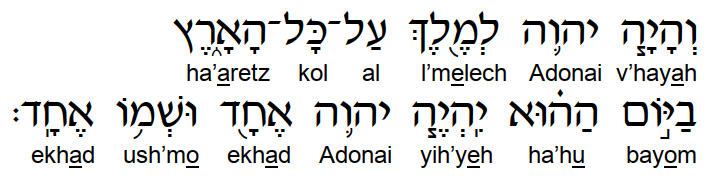
View whole verse and interlinear translation ...
Our text comes from the traditional haftarah portion for the
first day of the festival of Sukkot: Zechariah chapter 14. This
reading is formally designated by the sages of the Talmud - b.
Mehillah 31a - and speaks a universal annual pilgrimage to Jerusalem
as a practical consequence of the proclamation of sovereignty made in our
text. Zechariah was a post-exilic prophet, speaking in the days of the
return from the Babylonian exile, when the Temple was being rebuilt and the
cult of
The Name ...
HaShem: literally, Hebrew for 'The Name' - an allusion used to avoid pronouncing the Tetragrammaton, the so-called 'ineffable' name of G–d
HaShem being re-established, although Jerusalem was
only the provincial capital of the Persian province of Yehud, the Province
Beyond the River. Our text speaks to the desire of the community for the
restoration of HaShem's sovereignty in the land, of freedom from the Persian
rule and taxation instead of limited religious autonomy, for HaShem to be
recognised as "king over all the earth". The second phrase explicitly
uses the word אֶחָד, one to resonate with the Sh'ma:
"Hear, Israel: HaShem our G-d, Hashem is one" (D'varim 6:4). Michael
Fishbane points out that this has eschatological significance: "What the
Israelites affirm in the present is projected as universal reality in the
time to come."1
The rituals and ritual objects of Sukkot also affirm the unity of HaShem. Following the Torah - "On the first day you shall take the product of hadar trees, branches of palm trees, boughs of leafy trees, and willows of the brook" (Vayikra 23:40, NJPS) - we take and wave the lulav and etrog in all four quadrants of the compass to declare HaShem's sovereignty in all directions, in front, behind and on both sides, adding up and down to include the heavens and the underworld. There is nowhere that does not come under His authority and command. Our text is incorporated in the Alenu prayer at the end of each of the three daily prayer services in the synagogue, thus forming a "liturgical climax"2 to almost every act of communal Jewish worship. We hear a similar affirmation of unity among the early disciples of Yeshua: "There is one body and one Spirit- ... one Lord, one faith, one baptism, one G-d and Father of all, who is over all and through all and in all" (Ephesians 4:4-6, ESV).
The haftarah also vocalises an ancient connection between the
festival of Sukkot and rituals associated with praying for and
speaking of rain. In Second Temple times, a pitcher of clean water was
solemnly fetched in great procession from the pool of Siloam and brought up
into the Temple where it would be poured out (slowly) on the bronze altar
producing great clouds of steam. The early rabbis said that, "the
Torah required bringing the water-offering on the festival of
Sukkot so that the rain would be blessed on its account" (t.
Sukkah 3:18) citing the verse, " if any of the families of the earth do
not go up to Jerusalem to worship the King, the LORD of hosts, there will be
no rain on them" (Zechariah 14:7, ESV). The
Who Is ...
The Radak: Rabbi David Kimḥi (1160-1235 CE), rabbi, biblical commentator, philosopher and grammarian; born in Narbonne, France; best known for his commentaries on the Prophets, he also wrote a philosphical commentary on Bresheet that makes extensive use of the Targum of Jonathan ben Uzziel; influenced by a strong supporter of Ibn Ezra and Maimonides
Radak
comments, "When the nations who come to Jerusalem see the wonders mentioned
here, they will recognize that the Lord reigns over all the earth and exerts
His providence on the lower world. He does with them as he pleases, and
nature is transformed to do the will of those who fear Him, because
everything is the work of His hands."
At the half-way point in our text, starting the second colon in the verse, are the words בַיוֹם הַהוּא, "on that day." This phrase is repeated seven times in the haftarah and at least another ten times in the preceding three chapters. HaShem's feet will stand on the Mount of Olives (v. 4) on that day; on that day there will be no light or dark (v. 6), and water will flow out of Jerusalem to the east and to the west (v. 8). According to our text, on that day HaShem and His name will be one (v. 9). On that day, a great panic will fall on those fighting over Jerusalem (v. 13), while on that day "Holy to HaShem" will be inscribed upon the bells of the horses (v. 20) and there will be no more merchants in the house of HaShem (v. 21). Although these must be distinct days, following sequentially but not contiguously from each other, the phrase emphasises that these are all specific days whose exact date is already known and determined by HaShem. These are days that will, in the fullness of His time, happen; the designated events will occur on those days - or in those seasons - and He will be proved right in His predictions and warnings.
What are we to make of the curious assertion that in that day,
HaShem will be One? Is He not one already - has He not always been one and
will that oneness not continue for ever? Yes, of course, that is the unity
that we proclaim and which the Spirit has caused to be written for us so that
we should not be confused. And does He not have one name, by which He is
known, proclaimed and worshipped? Yes, absolutely. For those who know Him,
that goes without saying. But, as Rabbi Adin Steinsaltz explains, "there are
many people who believe in G-d to a certain extent, but they do not know
which name to call Him, and therefore there are numerous names for G-d,
different opinions, and various religions. In the future, just as He will be
one, so too, all will call Him by a single name."3
Who Is ...
Abraham Ibn Ezra: (1089-1167 CE), born in Tudela, Spain; died in the South of France after wandering all around the shores of the Mediterranean and England; a philosopher, astronomer, doctor, poet and linguist; wrote a Hebrew grammar and a commentary on the Bible
Ibn Ezra notes that while there are many biblical names for
HaShem, these point to or describe different aspects of His character and
they will all be resolved into one name on that day: "the name that denotes
the Divine Essence alone."
What Is ...
Targum Jonathan: An early (1st-2nd Century CE) translation/paraphrase of the Prophets into Aramaic; attributed to the 1st century Jewish scholar Jonathan ben Uzziel; similar to Targum Onkelos, but at times a looser paraphrase
Targum Jonathan says that on that
day "there will be a revelation of the sovereignty of HaShem." Finally, the
Malbim writes that "in the future, the name of Hashem -- the Tetragrammaton
-- will also be pronounced as it is written."
Gunther Plaut writes that our text "expresses a central messianic hope."4 He suggests that Zechariah's vision helped to transform the Temple from just another building to "a place of holy striving, where the flame of faith was kept burning for the time when G-d would make Jerusalem the goal of one vast human pilgrimage."5 That day was realised when Yeshua went up to the festival of Sukkot and, after teaching in the Temple for several days, stood up on the last day of the festival - the day known as Hoshana Rabbah - and cried out, "If anyone thirsts, let him come to Me and drink. Whoever believes in Me, as the Scripture has said, 'Out of his heart will flow rivers of living water'" (John 7:37-38, ESV). This is perhaps a reference to Isaiah's words about living water, "With joy you will draw water from the wells of salvation" (Isaiah 12:3, ESV), which are immediately followed by an "on that day" promise: "You will say in that day: 'Give thanks to the L-RD, call upon His name, make known His deeds among the peoples, proclaim that His name is exalted'" (v. 4, Bibie(ESV)). This is a revelation of HaShem's name.
But John isn't content with that. He immediately explains that the living water is different from the physical water offering that had been brought from the Pool of Siloam. That certainly was living water, for it came from a steadily flowing source, but that wasn't what Yeshua meant: "Now this He said about the Spirit, whom those who believed in Him were to receive, for as yet the Spirit had not been given, because Yeshua was not yet glorified" (John 7:39, ESV). It is the Spirit who reveals the truth and the presence of HaShem; it is the Spirit who brings all the disciples of Yeshua together to acknowledge Him as their king; and it is the Spirit who makes Yeshua's name one: "for there is salvation in no one else, for there is no other name under heaven given among men by which we must be saved" (Acts 4:12, ESV). Although Yeshua's name has been translated and transliterated into many languages and representations, His name is still - universally and unambiguously - "the name that is above every name, so that at the name of Yeshua every knee should bow, in heaven and on earth and under the earth, and every tongue confess that Yeshua the Messiah is Lord, to the glory of G-d the Father" (Philippians 2:9-11, ESV).
We who live on the other side of Pentecost from Yeshua's declaration in Jerusalem - that is, after Yeshua's crucifixion and resurrection, when He was indeed glorified - have received the promised gift of the Spirit. We are called to proclaim the sovereignty of HaShem and announce the kingdom of heaven, as Yeshua Himself did: "Repent, for the kingdom of heaven is at hand" (Matthew 4:17, ESV). For that we must always be ready. We live in days of intense and relentless challenge: when the world scoffs at those who try to live their lives in quiet obedience to the Scriptures, laughs at those who hold to the standard of truth and excellence the Bible mandates, denies the possibility of divine intervention into the affairs of men, and mocks those who dare to try to call the world to account for the way it behaves.
The good news is that not only does our text proclaim that "on that day" HaShem will be king over the whole earth, in Yeshua He already is. Nothing the world can say or do can make the slightest difference to His absolute and complete sovereignty; He is already and always has been King! Baruch HaShem!! The truth also is that, in its heart of hearts, the world knows that too, which is why it is so desperate to deny it and carry on with its policy of business as usual. It is our job to quietly but firmly confront the world whenever they challenge the kingdom of G-d, to push back against the lies of the enemy and proclaim the sovereignty of G-d and the unity of G-d: there is only one G-d and this is His name!
Hag Sukkot Sameach b'Yeshua!
1. - Michael Fishbane, Haftarot, The JPS Bible Commentary, (Philadelphia, PA: JPS, 2002), page 402.
2. - Ibid.
3. - Rabbi Adin Steinsaltz, The Steinsaltz Nevi'im, (Jerusalem, Koren, 2019).
4. - Gunther Plaut, The Haftarah Commentary, (New York, UAHC Press, 1996), page 661.
5. - Ibid., page 665.
Further Study: Psalm 103:17-19; Isaiah 45:5-7; Acts 4:24-31; Colossians 1:16-18
Application: Do you feel confident to carry out the assignment of proclaiming the sovereignty of G-d and the name of Yeshua? Call on the Master Herald and ask Him to embolden you to speak on His behalf today. Ask Him to help you to be ready, at a moment's notice and even in the heat of battle, to gently but firmly proclaim the truth and glorify His name.
Buy your own copy of the Drash Book for Deuteronomy/D'varim now at Amazon US or Amazon UK.
© Jonathan Allen, 2026
| Messianic Trust Home Page | Join Weekly Email | More Weekly Drashot |
| Last Week |
Support the work of producing this weekly commentary
|
Next Week |
| Last Year - 5786 | Scripture Index |
|
Your turn - what do you think of the ideas in this drash ? Like most print and online magazines, we reserve the right to edit or publish only those comments we feel are edifying in tone and content. |