
| Sukkot |

| Messianic Education Trust | |||||
|
|
|
|
|||
John 1:14 And the Word became flesh and lived among us; and we saw His glory, like the glory of an only son of his father, great in loving-kindness and truth.
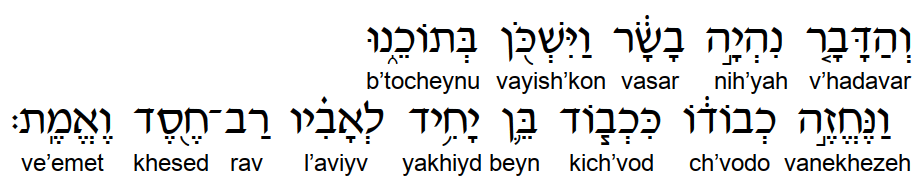
View whole verse and interlinear translation ...
Our text, certainly not one of the traditional readings for the festival of Sukkot, Tabernacles, comes from the prologue to John's Gospel as presented in a Hebrew translation of the Apostolic Writings that was undertaken by the nineteenth century theologian Franz Delitzsch.1 Delitzsch wrote before the rebirth of Hebrew as a modern language and drew heavily on both vocabulary and style from the Tanakh and the Mishnah. His word choices are not always an exact equivalent of the Greek text, but sometimes reflect a phrase or expression taken from Tanakh or the early rabbinic writings. Nevertheless, the Delitzsch translation offers a valuable insight into what might have been - if they existed - the Hebrew roots of the gospels, the 'teachings' and 'actions' documents proposed by the Jerusalem School of the Synoptic Gospels under the leadership of the late Professor David Flusser of the Hebrew University of Jerusalem.
Particularly relevant for the Sukkot festival is the second
verb in the first half of the verse, וַיִּשְׁכֹּן - the Qal
3ms prefix form of the root שׁכן, "to dwell, live, abide,
rest, nest, stay, remain"2, in a vav-conversive
construction. The straightforward translation of the word is - as above -
"and he lived", however, the root שׁכן is also the source of
the noun מִשְׁכָּן, mishkan, literally "place of dwelling",
given as the name of the Tabernacle,
The Name ...
HaShem: literally, Hebrew for 'The Name' - an allusion used to avoid pronouncing the Tetragrammaton, the so-called 'ineffable' name of G–d
HaShem's
point-of-presence among the Israelites before the building of the Temple in
Jerusalem. There, according to multiple texts, HaShem dwelled, rested,
remained, among the Israelites. Perhaps, in the vernacular, we might say
that He tabernacled among them. After the Temple was built in Jerusalem,
Solomon marvelled at the sheer impossibility of G-d dwelling in a physical
structure: "But who is able to build Him a house, since heaven, even
highest heaven, cannot contain Him? Who am I to build a house for Him,
except as a place to make offerings before Him?" (2 Chronicles 2:6,
ESV). Bricks and mortar simply cannot contain G-d!
Nevertheless, at Mt. Sinai, HaShem instructed Moshe for the Israelites, "Let them make Me a sanctuary that I may dwell among them" (Shemot 25:8). These are His words; it is His idea. The word 'sanctuary' is מִקְדָּשׁ, from the root קדשׁ, a place of holiness, while the verb 'I may dwell' comes from שׁכן. In the next sentence, HaShem says that the sanctuary is to be made exactly like "תַּבְנִית הַמִּשְׁכָּן the pattern of the Tabernacle" that He will show Moshe. Creation is happening again. See how the Spirit is given to Betzalel, the lead craftsman: "I have endowed him with a divine spirit of skill, ability, and knowledge in every kind of craft" (31:3, NJPS). Then, at the end of the work, parallel to HaShem's own actions - "G-d saw all that He had made, and found it very good" (B'resheet 1:31, NJPS) and "G-d blessed the seventh day and declared it holy" (2:3, NJPS) - Moshe inspects everything that has been made, "when Moses saw that they had performed all the tasks -- as the L-RD had commanded, so they had done -- Moses blessed them" (Shemot 39:43, NJPS), and blesses the people.
HaShem is now going to dwell in the place of dwelling that the Israelites have built according to His specifications. Once the Tabernacle has been dedicated and consecrated, HaShem tells Moshe that "If you walk in My laws and faithfully observe My commandments" (Vayikra 26:3) many blessings will follow, including "I will set מִשְׁכָּנִי My dwelling place in your midst" (v. 11), adding "I will walk among you and I shall be your God, and you shall be My people" (v. 12). HaShem's dwelling place is now and will be in the midst of the people, later to be confirmed when the Tabernacle is set in the middle of the camp, surrounded by the Levites camping "around the Tabernacle" (B'Midbar 1:53) and further out, the twelve tribes "at a distance" (2:2). He remained in the midst of the people when they camped and when they travelled. While the books of Samuel, Kings and Ezra/Nehemiah show difficult times when the presence of G-d in the midst of the people was often hindered by the sin of the Israelites, this image is confirmed for the long-term future by the prophet Ezekiel: "מִשְׁכָּנִי My dwelling place shall be with them, and I will be their G-d, and they shall be My people" (Ezekiel 37:27, ESV).
More critically for us as the disciples of Yeshua, John too sees the same picture: HaShem dwelling with His people, "Behold, the dwelling place of G-d is among man. He will tabernacle among them. They shall be His people, and G-d Himself shall be among them and be their G-d" (Revelation 21:3, TLV). In the same way, in our text, John tells us that during His years of ministry in first-century Israel, Yeshua was HaShem's point-of-presence among His people: He lived, ate, talked and walked with His disciples, attended weddings and funerals and taught in the synagogues. This is the testimony of the gospels, which together relate much of Yeshua's words and actions. This is why John will later write about Yeshua as the one "who we have heard, who we have seen with our eyes, who we looked upon and have touched with our hands" (1 John 1:1). This is the man, John is saying, whose back we have clapped, who has laughed and cried with us, shared our grimaces over burnt food, slept rough some nights and calloused His hands with hard work. This man is for real; He really did pitch His tent with us!
Although the Hebrew words מִשְׁכַּן, mishkan, and סֻכָּה, sukkah, are often translated using the same English word, 'tabernacle', they come from completely different roots. שׁכן, as detailed above, means to rest, dwell, settle, remain, etc., while סכך means to cover, protect, and weave.3 The Israelites are commanded to build both, but the experience could not be more different. They built one מִשְׁכַּן, once, for HaShem that He might dwell among His people, built under the personal supervision of the Ruach, to the highest specification; every year they built thousands of סֻכֹּת, sukkot, to live in and remember living in, during the wilderness journeys and beyond - we are still building them each year, today! - out of harvest refuse and left-over materials at the end of the agricultural year, camping in them for just seven days as a reminder of our human frailty and dependence on G-d. And yet both are holy; both are מִקְּדָשׁ, a place of holiness, built at at HaShem's command; the one where HaShem dwells, the other where man dwells. HaShem is holy, man is called to be holy.
This is why John's proclamation of Yeshua, who is both perfectly G-d and man, the only begotten Son of G-d and the unique Son of Man, is so important at this time of year. While the mainstream Jewish world builds a sukkah only to remember the past - the forty years of wandering in the desert and the clouds of glory that surrounded and protected our ancestors - we build a sukkah to remember Yeshua, who was probably born during the festival of Sukkot, and His amazing years of ministry among the people of Israel that culminated in His death of the cross and resurrection from the dead. We live, eat and sleep in the sukkah to remind ourselves that year-round we live, eat and sleep in Yeshua as He lives in us by His Spirit. Based on HaShem's command, "You shall live in tabernacles for seven days" (Vayikra 23:42), the Talmud reports this conversation: "It refers to the 'clouds of glory' said Rabbi Eliezer; Rabbi Akiva says: G-d made real sukkot for them" (b. Sukka 11b). This resonates with the writer to the Hebrews who reminds us that "when Messiah comes into the world, He says, 'Sacrifice and offering You did not desire, but a body You prepared for Me" (Hebrews 10:5, TLV).
Yeshua took on human flesh, made - just like us - "in the image of G-d" (B'resheet 1:27), that He might show us His glory, "in order to make known the riches of His glory" (Romans 9:23). In the sukkah, the tabernacle, the physical representation of the One New Man, we see His glory and He gives us hope for our future with Him as Rav Sha'ul explains: "For we know that if the tent that is our earthly home is destroyed, we have a building from G-d, a house not made with hands, eternal in the heavens. For in this tent we groan, longing to put on our heavenly dwelling" (2 Corinthians 5:1-2, ESV). His clouds of glory surround us, covering and protecting us until we are with Him: "we know that when He appears we shall be like Him, because we shall see Him as He is" (1 John 3:2, ESV). This year, when you build your sukkah and wave the arba minim before HaShem as a symbol of His sovereignty over the whole universe, ask the Spirit to give you a glimpse of the clouds of glory that surround you even now and - as an exile, still confided in this place, away from home and longing to be there - to seal your heart and mind in the glory that awaits us all as sons and daughters of The King, siblings and joint heirs with Yeshua on the day He returns "with His angels in the glory of His Father" (Matthew 16:27, ESV).
Hag Sukkot Sameach b'Yeshua!
1. - This text comes from the 11th edition, 1892, with added cantillation marks.
2. - David J. A. Clines (ed.) The Concise Dictionary of Classical Hebrew, (Sheffield: Sheffield Phoenix Press, 2009), pages 460-461.
3. - Clines, page 296.
Further Study: Daniel 7:13-14; 1 Thessalonians 4:16-18; 2 Peter 1:13-14
Application: Reach out to Yeshua today and ask Him to transport you from the sukkah to the Mishkan so that His clouds of glory may be clearly seen in your every-day lfie.
Buy your own copy of the Drash Book for Deuteronomy/D'varim now at Amazon US or Amazon UK.
© Jonathan Allen, 2024
| Messianic Trust Home Page | Join Weekly Email | More Weekly Drashot |
| Last Week |
Support the work of producing this weekly commentary
|
Next Week |
| Last Year - 5784 | Scripture Index | Next Year - 5786' |
|
Your turn - what do you think of the ideas in this drash ? Like most print and online magazines, we reserve the right to edit or publish only those comments we feel are edifying in tone and content. |