
| Sukkot |

| Messianic Education Trust | |||||
|
|
|
|
|||
Nehemiah 8:17 And the whole congregation - the ones returning from the captivity - made sukkot and they dwelt in the sukkot ... and there was very great joy!
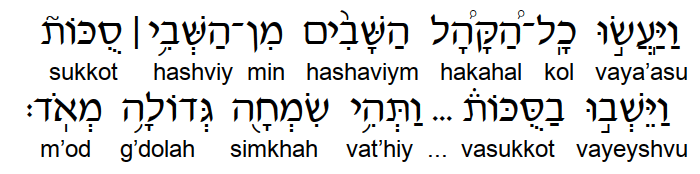
View whole verse and interlinear translation ...
This verse from the book of Nehemiah tells us what was happening in
the days when Israel had been released from captivity in Babylon and was
allowed to return to the land of Israel, albeit that it was now known as the
province of Yehud, a small part of the region that was "beyond the river" -
the river Euphrates - in the mighty Persian empire. Cyrus the Great, who had
conquered the Babylonian empire, announced that "the L-RD G-d of Heaven
has given me all the kingdoms of the earth and has charged me with building
Him a house in Jerusalem, which is in Judah" (Ezra 1:2, NJPS),
adding that "anyone of you of all His people -- may his G-d be with him --
let him go up to Jerusalem that is in Judah and build the House of the L-RD
G-d of Israel, the G-d that is in Jerusalem" (v. 3, NJPS). Not,
perhaps, quite the ringing endorsement of
The Name ...
HaShem: literally, Hebrew for 'The Name' - an allusion used to avoid pronouncing the Tetragrammaton, the so-called 'ineffable' name of G–d
HaShem's
sovereignty for which we might have hoped, but quite enough to fulfill the
promise HaShem had made through the prophets: "He is My shepherd; He shall
fulfill all My purposes! He shall say of Jerusalem, 'She shall be rebuilt,'
and to the Temple: 'You shall be founded again'" (Isaiah 44:28,
NJPS) and "When seventy years are completed for Babylon, I will
visit you, and I will fulfill to you My promise and bring you back to this
place" (Jeremiah 29:10, NJPS).
Just as there were four waves of exile - starting with some of the young nobility in 605 BCE, followed by a larger exile of the court and many officials in 597 BCE when Jerusalem fell to Nebuchadnezzar; a third wave of priests, merchants and artisans in 587 BCE after the failed revolt against Babylonian rule and finally a last wave in 583 BCE after the assassination of Gedalia - there were four waves of return. The first wave happened shortly after the edict of Cyrus in 538 BCE, led by Sheshbazzar at the request of Cyrus, arriving in perhaps 535 BCE; a second was led soon after by Zerubbabel the son of Shealtiel and Joshua the High Priest. A third wave was led by Ezra the priest, some eighty years later in 458 BCE and finally, the fourth return was led by Nehemiah in 445 BCE. The exact dates are debated, depending on some ambiguity as to exactly which Persian monarch is in focus. It is however clear that individual travellers, traders and officials made journeys between Yehud and Babylon during throughout that period. The Land itself was never left empty; that is simply a myth; the Babylonians needed someone to farm the land and pay tax, so would have left the majority of the village and agricultural infrastructure and people in place.
We know from the Bible and from ancient Babylonian documents that many Jewish people did not respond to Cyrus' invitation to return to Jerusalem and rebuild the temple of HaShem. They were now settled in their country of birth and the farm and land grants that had been made to them when they were taken into exile. Many would have had official positions within the structure of government or developed trading businesses, while others had worked up their farms and land-holdings to provide a stable income and social status for themselves and their families. They were not really interested in leaving everything for which they had worked over the last decades for a risky journey across hostile terrain to rebuild a temple that they had never seen in an ancient homeland of uncertain character. This significant Jewish community "in exile" thrived for nearly a thousand years, providing a safe haven for Jews forced to leave the land of Israel by the Romans in the second and third centuries CE and produced the Bavli, the Babylonian - and authoritative - Talmud.
Nevertheless, many Jews "whose spirit had been roused by G-d" (Ezra 1:5, NJPS) did make the journey back to the Land and settled down in their ancestral farms, villages and cities. They formed the community of the golah, the exile, the returnees from Babylon. They replanted the foundations of the temple in Jerusalem, established an altar and - in time - rebuilt the walls of Jerusalem. They faced significant opposition from two main sources: other Persian officials and the local people of the land who had not been exiled. Both were rebuffed and not allowed to share or participate in the building or in the community on the grounds that "You have nothing to do with us in building a house to our G-d; but we alone will build to the L-RD, the G-d of Israel, as King Cyrus the king of Persia has commanded us" (4:3, NJPS). The community is firm that it and it alone carries the mantle of Jewish identity and is to inherit the Land and the covenants of promise.
Our text is set early in the seventh month of the year in the Jewish calendar. Now known by its Babylonian name, Tishrei, Nehemiah's account of these events references it by its number: "Ezra the priest brought the Torah before the assembly, both men and women and all who could understand what they heard, on the first day of the seventh month" (Nehemiah 8:2). According to Vayikra chapter 23, the master list of HaShem's appointed times throughout the year, the seventh month hosts the most concentrated set of festivals, today known as the High Holy Days: Yom Teruah, Yom Kippur, Sukkot and Shemini Azteret. We read that the community gathers in Jerusalem on the first day of the seventh month - "In the seventh month, on the first day of the month, you shall observe complete rest, a sacred occasion commemorated with loud blasts" (Vayikra 23:24, NJPS) - and, after Ezra has read the Torah to them from first light until midday, they celebrate and rejoice: "all the people went to eat and drink and send portions and make great merriment, for they understood the things they were told" (Nehemiah 8:12, NJPS).
Gathering again on the second day, they come for another day of Torah study and discover that the festival of Sukkot is to be held in the seventh month: "You shall live in booths seven days; all citizens in Israel shall live in booths, in order that future generations may know that I made the Israelite people live in booths when I brought them out of the land of Egypt, I the L-RD your G-d" (Vayikra 23:42-43, NJPS). This, then, is exactly what the people do, building sukkot in every available space: "booths on their roofs, in their courtyards, in the courtyards of the House of God, in the square of the Water Gate and in the square of the Ephraim Gate" (Nehemiah 8:16, NJPS). We may imagine Jerusalem as the Old City is today, with a sukkah on every balcony, in every courtyard: on every square inch of space that can be found or commandeered! And this is where our text bears on the narrative.
Exactly who built all these sukkot? The text is very specific: "the whole congregation - the ones returning from the captivity". The Hebrew starts with כָל־הַקָּהָל "the whole congregation", but then qualifies it with the words הַשָּׁבִים מְן־הַשְּׁבִי, "those returning from the captivity". The first word is a Qal mp participle from the root שׁוּב, "to return"; the second is a noun derived from the root שָׁבָה, "to take prisoner, to carry away captive". The use of the participle, usually for ongoing action, implies that these people - even after between ten and thirty years - still see themselves as in the process of returning from captivity. This is very exclusive; it clearly excludes those who are not Jewish - Persian officials, peoples of other nations brought in during the time of the exile by the Persians - but it also excludes other Israelites, probably the majority of the original inhabitants of the southern kingdom of Judea, who were not taken into exile but left in situ in order to farm the land and pay tax. The congregation is defining itself as only those who have been through the exile experience and returned to the Land at the call of G-d!
Consequently, we need to see this concern with the Torah and the festival of Sukkot as a statement and action of identity. It is a matter of obedience that the community performs in order to affirm who they are. As Hannah Harrington explains, "the new community is redefined not only by birth and cultural identity but by its responsiveness to the will of God."1 It is the returnees from the golah who are documented as celebrating Sukkot. Does that mean that others Judeans didn't keep the festival or didn't build a sukkah in their villages or farms? We simply don't know because the narrative doesn't tell us; the narrative doesn't want to tell us. As a pilgrimage feast, all the Jewish people should come up to Jerusalem to celebrate the feast, but perhaps the golah community prevented the others from doing so. We might say today that that was too harsh and ungracious; an intolerance of diversity. But it was a very clear identification of who the believing community is; moreover, it is the record that has survived.
As the followers of Yeshua, those who have been "plucked from the fire" (Zechariah 3:2, NJPS), we too are returning from exile. Like the golah community in Jerusalem, we are still returning from exile and will be until the day we stand before Him in the Olam HaBa, the world to come. Returning is a daily task as we are "conformed to the image of [Yeshua], in order that He might be the firstborn among many brothers" (Romans 8:29, ESV). This doesn't happen overnight; it takes time as the Ruach shapes, contours and - in some cases - abrades us, removing both the sharp corners and jagged edges, and the stain and tarnish of exile in the kingdoms of this world. But the question is: what identity statement are we making and how exclusive are we being? Are we unashamedly declaring our identity as disciples? Are we showing our obedience every day in the way that we "love one another" (John 13:34) and "love [our] enemies and pray for those who persecute [us]" (Matthew 5:44). According to Yeshua, this is how we become "sons of [our] Father who is in heaven" (v. 45). Peter puts it this way: "Live such good lives among the pagans that even though they now speak against you as evil-doers, they will, as a result of seeing your good actions, give glory to God on the Day of His coming" (1 Peter 2:12, ESV).
Likewise, are we very clear about who is part of the community and who is not? This is obviously a balancing act: welcoming and embracing the strangers, showing Yeshua's love to those around us, while always seeking to introduce people to Yeshua and inviting them to become a part of the community by accepting Him as Saviour and Lord. How can we persist in those introductions or know who to invite unless we recognise that there is a difference? It is fundamentally disingenuous to allow people to settle and become comfortable in our midst without make it clear that membership of the community is dependent on a relationship with the Father through Yeshua. You may get to do lots of fun things with the people of G-d, but you don't actually become a part of His people until you accept His offer to join the kingdom of G-d on His terms! Compassion must never extend to ignoring sin. This too is an identity statement that disciples of Yeshua are called to make in these days.
Hag Sukkot Sameach b'Yeshua!
1. - Hannah K. Harrington, The Books of Ezra and Nehemiah (Grand Rapids, MI: Eerdemans, 2022), page 109.
Further Study: Zechariah 1:14-17; Luke 6:27-31; 1 Peter 3:14-16
Application: Are you clear in your identity as a disciple of Yeshua so that all those around you - friends, family, co-workers - know exactly who you are? Have you invited them to join the kingdom of G-d right now, in these days, lest they are lost for eternity? Ask the Spirit to guide you in conversations today and be ready to see what happens!
Comment - 17:13 16Oct24 Russell Graff: Thank you!
Buy your own copy of the Drash Book for Deuteronomy/D'varim now at Amazon US or Amazon UK.
© Jonathan Allen, 2024
| Messianic Trust Home Page | Join Weekly Email | More Weekly Drashot |
| Last Week |
Support the work of producing this weekly commentary
|
Next Week |
| Last Year - 5784 | Scripture Index | Next Year - 5786 |
|
Your turn - what do you think of the ideas in this drash ? Like most print and online magazines, we reserve the right to edit or publish only those comments we feel are edifying in tone and content. |