

|
Sh'mini (Lev 9:1 - 11:47) |

| Messianic Education Trust | ||||||
|
|
Always Being Ready
|
|
||||
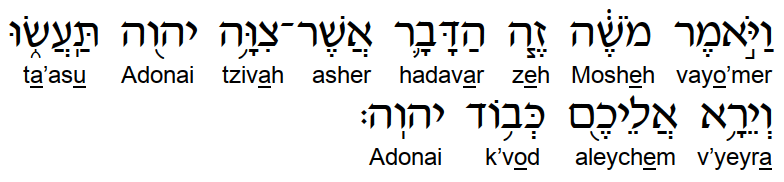
Vayikra/Leviticus 9:6 And Moshe said, "This is the thing that the L-rd has commanded [that] you shall do; and the glory of the L-rd will appear to you."
View whole verse and interlinear translation ...
Aharon has been ordained as the Cohen Gadol, the High Priest
and - after Moshe has been offering the morning and evening sacrifices each
day for seven days - he and his sons are about to take over the operation of
the priesthood. Moshe calls Aharon, his sons and the elders of Israel and
tells them to bring all what is needed for a sin offering and a burnt
offering for Aharon and a sin offering, burnt offering and peace offerings
for the people. Aharon, assisted by his sons, will present all the offerings
in turn according to the prescribed ritual and there will be a sign from
The Name ...
HaShem: literally, Hebrew for 'The Name' - an allusion used to avoid pronouncing the Tetragrammaton, the so-called 'ineffable' name of G–d
HaShem "by which", the
Who Is ...
Bekhor Shor: Joseph ben Isaac Bekhor Shor; a twelfth century French tosafist, commentator and poet; he lived in Orleans and was a pupil of the Rashbam and Rabbenu Tam; wrote a commentary to the Torah and made contributions to the Talmud commentaries; followed the p'shat method of interpretation in the style of Rashi, to the extent of rationalising many miracles
Bekhor Shor says, "you
will know that HaShem has chosen Aharon and his sons to serve Him." The
purpose of the offerings that Aharon is about to present is clearly stated at
the outset: "for today the L-RD will appear to you" (Vayikra 9:4), an
immediate response from heaven. That, Mark Rooker comments, is "the desired
result of the entire proceeding."1 The sign is more than the
immediate approval of Aharon however; John Hartley points out that it also
says that "to an obedient, responsive people, HaShem will
appear."2
Let's take a closer look at our text and see what else is going on. The first thing to notice is that the 'you' is plural: both the verb תַּעֲשׂוּ - the Qal 2mp prefix form of the root עשׂה, to do, make or perform, here "you shall do" - and the indirect object אֲלֵיכֶם - the preposition אֶל with the 2mp object pronoun, "to you" - are plural and so addressed to Aharon, his sons and the elders of the people. It is easy to assume from an English translation that Moshe is talking to Aharon alone, about the ritual steps he is about to perform, especially as the next verse starts a series of detailed instructions explicitly to Aharon: "Draw near to the altar" (v. 7). We know from the previous verse - "And they brought what Moshe commanded in front of the tent of meeting, and all the congregation drew near and stood before the L-RD" (v. 5, NJPS) - that the people have already done what Moshe commanded, so why is the verb here using future tense and not past? Samuel Balentine explains that "the strategic reminder that Moshe issues and the priests obey 'what HaShem has commanded', a phrase already repeated seven times in the preceding chapter, makes the point that careful adherence to these instructions continues to be definitive for this and all future public enactments of what G-d has decreed."3
We should also notice another difference between our text and the
previous verse. There it says, "And they brought what Moshe commanded"
(v. 5), whereas here the Torah reports Moshe saying, "This is
the thing that the L-RD commanded you to do" (v. 6). Who is doing the
commanding here? Baruch Levine responds that "Moshe has an
enhanced role in this celebration as the transmitter of HaShem's commands.
In Vayikra, it is usually HaShem who commands, not Moshe." Moshe is
allowed to convey the words of HaShem to the people with authority because of
his position as the covenant mediator and leader of the people, but he is
then very clear in our text that he is only the messenger. Rabbi
Who Is ...
Hirsch: Rabbi Samson Raphael Hirsch (1808-1888 CE), German rabbi, author and educator; staunch opponent of the Reform movement in Germany and one of the fathers of Orthodox Judaism
Hirsch affirms that "this was no subjective human idea that was
being carried out, which could be altered or abrogated according to the
feelings of wishes of the bringers, but was solely the directions and
commands given by G-d Himself." It is quite simple, the
Who Is ...
Ramban: Rabbi Moshe ben Nachman Girondi or Nachmanides (born in Gerona, 1194; died in Israel 1270), Spanish rabbi, author and physician; defended Judaism in the Christian debates in Barcelona before making aliyah
Ramban
writes: "Aharon would not do anything but what Moshe has told him, and Moshe
would not tell them to do anything but what G-d had commanded him."
It seems that precise and particular obedience is one of HaShem's
requirements: do this and only this. The
Who Is ...
The Netziv: Rabbi Naphtali Zvi Yehuda Berlin (1816-1893), also known as Reb Hirsch Leib Berlin; born in Mir, Russia; rabbi, and dean of the Volozhin Yeshiva (Russia, now Belarus) during its most prestigious years (1849-92); his Torah commentary is known as Ha'amek Davar.
Netziv writes that,
"this is the great merit of those who adhere to the Torah, that they
forgo the infinite delight of union with G-d for the sake of fulfilling
faithfully and scrupulously their religious routine." Perhaps this helps to
explain the following disaster with Aharon's two eldest sons, Nadav and
Avihu. Fearing, according to some rabbinic commentators, that the promised
sign was not going to occur, they rushed forward to provide earthly fire of
their own to start to consume the sacrifices on the altar. HaShem refuses to
be pre-empted, so when the heavenly fire did come forth "from before the
L-RD and consume the burnt offering" (v. 24), it also consumed them for
bringing "strange fire" (10:1) - translated "unauthorised fire"
by NJPS - as if HaShem might have failed to keep His word.
With the descent of the heavenly fire that consumed the burnt
offering and all the fat that the priests had placed upon the altar, HaShem
democratised His approval of the Tabernacle and the Levitical priesthood.
Previously, after Moshe had erected the Tabernacle and offered the first
burnt offering and grain offering, "the cloud covered the Tent of
Meeting, and the Presence of the L-RD filled the Tabernacle" (Shemot 40:34,
NJPS). The narrator tells us there that "Moshe could not enter
the Tent of Meeting, because the cloud had settled upon it and the Presence
of the L-RD filled the Tabernacle" (v. 35, NJPS). But now, as the
Who Is ...
Sforno: Rabbi Ovadiah Sforno (1470-1550 CE), Italian rabbi, philosopher and physician; born in Cesena, he went to Rome to study medicine; left in 1525 and after some years of travel, settled in Bologna where he founded a yeshiva which he conducted until his death
Sforno says, "in addition to the appearance of the
Shekhinah in the Tabernacle, it would now appear 'to all the
people' (Vayikra 9:23) as well." It was important that all the people saw
and understood that HaShem was available for and among His people, a
down-payment on His promise that when the Israelites bring "a regular
burnt offering throughout the generations, at the entrance of the Tent of
Meeting before the L-RD, there I will meet with you, and there I will speak
with you, and there I will meet with the Israelites, and it shall be
sanctified by My Presence" (Shemot 29:42-43, NJPS). As Gordon
Wenham observes, "there was a recognition that if G-d was not present in the
Tabernacle then all worship there was meaningless."4
Although as disciples of Yeshua, both Jew and Gentile, our method of access to the Father has slightly changed - we now approach Him through our great High Priest, Yeshua, in faith and in the merit of His once-for-all sacrifice of His own blood in the heavenly Tabernacle, rather than the sin offerings, burnt offerings and peace offerings in view through our text - the fundamental premise still applies: that obedience is an essential component of our relationship with Him. Perhaps that is why John's frequently cited verse about forgiveness - "If we confess our sins, He is faithful and just to forgive us our sins and to cleanse us from all unrighteousness" (1 John 1:9, ESV) - is immediately bracketed by two statements of obedience: "If we say we have no sin, we deceive ourselves, and the truth is not in us" (v. 8, ESV) and "If we say we have not sinned, we make Him a liar, and His word is not in us" (v. 10, ESV). We have to be obedient, acknowledging the truth and not hiding behind either of these convenient and all-too-easy false positions.
Yeshua tells us that obedience is essential: "Therefore whoever relaxes one of the least of these commandments and teaches others to do the same will be called least in the kingdom of heaven, but whoever does them and teaches them will be called great in the kingdom of heaven" (Matthew 5:19, ESV). He goes further, stating quite bluntly, "If you love Me, you will keep My commandments" (John 14:15, ESV). Presumably, if we don't keep His commandments, then we don't love Him, which is why He asks "Why do you call Me 'Lord, Lord,' and not do what I tell you?" (Luke 6:46, ESV). James picks up the baton, urging his readers to "be doers of the word, and not hearers only, deceiving yourselves" (James 1:22, ESV). The word must find its way into our practice, not just our conversation; we must actually do it, rather than just talk about it. Paul writes to the congregations in Thessalonica, in the same way: "as you received from us how you ought to walk and to please G-d, just as you are doing, that you do so more and more" (1 Thessalonians 4:1, ESV). These are all ways in which we obey the word of HaShem, guided by the voice of the Spirit.
Are we always ready to actually do what HaShem commands us to do so that His presence may be manifest in and to us? Do we always listen to and then obey the voice of the Spirit? Certainly, we must always verify that what we think is the voice of the Spirit really is the Spirit by checking for consistency with the written Scriptures, but we must never refuse to obey the voice of HaShem once we are sure that it is He speaking. Is that why many people complain that they have never experienced the presence of HaShem, let alone His glory? Scripture tells us that "by this we know that we have come to know Him, if we keep His commandments" (1 John 2:3, ESV) - by being obedient, by being ready to do exactly what He says, rather than modifying, embroidering or diluting His voice to mean something else or nothing at all. If we would see His face and feel His presence among us, if we want to see His kingdom growing and revival sprouting up in our communities, then we need to be certain that we are not blocking the Spirit's work, even if by accident or ignorance. Let us be the obedient and responsive people to who the presence and glory of HaShem is revealed.
1. - Mark F. Rooker, Leviticus, The New American Commentary, (Nashville, TN: B&H Publishing Group, 2000), page 151.
2. - John E. Hartley, Leviticus, Word Biblical Commentary, (Nashville, TN: Thomas Nelson, 1992), page 123.
3. - Samuel E. Balentine, Leviticus, Interpretation, (Louisville, KY: Westminster John Knox Press, 2002), page 84.
4. - Gordon J. Wenham, The Book of Leviticus, NICOT, (Grand Rapids, MI: Eerdmans, 1979), pages 148.
Further Study: Matthew 7:21-23; 2 Corinthians 10:3-6; 1 John 2:3-6
Application: Search your heart, mind and spirit to see if there is any disobedience in your walk before our Master. Ask Him to send His Spirit to reveal what is unknown or forgotten, to convict hidden or camouflaged disobedience so that you may confess and seek forgiveness, and to remove hesitancy or doubt so that we may all move forward in the unity of the Spirit.
Buy your own copy of the Drash Book for Leviticus/Vayikra now at Amazon US or Amazon UK.
© Jonathan Allen, 2026
| Messianic Trust Home Page | Join Weekly Email | More Weekly Drashot |
| Last Week |
Support the work of producing this weekly commentary
|
Next Week |
| Last Year - 5785 | Scripture Index |
|
Your turn - what do you think of the ideas in this drash ? Like most print and online magazines, we reserve the right to edit or publish only those comments we feel are edifying in tone and content. |