

|
Shemot (Ex 1:1 - 6:1) |

| Messianic Education Trust | ||||||
|
|
Living in Exile
|
|
||||
Shemot/Exodus 4:31 And the people believed; when they heard that the L-rd had remembered the Children of Israel, and that He had seen their oppression - and they bowed their heads and they worshipped.
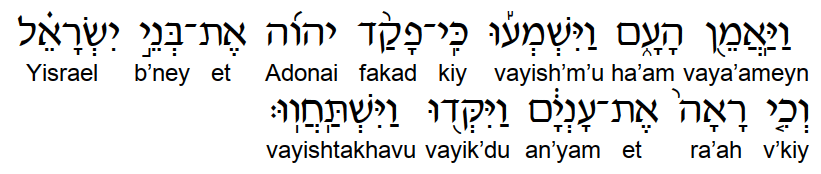
View whole verse and interlinear translation ...
Moshe and Aharon have followed
The Name ...
HaShem: literally, Hebrew for 'The Name' - an allusion used to avoid pronouncing the Tetragrammaton, the so-called 'ineffable' name of G–d
HaShem's instructions
upon their return to Egypt. They have "called together all the leaders of
the Israelites" (Shemot 4:29); Aharon has "repeated all the words that
HaShem spoke to Moshe" and "performed the signs in front of all the
people" (v. 30); and then our text tells us that the people move from a
state of despair to one of faith: they believe. Umberto Cassuto suggests
that "they heard and believed that the L-rd had remembered the Children of
Israel, as Moshe had been charged to tell them (3:16) ... this scene shows us
the luminous picture of the people bowing and prostrating themselves in
gratitude to the L-rd for the heartening tidings that Moshe and Aharon had
announced in His name and as His envoys."1
Not all the commentators agree about exactly what happened. Robert
Alter, a modern translator and commentator says that "in the event, the two
signs of the staff and the hand are sufficient to win their trust ('believe'
does not have any doctrinal sense here)"2
Who Is ...
Abraham Ibn Ezra: (1089-1167 CE), born in Tudela, Spain; died in the South of France after wandering all around the shores of the Mediterranean and England; a philosopher, astronomer, doctor, poet and linguist; wrote a Hebrew grammar and a commentary on the Bible
Ibn Ezra,
a mediaeval commentator and Hebrew scholar/teacher, says exactly the
opposite: "It was not the signs that convinced them. The people were
convinced when they heard that the L-rd had taken note of the Israelites,
that the time promised to Avraham for their rescue had arrived." It seems
that the punctuation - the atnakh accent on the second word of our
text, the major disjunctive mark within the verse - is misleading. Some take
it as coupling those two words to the end of the previous verse -
"[Aharon] performed the signs in the sight of the people, and the people
were convinced" - while others see the verse break as being more
significant, de-coupling the signs from the faith, which is then a result of
the hearing described in our text: "[Aharon] performed the signs in the
sight of the people. And the people were convinced when they heard."
Perhaps the word וַיַאֲמֵן itself - the Hif'il
3ms prefix form of the root אָמַן, "to be firm, true,
faithful", in Hif'il, "to trust, confide, believe in"
(Davidson) - can help us? The
Who Is ...
Ba'al HaTurim: Rabbi Yaakov ben Asher (1269-1343 CE), born in Cologne, Germany; lived for 40 years in and around Toledo, Spain; died en route to Israel; his commentary to the Chumash is based upon an abridgement of the Ramban, including Rashi, Rashbam and Ibn Ezra; it includes many references to gematria and textual novelties
Baal HaTurim
reports that the word only appears twice in this exact form in Tanakh.
Our text is the first; the second is "וַיַּאֲמֵן אְכִישׁ בְּדָוִד And
Achish believed David" (1 Samuel 27:12). In the second usage, the phrase is
followed by לֵאמֹר, "to say" or "saying/thinking", connecting
the belief to what follows. This confirms that our text, where the verb is
followed by וַיִּשְׁמְעוּ, "and/when they heard" should be taken in
the same way. The belief is not as result of what they saw (preceding) but
what they heard (following). More homiletically, our Sages tell us that two
excellent leaders arose for Israel: Moshe and David. G-d tested them both
with sheep. Moshe and David were faithful shepherds and therefore the people
had faith in them (Shemot Rabbah 2:3).
Rabbi
Who Is ...
Hirsch: Rabbi Samson Raphael Hirsch (1808-1888 CE), German rabbi, author and educator; staunch opponent of the Reform movement in Germany and one of the fathers of Orthodox Judaism
Hirsch tells us that "'believe' or 'belief' does
not adequately express or translate וַיַאֲמֵן. The Hif'il
stem means more than the basic root. "*(הַאֲמֵין) is to
acknowledge that which is told us, as אָמֵן, truth, is the firm
fixed point on which we can depend, on to which we can hold; that is to be
our אֹמֶן, faithfulness, to guide and educate us." The people
accepted, believed as truth, and allowed to guide them, Hirsch continues,
"two things from Moshe, (a) that G-d considered the time had arrived to
'invest' (פָקַד) Israel with the fate that been promised them,
and (b) that G-d had seen (רָאָה) their misery, that is to say
that even if the real salvation should not come immediately, they could at
least expect that they would be protected under G-d's eye from fresh new
injustice." The two verbs that follow, "bowing the head" and "worship" cover
first "the expression of submitting the head, the thoughts, the intellect, to
a higher power" and then "throwing the whole body prostrate on the ground,
placing your whole existence at G-d's disposal." Hirsch tells us that "the
Israelites did both."
So what has happened? Everett Fox says that "for the first time in the Torah, Israel responds to G-d's promises in a positive manner", adding rather dryly, "something that will rarely happen again".3 Leon Kass proposes that "at long last, they are willing to believe, the L-rd was going to do something about their affliction and abasement."4 Echoing Hirsch, Walter Brueggemann looks at the following verbs and comments: "What is believed is not simply that Moshe had been the receiver of an appearance from Yahweh. What is believed is not simply that Yahweh intends to emancipate Israel. What is believed is that Yahweh has attended to (פָקַד) and has seen (רָאָה, taken note of) Israel's oppression."5 Terence Fretheim comments: "In response to these words and deeds, the people believe, that is, they believe that what he has said is the truth. But the people not only believe, they worship. Their worship is said to follow specifically upon their hearing one particular word. It is a gospel word - G-d's having seen their affliction and becoming active on their behalf - that occasions their worship. It is not the signs that prompt this activity but the specific promise inherent in G-d's involvement."6
Moshe and Aharon brought the people good news, the news of HaShem's notice and His intention to act on their behalf: to fulfil His promise to the patriarchs to bring their descendants into the land of Canaan and give it to them as a permanent possession, that they might be His people and He might be their G-d. When the people heard the good news they responded in worship. The prophets Isaiah, Jeremiah and Ezekiel brought good news to the exiles in Babylon: of their homecoming, of HaShem's continued involvement with them, and of the larger work of restoration - the ingathering from the nations, the new heart of flesh, the filling with the Spirit and the restored unity of Judah and Ephraim. Yeshua, the Jewish Messiah and Saviour of the world, brought good news: the in-breaking of the kingdom of G-d, the outreach of the kingdom to all the nations, salvation and forgiveness in His name, the start of the "last days" and the outpouring of the Ruach. We stand as perhaps the last generation bearing witness to the promises of G-d, demonstrating what G-d is doing among His people and in His world today and urging everyone on behalf of Messiah, "be reconciled to G-d" (2 Corinthians 5:20).
It is essential that exiles talk amongst themselves, to rehearse and review the promises of G-d and His faithfulness. Only by hearing, discussing and debating - a conscious cycle of reinforcement - will the steady faith in G-d's alternative arise and become dominant among the exiles; only then will the power of despondency and despair be overcome with G-d's new and fresh alternative. The words of the prophets served for ancient Israel not primarily as reminders of G-d's past actions and wonders, but as anticipatory assertions of what G-d is about to do. Israel is - was then and is still now - called to "Sing to the L-RD a new song, His praise from the ends of the earth" (Isaiah 42:10, NJPS) for His sovereign, liberating, restoring, action that is about to take place. As believers in Yeshua, we must encourage, facilitate and participate in such discussions; we must ensure that they take place within our communities - one-to-one, in families, in small groups, from leadership - in every context that presents itself: over lunch or coffee, standing in the hall, talking on the 'phone, before or after services. We must promote the habit of reviewing and refreshing G-d's promises and coming proximity until it is taken up by others; initiating the conversations and drawing others into His presence.
How is this primarily to happen? Rav Sha'ul explains in his letter to the Romans: "How then will they call on Him in whom they have not believed? And how are they to believe in Him of whom they have never heard? And how are they to hear without someone preaching? And how are they to preach unless they are sent?" (Romans 10:14-15, ESV). How indeed! But that is our calling as exiles in these days. Belonging yet not belonging, living in exile yet "seated - in Messiah Yeshua in heavenly places" (Ephesians 2:6), "sorrowful, yet always rejoicing; as poor, yet making many rich; as having nothing, yet possessing everything>" (2 Corinthians 6:10, ESV). We have been sent, deliberately and explicitly, to preach the good news, to share the love and compassion of Yeshua and announce the coming - may it be soon and in our days - judgement of the world.
Walter Brueggemann points out that "our current world of bewilderment is often described as though everything good is ending, as though the forces of chaos have won." And so it can seem to us when we spend too much time focusing on what is going on around us, rather than what our Father has to say about the times in which we live; when we listen more to the voice of the world and not enough to the voice of the Spirit, most often expressed in the world. Our tradition of Yeshua, "authorises the church to identity and redescribe this present place as the arena in which the rule of G-d is working a wondrous newness. Our singing and utterance of such lyrical faith assert that we will not submit to the gods of fear and anticovenantal power relations. In such a situation as ours, the words and music for a 'new song' are acts of powerful renewal."7 Lift up your voice today and let that song be heard, "for salvation is nearer to us now than when we first believed" (Romans 13:11, ESV).
1. - Umberto Cassuto, A Commentary on the Book of Exodus, (Magnes Press, Jerusalem, 1983), page 63.
2. - Robert Alter, The Five Books of Moses, (New York, Norton, 2004), page 332.
3. - Everett Fox, The Five Books of Moses The Schocken Bible Vol 1, (New York, NY: Schocken Books, 1995), page 281.
4. - Leon R. Kass, Founding G-d's Nation - Reading Exodus (New Haven, Yale University Press, 2021), page 99.
5. - Walter Brueggemann, "Exodus", in The New Interpreter's Bible Commentary Vol I, edited by Leander E. Keck, (Nashville, TN: Abingdon Press, 2015), page 311.
6. - Terence E. Fretheim, Exodus, Interpretation, (Louisville, KY: Westminster John Knox Press, 2010), page 82.
7. - Walter Brueggemann, Cadences of Home, (Louisville, KY: Westminster John Knox, 1977), page 21.
Further Study: Isaiah 56:1-2; Luke 21:25-28; Ephesians 5:11-14
Application: How can you redescribe the world around you so that others can see what G-d is doing in these days and join with you in singing that new song of praise of G-d? Ask the Spirit how to start those conversations among our fellow exiles that will lift and inspire us all with the vision and excitement of what G-d really is just about to do in our midst?
Buy your own copy of the Drash Book for Exodus/Shemot now at Amazon US or Amazon UK.
© Jonathan Allen, 2025
| Messianic Trust Home Page | Join Weekly Email | More Weekly Drashot |
| Last Week |
Support the work of producing this weekly commentary
|
Next Week |
| Last Year - 5784 | Scripture Index | Next Year - 5786 |
|
Your turn - what do you think of the ideas in this drash ? Like most print and online magazines, we reserve the right to edit or publish only those comments we feel are edifying in tone and content. |