

|
Pinchas (Num 25:11 - 30:1(29:40)) |

| Messianic Education Trust | ||||||
|
|
|
|
||||
B'Midbar/Numbers 29:16 And one male of the goats [for] a sin offering
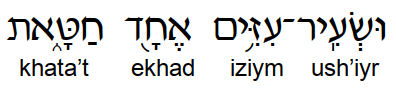
View whole verse and interlinear translation ...
This is the last item in the list of sacrifices to be brought on the first day of Sukkot, following the thirteen bulls, two rams, fourteen lambs - all of which is to accompanied by the appropriate meal and drink offering and all in addition to the regular burnt offerings for the day. In fact, it is the last item on the list for all seven days of the Sukkot festival. Looking carefully at the offerings for all the festival days throughout the year, we can see that every single one of them includes one male goat for a sin offering. Why would a sin offering be required on a festival day and what or whose sin is being addressed?
A sin offering - חַטָּאת, a feminine singular noun from the root חָטַא, "to stumble, fall, sin" (Davidson) - effects atonement for sin: for sin that was committed unintentionally. Vayikra chapter 4 describes sin offerings brought for the high priest, the entire community, a leader and an individual who has inadvertently committed a sin by breaking one of the commandments. The choice of a goat, normally considered a hardy and robust animal, is significant as it symbolises the seriousness of sin and the strength needed to remove it. That is why two goats are specified for the sin offering on Yom Kippur: one that is slaughtered and offered in the Sanctuary, the other that is sent off into the wilderness taking away the sins of the people.
In our text, one male goat is offered each day during the whole of
the Sukkot festival. It is one of the list of offerings that are made
by the community, not by any one individual. This points to the need for the
whole community to remain in good standing before
The Name ...
HaShem: literally, Hebrew for 'The Name' - an allusion used to avoid pronouncing the Tetragrammaton, the so-called 'ineffable' name of G–d
HaShem
throughout the festival. HaShem instructs the Israelites to be careful
"so that they do not defile the camp of those in whose midst I dwell"
(B'Midbar 5:3, NJPS). At the festivals, "the appointed times
of HaShem" (Vayikra 23:4), He meets with His people as they come up to
spend time in His presence and sin - even unintentional sin - must not be a
part of that meeting. But, ironically, the Israelites are in a time of
greater risk: they are away from home, out of their normal environment and
dependent to a much larger extent on the observance and provision of others.
In particular, whilst normally at home a person may be very careful about
what they eat, when in Jerusalem and dependent either upon the hospitality of
others suddenly catering for a huge extended family or upon suppliers and
markets providing for thousands of pilgrims, it might be all too easy to eat
something that was unclean or had unknowingly become unclean - and thus break
the dietary laws.
It is therefore for these sorts of reason - an individual member of the community inadvertently becoming unclean - that the community as a whole is to take responsibility for all its members and seek atonement for the community on a daily basis throughout the festival. Where an individual becomes aware of their sin in such a way, they themselves can bring the appropriate offering, but how do you address something that you don't know exists? The ancient sages described this situation as "that uncleanness for which there is no awareness of uncleanness either at the beginning or at the end", adding that "[the goats] of the festivals effect atonement for a case in which there is no awareness of uncleanness either at the beginning or the end of the sequence of events" (m. Shevu'ot 1:4). In a parallel discussion, they report that "the goats offered on the festivals and the goats offered on the new month effect atonement - the words of Rabbi Judah. Rabbi Simeon says: the goats offered on the festivals effect atonement, but not the goats of the new months" (t. Shevu'ot 1:1). Atonement for the community and for the individuals who have unknowingly and unintentionally brought sin into the festival.
A strong community focus is therefore at the root of this command that HaShem has given. Recognising that it is precisely at community times that accidents are more likely to happen, He commands that a sin offering must be a part of each day of every festival that requires people to travel to the Sanctuary. As the rabbis will later say, "because the text says: And one goat for a sin offering unto the Lord: for a sin which is known only to the Lord shall this goat atone" (b. Shevu'ot 9a). The Almighty, the One who knows and sees everything, may be the only one who is aware that a trespass has taken place. Right from the start, He has already built atonement for inadvertent sin into the very fabric of the festivals. Perhaps this is why Sukkot is known as z'man simchateynu, the time of our rejoicing, because during the festival, Israel can rejoice before HaShem, knowing that He already has their backs covered!
It seems clear that Tanakh offers a picture of clear collective responsibility for the sins of individuals. We can see, for example, Nehemiah praying, not so much for himself but for the nation: "Let Your ear be attentive and Your eyes open to receive the prayer of Your servant that I am praying to You now, day and night, on behalf of the Israelites, Your servants, confessing the sins that we Israelites have committed against You, sins that I and my father's house have committed" (Nehemiah 1:6, NJPS). That corporate ownership of sin committed by individual members of the community does not in any way decrease individual responsibility; on the contrary, it adds the weight of letting down or involving the whole community in one person's sin, while at the same time notifying the whole community that individuals do sin, that they often need community help and support, and that the community cannot turn aside and pretend that it doesn't happen.
In the early days of entering the Land, Israel failed in its first attempt to take the city of Ai because of the sin of one man, Achan, keeping some of the devoted things. The whole community was affected by the sin, even they were in complete ignorance of it, and needed to purge that sin from their midst before they could move forward. When Israel breaks covenant with G-d, the whole nation must atone for past and current sins to restore the covenant, repent of the sin and remedy the defect. While Israel is made up of individuals, Israel is judged corporately by HaShem and must take ownership and responsibility for repentance and rectification. A national and corporate turning away from sin - not just in name, leaving individuals to put that into practice, but as a community, all holding each other accountable - is needed to eliminate sin within the people.
Rav Sha'ul makes it clear that the Body of Messiah works in the same way, declaring that "Gentiles are fellow heirs, members of the same body, and partakers of the promise in Messiah Yeshua through the gospel" (Ephesians 3:6, ESV) - that is, fellow heirs and co-participants with the Jewish people. We are all in this together, like a marriage, in sickness and in health. We see Sha'ul admonishing whole congregations for foolishness (the Galatians) and for tolerance of sexual sin (the Corinthians) being undertaken just by some members of their community but with the knowledge of the whole. The community must act to oppose sin together, as a community rather than one or more individuals, to stand against the sin-culture of the world that seeks to infiltrate and drag down all of Yeshua's disciples.
Writing to the Galatians, Sha'ul urges them: "Brothers, if anyone is caught in any transgression, you who are spiritual should restore him in a spirit of gentleness. Keep watch on yourself, lest you too be tempted. Bear one another's burdens, and so fulfill the law of Messiah" (Galatians 6:1-2, ESV). Those who are spiritually strong are obliged to support those who are weak; the community is to work together to bear the burdens, carry the load, so that no-one is isolated or overcome by the strain. If one falls, then we all fall; certainly an individual will be judged for their sin - that is their inalienable responsibility - but the community will also be judged for tolerating that sin in their midst and for standing by while their brother or sister is deceived, beaten, crushed and torn away by sin. Redemption is rarely an individual action; holiness, true holiness, is not usually a one-man status. Just as the Torah says, "Consecrate yourselves, therefore, and be holy, for I am the L-RD your G-d" (Vayikra 20:7, NJPS), so Peter echoes, "as He who called you is holy, you also be holy in all your conduct" (1 Peter 1:15, ESV) - all the 'you' words are plural!
Holiday times - then and now - are an issue. Away from home and out of our usual routine and environment, it is easy to make a mistake: to look where we shouldn't look, to join in an unhelpful conversation, to eat or drink something that we don't need. It is easy too to rationalise bad choices on the grounds that it's only this once, no-one is looking on holiday, or even, it's outside of my control, I really can't do anything about it. For disciples of Yeshua, that is nothing but a lie of the enemy. On the contrary, the word tells us, "greater is He who is in you than he who is in the world" (1 John 4:4, NASB); "Submit therefore to G-d. Resist the devil and he will flee from you" (James 4:7, NASB). Yeshua has given us His personal promise never to leave us and given us "the full armour of G-d, that you may be able to resist in the evil day, and having done everything, to stand firm" (Ephesians 6:13, NASB). We can stand firm, we must stand firm; the Master expects us to stand firm at all times, even on holiday!
Yeshua isn't a kill-joy. Whilst the passage in B'Midbar talks of the sacrifices for festivals, the parallel in Vayikra very deliberately tells us to "rejoice before the L-RD your G-d seven days" (Vayikra 23:40, NJPS). Festivals and holidays are to be a time for rejoicing, feasting, connecting with family and friends, laughter and memories, acknowledging together all the good things that G-d has done. Yeshua told the disciples, "These things I have spoken to you, that My joy may be in you, and that your joy may be full" (John 15:11, ESV). But, as we rejoice, we also have to remain on guard so that we don't accidentally slip into sin and by doing so, affect our families, friends and fellowship. Even on holiday we should be constant in our devotion to Yeshua, in obeying the voice of the Spirit and in giving glory to our Father in heaven.
Further Study: John 16:24; Romans 15:1; James 5:19-20; 1 Peter 5:8-9
Application: Wherever you are, at home or away, take care to avoid sin and call upon our sin offering, Yeshua Himself, to cleanse you from anything that slips through your fingers. Keep an eye out for others in your community and help them to stand firm and resolute to resist the enemy and give glory to G-d!
Buy your own copy of the Drash Book for Numbers/B'Midbar now at Amazon US or Amazon UK.
© Jonathan Allen, 2024
| Messianic Trust Home Page | Join Weekly Email | More Weekly Drashot |
| Last Week |
Support the work of producing this weekly commentary
|
Next Week |
| Last Year - 5783 | Scripture Index | Next Year - 5785 |
|
Your turn - what do you think of the ideas in this drash ? Like most print and online magazines, we reserve the right to edit or publish only those comments we feel are edifying in tone and content. |