

|
Pesach V |

| Messianic Education Trust | ||||||
|
|
|
|
||||
Shemot/Exodus 13:7 Matza shall be eaten [for] seven days; and khametz shall not be seen for you, and leaven shall not be seen for you, in all your borders.
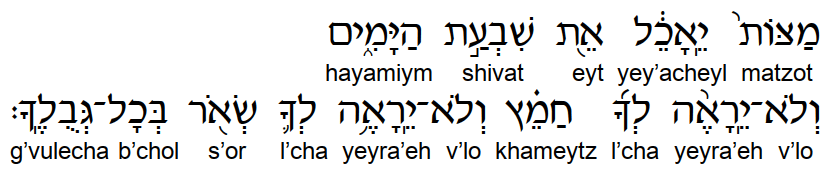
View whole verse and interlinear translation ...
By Shabbat, when our gums are really starting to appreciate all that crispy, crunchy matzah, some of us will be asking the question, "Just why are we doing all this anyway?" It's a good question and perhaps the Torah is being charitable when it puts the question in the mouths of our children rather than ourselves. Children are generally much more open than adults and will often - naïvely (or even, shhh!, provocatively) - ask questions that an adult knows that they shouldn't ask, even if they want to ask it - literally or rhetorically! Parents will keep a Pesach seder and follow all the many special regulations for the festival without necessarily understanding them or, in some cases, wanting to do them. A child will simply ask why - why are we doing all this? - putting into words the unspoken questions or emotions that the adults themselves feel but have suppressed: why on earth are we doing all this?
Let's start by defining some terms and understand exactly what is in view here. Strictly, שְׂאֹר is the leavened starter from which a new batch of leavened bread is made, while חַמֵץ is food to which some of the starter has been added. מַצָּה, plural מַצּוֹת, is unleavened bread, bread made from grains which can support the fermentation process - wheat, barley, emmer, rye and oats - but which has been made without adding any שְׂאֹר and quickly enough that natural fermentation cannot begin. In practice, the process of fermentation - from natural yeast in the air or possible yeast fragments in the flour - is possible to start from the moment water is added to flour, but eighteen minutes - the time taken by the more athletic of the rabbinic sages to walk from Migdal Nunia (the Fish Tower) to Tiberias (b. Pesachim 46a), a distance of some two thousand cubits - is the time it takes for there to be any visible 'rise'. Modern commercial matzah production - for mixing, kneading, rolling, perforating and baking - usually takes between five and eight minutes per matzah, but making matzah by hand is more consuming and can be tricky to complete in the allotted time!
Technically, this command repeats the first command given to eat matzah for seven days following the sacrifice and consumption of the Pesach offering: "In the first [month], from the fourteenth day of the month at evening, you shall eat unleavened bread until the twenty-first day of the month at evening" (Shemot 12:18). There, however, the context is that of the first Pesach, when Israel was in the process of leaving Egypt - it was happening in real time. Here, the command is given in the context of remembering that first Pesach in subsequent years: "when the L-RD has brought you into the land of the Canaanites, the Hittites, the Amorites, the Hivites, and the Jebusites, which He swore to your fathers to give you, a land flowing with milk and honey, you shall observe in this month the following practice" (13:5, Bible)NJPS)). As Walter Brueggemann comments, "the festival intends to keep Israel with a more difficult past."1
Now, less detail about specific days is given - that is assumed -
but the prohibition of khametz spreads from its eating to include its
possession: leaven and khametz are not to be seen anywhere in the
territory belonging to the people of Israel. The cantillation marks set the
closing phrase of the verse - בְּכָל־גְּבֻלֶךָ, in all your borders -
slightly apart from the immediately preceding repeated "none of this for you"
phrases, an indication that its scope addresses both of them. Translating
גְבֻלֶךָ as "your borders" pushes the prohibition to the physical
borders of contiguous Israel. This has distinct ramifications for those from
the nations, sojourning in Israel;
Who Is ...
Abraham Ibn Ezra: (1089-1167 CE), born in Tudela, Spain; died in the South of France after wandering all around the shores of the Mediterranean and England; a philosopher, astronomer, doctor, poet and linguist; wrote a Hebrew grammar and a commentary on the Bible
Ibn Ezra explains that "just
as 'the stranger' is prohibited from working on Shabbat if he wants to
live 'within your settlements' (20:10), so too even the stranger shall
not eat leaven on Passover in all G-d's territory." Taking the slightly wider
meaning of גְבֻלֶךָ as "your territories", it then addresses
wherever Jewish people own land, buildings or premises. Since Second Temple
times, this has been understood to cover all Jewish people, their houses,
lands and businesses, anywhere in the world: wherever they are living.
When Israel finally crossed the Jordan to start the conquest and
possession of the Land that HaShem had sworn to Avraham, Yitz'khak and
Ya'akov He would give to their descendants, they paused before beginning the
assault on Jericho. Tanakh tells us that "the people came up from
the Jordan on the tenth day of the first month, and encamped at Gilgal on the
eastern border of Jericho" (Joshua 4:19, NJPS). They had crossed
the Jordan on the tenth day of Aviv, the first month of the year - the day
when the lamb to be slaughtered as the Pesach sacrifice is chosen and
taken into the house - and were just four days away from celebrating the
festival of Pesach to remember their exodus from Egypt forty years
ago. But there was a problem: none of the male children born during the
wilderness journey had been circumcised. How were they - now the fighting
force of Israel - to celebrate the feast when the Torah is so clear:
"no uncircumcised person may eat of it" (Shemot 12:48, NJPS)?
The Name ...
HaShem: literally, Hebrew for 'The Name' - an allusion used to avoid pronouncing the Tetragrammaton, the so-called 'ineffable' name of G–d
HaShem tells Joshua to "make flint knives and circumcise
Israel" (Joshua 5:2). Joshua does what he is told - "Joshua had flint
knives made, and the Israelites were circumcised" (v. 3, NJPS) -
and then the people rest to heal before they move to take Jericho.
In the meantime, "Encamped at Gilgal, in the steppes of Jericho, the Israelites offered the Passover sacrifice on the fourteenth day of the month, toward evening" (Joshua 5:10, NJPS); they ate unleavened bread and fresh parched grain, the produce of the Land. This is the first celebration of Pesach for thirty eight years and the first time Pesach is celebrated in the Land! Then an amazing thing happened: "On that same day, when they ate of the produce of the land, the manna ceased" (v. 12). In fact, Israel was to eat from the yield of the Land for the whole year. HaShem ensured that, instead of Him providing manna each day, the Land itself produced enough food to feed the people while they took possession of the Land and settled in its cities as Nehemiah will later confess before HaShem: "they captured fortified cities and a rich land, and took possession of houses full of all good things, cisterns already hewn, vineyards, olive orchards and fruit trees in abundance. So they ate and were filled and became fat and delighted themselves in your great goodness" (Nehemiah 9:25, NJPS).
What lesson should we learn from that? That Israel had to be in the right spiritual state before HaShem - fully in covenant, having observed all the covenant signs and procedures - before they could undertake the possession of the Land. G-d's sworn gift it certainly was, an inheritance promised to the fathers for the generations of children to come, but they had to be in the right place before they could accept it and actualise His promises on their behalf. Sadly, Israel did not continue in that way; they turned away from the L-rd their G-d on many occasions, despite His mercy and grace reaching out to them and sending leaders and prophets who would call the people back to the L-rd for a short time. What kept going wrong? Assuming that the people were still circumcised, weren't they still in the covenant with HaShem?
HaShem gives Jeremiah the words to tackle the matter head-on: Israel may be physically circumcised, but that it not enough. HaShem tells them, "Circumcise yourselves to the L-RD; remove the foreskin of your hearts, O men of Judah and inhabitants of Jerusalem; lest My wrath go forth like fire, and burn with none to quench it, because of the evil of your deeds" (Jeremiah 4:4, ESV). This isn't new, something extra that was added, that He sneaked in while no-one was looking. Reminding the people that even though HaShem made the heavens and earth, He had still chosen the Israelites to be His people, Moshe told them, "Circumcise therefore the foreskin of your heart, and be no longer stubborn" (D'varim 10:10, ESV). Jeremiah rebukes the Israelites because they have become just like the uncircumcised nations around them: "all the house of Israel are uncircumcised in heart" (Jeremiah 9:26, ESV).
Centuries later, Rav Sha'ul will pick up the same theme as he chastises the Jewish disciples in Rome because they are trusting in circumcision and not living according to the Torah: "For no one is a Jew who is merely one outwardly, nor is circumcision outward and physical. But a Jew is one inwardly, and circumcision is a matter of the heart, by the Spirit, not by the letter" (Romans 2:28-29, ESV). He is even sharper in his criticism of the Galatians who are being pressured to become fully Jewish and be circumcised: "if you accept circumcision, Messiah will be of no advantage to you" (Galatians 5:2, ESV). Absolutely not, he warns them in no uncertain terms: "You are severed from Messiah, you who would be justified by the law; you have fallen away from grace" (v. 4, ESV). Circumcision of the heart happens when we know and are committed to following Yeshua.
Our question, as we observe the festival of Pesach and the week of matzah, is whether we are in the right place before HaShem to go forward in His plans and accept the inheritance that he has prepared for us. Are we trusting in tradition or heritage - Jew and Gentile both have them - or have we allowed Yeshua to circumcise our hearts so that we are open and available for Him? Are we open to the voice and movement of the Spirit as He draws us into the "good works, which G-d prepared beforehand, that we should walk in them" (Ephesians 2:10, ESV), all the while building us as living stones - "on the foundation of the apostles and prophets, Messiah Yeshua himself being the cornerstone" (v. 20, ESV) - into "a holy temple in the Lord ... a dwelling place for God" (vv. 21-22, ESV).
Chag Matzah Sameach!
1. - Walter Brueggemann, "Exodus", in The New Interpreter's Bible Commentary Vol I, edited by Leander E. Keck, (Nashville, TN: Abingdon Press, 2015), page 363.
Further Study: Psalm 78:2-6; Colossians 2:11-13; 1 Peter 3:3-6
Application: Has your heart been circumcised by Yeshua and are you walking with Him or are you trusting in some form of physical circumcision or observance to see you through? Cry out to Yeshua during the days of the feast and ask Him to circumcise your heart, to remove the build-up of fat that blocks your life in Him.
© Jonathan Allen, 2024
| Messianic Trust Home Page | Join Weekly Email | More Weekly Drashot |
| Last Week |
Support the work of producing this weekly commentary
|
Next Week |
| Last Year - 5783 | Scripture Index | Next Year - 5785 |
|
Your turn - what do you think of the ideas in this drash ? Like most print and online magazines, we reserve the right to edit or publish only those comments we feel are edifying in tone and content. |