

|
Pekudei (Ex 38:21 - 40:38) |

| Messianic Education Trust | ||||||
|
|
|
|
||||
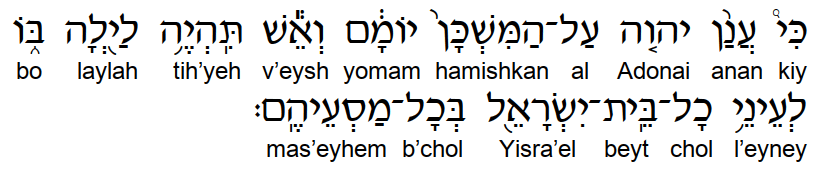
Shemot/Exodus 40:38 For the cloud of the L-rd [was] over the Tabernacle by day and fire was in it by night, before the eyes of the whole house of Israel in all their journeys.
View whole verse and interlinear translation ...
In the very last verse of Shemot, we read that the pillar of cloud and fire which has been with since their initial departure from Egypt, has settled over the Tabernacle. As Nahum Sarna writes, "The Book of Exodus, which opened with a tale of misery and oppression, closes upon an auspicious note. Israel is assured that, day and night, the Divine Spirit hovers over it, guiding and controlling its destiny." The previous two verses explain that when the cloud lifted, Israel would journey and when the cloud did not lift, Israel did not journey. All three verses use either infinitive or prefix verbs throughout, denoting ongoing, continual or repetitive action. This was - and, from the narrator's point of view, is - the rule. Here in our text, the first half of the verse is split in two: "the cloud עֲנַן was over the Tabernacle by day" and "fire אֵשׁ was in it [the cloud] by night". We can speculate that the fire was always in the pillar, but that during the day, the light rendered the cloud opaque so that the fire could not be seen, while at night with no external light, the cloud became transparent revealing the fire at its core. The whole house of Israel saw it, every moment of every day.
Perhaps the last two words in the verse point most clearly to the
sense of ongoing movement - בְּכָל־מַסְעֵיהֶם, in all their journeys
- the word 'journeys' comes form the root נָסַע. David Clines
suggests there are two homonyms in play here:1 the first meaning
"to pull up or pull out", is used particularly of tent pegs, "When you
gaze upon Zion, our city of assembly, your eyes shall behold Jerusalem as a
secure homestead, a tent not to be transported, whose pegs shall never be
pulled up, and none of whose ropes shall break" (Isaiah 33:20,
NJPS). The meaning Clines gives to the second - and, clearly,
strongly connected - homonym is "to travel, journey, move, go about"; the
meaning in our text. In order to travel, you have to break camp and pull up
the tent pegs. The journeys of
The Name ...
HaShem: literally, Hebrew for 'The Name' - an allusion used to avoid pronouncing the Tetragrammaton, the so-called 'ineffable' name of G–d
HaShem's people are always
ongoing, as He leads us on through the wilderness of this world towards our
final destination, "the city that has foundations, whose designer and
builder is G-d" (Hebrew 11:10, ESV). Life in the kingdom of G-d
is a never ending round of making and breaking camp, driving in and pulling
out tent pegs as we follow the pillar of fire and cloud.
Leon Kass explains that, "unlike the fixed palace of an earthly monarch, the portable Tent of Meeting moves as the L-rd directs. As He is not bound to a natural place or to a manufactured residence, so His dwelling place, like the people who built it, moves after Him. Moreover, unlike the so-called divinities of nature, He moves not in circles but towards a goal. The people who follow Him do likewise. Throughout all their journeys - and not only on their spatial journeys - they are blessed to be able to follow the path He leads them on. The end of Exodus invites us to accompany the Children of Israel on their future journeys - journeys still unfinished, and still following the L-rd."2 There is a purpose and a plan - His plan - and the certainty that, because He has promised, we shall safely arrive. Thomas Dozeman takes up the story: "The closing image of the presence of G-d is not of the stationary Glory of Yahweh in the cult, but of the divine cloud leading the Israelites in their wilderness march towards the promised land of Canaan. The cloud provides rhythm to the life journey of the Israelites. It determines when the people march and when they rest. It hovers over the Tabernacle by day, while at night the divine fire within it appears."3
Lest this sound endlessly disturbing and unstable, Terence Fretheim assures us that, "the dwelling of G-d is not a static, immobile, unchanging presence. There is movement with this G-d, a movement that signals the comings and goings of Israel. The people are now no longer subjected to a changeless system, to an increasingly dispirited bondage. They are followers of a G-d who is on the move, in whose service true freedom and joy are to be found."4 Our movement is dictated by His movement, as Peter Enns explains: "When G-d moves, the people move. When He stays put, so do they. It is, after all, G-d's plan and purpose that are being fulfilled. Israel's eventual arrival in the Promised Land will be solely by G-d's guidance and direction, by His will and in His time."5 Anything short of the Promised Land is a false destination; we dare not delay or prevaricate - the Master is calling!
Yeshua experienced that sense of movement while moving relentlessly towards His end goal. Matthew records His answer to a scribe who wanted to follow Him: "Foxes have holes, and birds of the air have nests, but the Son of Man has nowhere to lay His head" (Matthew 8:20, ESV). Although in the early part of His ministry, "when he returned to Capernaum after some days, it was reported that he was at home" (Mark 2:1, ESV and later "getting into a boat He crossed over and came to His own city" (Matthew 9:1, ESV), Yeshua would properly be described today as "of no fixed abode." He was always on the move, yet always heading in the same direction: "He went on His way through towns and villages, teaching and journeying toward Jerusalem" (Luke 13:22, ESV). When warned by some Pharisees to move on because Herod was trying to kill Him, He pointed to His larger calling: "I must go on my way today and tomorrow and the day following, for it cannot be that a prophet should perish away from Jerusalem" (v. 33, ESV).
It seems that the very natures of G-d and man are pulling in opposite directions here. Man is looking for stability, settledness and security, while by definition, G-d is always mobile. He instructs Nathan the prophet to tell David, "I have not lived in a house since the day I brought up the people of Israel from Egypt to this day, but I have been moving about in a tent for My dwelling" (2 Samuel 7:6, ESV). David wants to build a permanent house for G-d, but this is impossible: "Thus said the LORD: The heaven is My throne and the earth is My footstool: where could you build a house for Me, what place could serve as My abode?" (Isaiah 66:1, NJPS). In words that were misinterpreted to apply to Solomon, Nathan tells David: "When your days are fulfilled and you lie down with your fathers, I will raise up your offspring after you, who shall come from your body, and I will establish his kingdom. He shall build a house for My name, and I will establish the throne of his kingdom forever" (2 Samuel 7:12-13, ESV). No solely human kingdom could possibly be for ever, but these words point to Yeshua who fulfills Isaiah's words: "his name shall be called Wonderful Counselor, Mighty God, Everlasting Father, Prince of Peace. Of the increase of his government and of peace there will be no end, on the throne of David and over his kingdom, to establish it and to uphold it with justice and with righteousness from this time forth and forevermore" (Isaiah 9:6-7, ESV).
The very essence of G-d, His indwelling - first, physically among the Israelites in the desert in the Tabernacle, but now in the followers of Yeshua by His Spirit - makes this inevitable. Walter Brueggemann writes, "because of the presence, this community cannot stay centred in a place but must be on the move. This is a profound tension both in the character of G-d and in the destiny of Israel. G-d yearns to be in an available place for Israel, but this G-d is always on the move. Israel wants a safe place, but must be on the way, powered by a promise yet unfulfilled."6 He is always on the move, so a static house or building is never an appropriate expression of or location for His presence; He is to be found in the wilderness, always moving on and leading His people. This is the key to understanding Rav Sha'ul's modus operandi in Acts - constantly founding communities of believers and then moving on to the next town or city. Sha'ul is following the same pattern as Yeshua - "I am racing towards the finishing-point to win the prize of G-d's heavenly call in Messiah Yeshua" (Philippians 3:14, NJB). He understands what the house is all about: "we know that if the tent that is our earthly home is destroyed, we have a building from God, a house not made with hands, eternal in the heavens" (2 Corinthians 5:1, ESV). This is definitely not about bricks and mortar!
How are we to follow the cloud today? Dozeman comments: "Observing the festivals through the liturgical year is how the Israelites follow the cloud. It has the ability to lead them ahead in their journey to the promised land, while it is also able to bring them back to the Glory of Yahweh in the Tabernacle for rest and renewal in order to continue the journey."7 We are to find our way through the same means. The festivals tell us about Yeshua - who He is and what He has already done - while pointing us forward to His return. As we celebrate and rejoice, each week and and through the months, the appointed times of HaShem, we will be filled with the presence and power of Yeshua. It is that same presence of G-d who stirs or provokes us into movement. It does not go far to say that if we are not on the move, then we have lost sight of the pillar of cloud and fire - we have lost our way and His vision for our lives.
1. - David J. A. Clines (ed.) The Concise Dictionary of Classical Hebrew, (Sheffield: Sheffield Phoenix Press, 2009), page 276.
2. - Leon R. Kass, Founding G-d's Nation - Reading Exodus (New Haven, Yale University press, 2021), page 587.
3. - Thomas B. Dozeman, Exodus, Eerdmans Critical Commentaries, (Grand Rapids, MI: Eerdmanns, 2009), page 766.
4. - Terence E. Fretheim, Exodus, Interpretation, (Louisville, KY: Westminster John Knox Press, 2010), page 316.
5. - Peter Enns, Exodus, The NIV Application Commentary, (Grand Rapids, MI: Zondervan, 2000), page 599.
6. - Walter Brueggemann, "Exodus," in The New Interpreter's Bible Commentary Vol I, edited by Leander E. Keck, (Nashville, TN: Abingdon Press, 2015), page 505.
7. - Dozeman, page 766.
Further Study: Isaiah 57:14-15; 1 Corinthians 9:24-27; 2 Peter 1:12-14
Application: Are you on the move or have you fallen away and taken up static residence somewhere along the way? Have you fallen for the security of bricks and mortar, a building or fixed place of worship and fellowship with Yeshua? Hear afresh the call to put your trust in G-d's promises, to pull up your tent pegs and pick up the journey to which You have been called in Yeshua. You will find Him in the wilderness as the prophet said: "In the wilderness prepare the way of the L-RD; make straight in the desert a highway for our G-d" (Isaiah 40:3, ESV).
Buy your own copy of the Drash Book for Exodus/Shemot now at Amazon US or Amazon UK.
© Jonathan Allen, 2024
| Messianic Trust Home Page | Join Weekly Email | More Weekly Drashot |
| Last Week |
Support the work of producing this weekly commentary
|
Next Week |
| Last Year - 5783 | Scripture Index | Next Year - 5785 |
|
Your turn - what do you think of the ideas in this drash ? Like most print and online magazines, we reserve the right to edit or publish only those comments we feel are edifying in tone and content. |