

|
Mishpatim (Exodus 21:1 - 24:18) |

| Messianic Education Trust | ||||||
|
|
Living in Exile
|
|
||||
Shemot/Exodus 23:20 Behold! I am sending a messenger before you to guard you on the way and to bring you to the place that I have prepared.
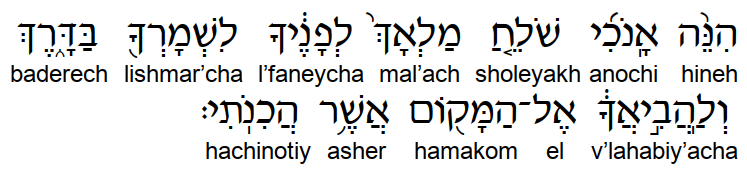
View whole verse and interlinear translation ...
Much ink has been used, both in ancient writing and in modern print,
discussing the identity and role of this figure,
The Name ...
HaShem: literally, Hebrew for 'The Name' - an allusion used to avoid pronouncing the Tetragrammaton, the so-called 'ineffable' name of G–d
HaShem's
מַלְאָךְ, mal'ach, messenger or angel. Coming from an
unused root לָאַךְ, la'ach, that Davidson
suggests should mean to send or to minister, it appears a number of times in
Tanakh - 213, to be precise, with another 81 occurrences in the Dead
Sea Scrolls - usually with a certain enigmatic quality. David Clines offers
'messenger' as the first meaning, followed by 'angel' or 'heavenly
messenger'.1 In some cases, the 'angel' role seems clear -
"The angel of the L-RD appeared to the woman and said to her, 'Behold, you
are barren and have not borne children, but you shall conceive and bear a
son'" (Judges 13:3, ESV) - where the angels appears to the mother
of Samson. In other places - "The oracle of the word of the LORD to
Israel by Malachi" (Malachi 1:1, ESV) - the human nature of "My
messenger" appears to be unmistakable. In all cases, as indeed in our text,
the 'sent' nature of the messenger is the essential quality; the messenger
speaks or acts with divine authority on behalf of HaShem who has
commissioned, equipped and sent His messenger.
Who is the messenger in our text? Is it a supernatural figure,
wielding immense authority, able to punish and forgive sin as the following
verses suggest; a figure that seems to be almost identical with HaShem
Himself? Or, as some commentators have tried to insist, is this an allusion
to Moshe himself, as HaShem tries to bolster his leadership authority with
the people of Israel? Umberto Cassuto notes that "in ancient
thought-processes the line of demarcation between the sender and the sent is
liable easily to be blurred; in the final analysis, the angel of G-d is
simply G-d's action."2 Rabbi
Who Is ...
Hirsch: Rabbi Samson Raphael Hirsch (1808-1888 CE), German rabbi, author and educator; staunch opponent of the Reform movement in Germany and one of the fathers of Orthodox Judaism
Hirsch tries to avoid
committing himself: "The term מַלְאָך does not necessarily imply
an individual, a human or superhuman creature, but may also be used for any
contrivance which G-d arranges for some special purpose.
It is clear, as Nahum Sarna reports, that "classical
Jewish commentators are divided on whether a heavenly or human messenger is
here intended by Hebrew מַלְאָך."
Who Is ...
Bekhor Shor: Joseph ben Isaac Bekhor Shor; a twelfth century French tosafist, commentator and poet; he lived in Orleans and was a pupil of the Rashbam and Rabbenu Tam; wrote a commentary to the Torah and made contributions to the Talmud commentaries; followed the p'shat method of interpretation in the style of Rashi, to the extent of rationalising many miracles
Bekhor Shor,
for example, says, "a messenger (as the word literally means), a prophet, not
a real angel" with
Who Is ...
Chizkuni: Rabbi Hezekiah ben Manoah (13th century), French rabbi and exegete; his commentary on the Torah was written about 1240 in memory of his father, based principally on Rashi, but using about 20 other sources
Chizkuni supplying the detail: "The
messenger-prophet referred to is Joshua." The
Who Is ...
Ramban: Rabbi Moshe ben Nachman Girondi or Nachmanides (born in Gerona, 1194; died in Israel 1270), Spanish rabbi, author and physician; defended Judaism in the Christian debates in Barcelona before making aliyah
Ramban, on the
other hand, says, "He is the 'redeeming angel' invoked by Ya'akov, 'the
angel who has redeemed me from all evil' (B'resheet 48:16, ESV),
of whom HaShem says 'My Name is in him' (Shemot 23:21, NJPS) -
'Trust in the L-RD for ever and ever, for in Yah the L-RD you have an
everlasting Rock' (Isaiah 26:4, ESV) - for it is the way of the
King to dwell in His house, though the text calls Him an angel."
What then are we to make of הַמָּקוֹם, ha'makom, the 'place' that HaShem has prepared? Sarna, explaining the consensus position, says, that this is "apparently, a reference to the land of Canaan, in which the Israelites will take possession of 'great and flourishing cities ... houses full of all good things ... hewn cisterns ... vineyards and olive groves', in the words of Devarim 6:10-11. Since Hebrew מָקוֹם frequently means 'sacred space', it is possible that this unusual designation of the land carries with it the idea of the Holy Land." Cassuto agrees, citing HaShem's words to Moshe at the Bush: "The sending of the angel will serve to guard you from all evil and to lead you on the way and to bring you, at the end of your journey on this road, to the place I have prepared for you: 'I have come down to rescue them from the Egyptians and to bring them out of that land to a good and spacious land, a land flowing with milk and honey, the region of the Canaanites, the Hittites, the Amorites, the Perizzites, the Hivites, and the Jebusites' (Shemot 3:8, ESV)."3
On the other hand, other commentators - here the Ramban takes the lead - have a very different idea: הַמָּקוֹם is none other than the Jerusalem Temple: "this is the temple - "You will bring them and plant them in Your own mountain, the place You made to dwell in, O L-RD, the sanctuary, O L-RD, which Your hands established" (Shemot 15:17, NJPS) - that is, 'the place I have made ready for Myself, to be My holy house; for there the Throne is complete.'" The site of the temple is set on Mt. Zion, which is also Mt. Moriah - and G-d's people will come to that place, come into spiritual alignment with the heavenly temple, when the earthly temple is built there. We can see the same idea at work in Rav Sha'ul's thinking when he talks about the Ruach building the new temple: "Do you not know that you are G-d's temple and that G-d's Spirit dwells in you?" (1 Corinthians 3:16). Peter, too, shares the same vision of those who are in Messiah: "you yourselves like living stones are being built up as a spiritual house" (1 Peter 2:5). We are becoming "the place" that G-d has prepared for Himself so that He can dwell among His people.
It is important to see our text in the context of the following
verses. Walter Brueggemann observes that "the 'angel' is a way of speaking
about G-d's own work on behalf of Israel. The angel is also the voice of the
G-d who commands and Israel must listen ... "Pay heed to him and obey him"
(Shemot 23:21, NJPS). Israel must obey - "if you obey him and
do all that I say" (v. 22) - because ... hearing is made the condition of
protection. The G-d who protects is the G-d who commands; there will be no
protection without obedience."4 When the angel appears to Joshua
outside Jericho - "I am the commander of the army of the L-RD. Now I have
come" (Joshua 5:14, ESV), as
Who Is ...
The Rashbam: Rabbi Samuel ben Asher (1085-1174 CE), a grandson of Rashi; lived in Northern France; worked from the plain meaning of the Hebrew text even when this contradicted established rabbinic interpretaton
Rashbam says, "to save
Israel" - Joshua responds by offering obedience, "What does my lord say to
his servant?" (v. 14, ESV) and, as commanded, takes of his sandals
as the presence of the angel make the place where he is standing holy ground.
Our text is also structured as an important announcement. Thomas Dozeman points out that "the opening section centers on the divine promise of a 'messenger'. The first person divine speech gives the divine promise immediacy. The particle הִנֵּה, hineh, 'see' is combined with the pronoun and participle, אָנֹכִי שֹׁלֵחַ, anochiy shole'ach, 'I am sending'. The same form is employed in other central divine predictions: the theophany to the Israelites ('See, I am coming to you in a dense cloud', Shemot 19:9) and the establishment of covenant ('See, I am making a covenant with you', 34:10)."5 Modern Hebrew uses the combination of a pronoun and a participle to form present tense verbs. We should hear these opening words as "Look! I am, right now, in real time, sending a messenger." It is as if HaShem wants to emphasise what He is doing: "I have already started, it is already happening and it will continue for ever to accomplish My purposes for you."
Now let's compare our text to another important announcement - one of several Yeshua made to His disciples in the context of His final Pesach seder on earth: "In My Father's house are many rooms. If it were not so, would I have told you that I go to prepare a place for you? And if I go and prepare a place for you, I will come again and will take you to Myself, that where I am you may be also. And you know the way to where I am going" (John 14:2-4, ESV). What tenses does Yeshua use for His verbs? In verse 2, the verb "I go" is present tense; I am going; in verse 3, "I will come again" is also present tense, while "I will take you" is future tense. "I am" and "you may be" are both present tense, as is "I am going" in verse 4. We hear a heavy emphasis on what is happening and what is going to be. Yeshua is clear that although He is - and this was about to happen for Him in the next 24 hours - going, He is coming again. The going away is a part, a necessary part, of the action of coming again, which is itself already under way. He is now, already, coming again. When His return is complete, which we know from other texts will be when He returns in glory with the Father's angels to rule in Jerusalem, He will then take us - that is, all those who have committed their lives to following Him - to be with Him, to actualise the reality which He has already promised and Rav Sha'ul echoes: G-d has "raised us up with Him and seated us with Him in the heavenly places" (Ephesians 2:6, ESV).
All exiles long for a homecoming, a return to our 'place', the place where we know we ought to be. For Jews living in the Diaspora, our hearts yearn even now, in this age - despite the difficulties of living there and adapting to the change of culture - to be in Eretz Yisrael, the lands of Israel. Believers in Yeshua - Jew and Gentile alike - have a longing to be with Yeshua, to see face-to-face the One we now see only "in a glass darkly" (1 Corinthians 13:12), but already know heart-to-heart. This is our homecoming and we must reinforce our hope regularly by reading about it and rehearsing it each day in our prayers: "Come soon Yeshua!" (Revelation 22:20). Our text - that HaShem has sent His messenger to bring His people to the place He has prepared for them - reminds us our Father has sent Yeshua to bring His people to the place He has prepared for us: beside Him, for ever! Like the Israelites, we must hear and obey the voice of His Spirit speaking through His word and in our hearts because the Saviour who saves is the Lord who commands; without obedience there is no salvation. Hear it, read it, believe it and rejoice in it - we are going home!
1. - David J. A. Clines (ed.) The Concise Dictionary of Classical Hebrew, (Sheffield: Sheffield Phoenix Press, 2009), page 222.
2. - Umberto Cassuto, A Commentary on the Book of Exodus, (Magnes Press, Jerusalem, 1983), page 305.
3. - Cassuto, page 306.
4. - Walter Brueggemann, "Exodus", in The New Interpreter's Bible Commentary Vol I, edited by Leander E. Keck, (Nashville, TN: Abingdon Press, 2015), page 436.
5. - Thomas B. Dozeman, Exodus, Eerdmans Critical Commentaries, (Grand Rapids, MI: Eerdmanns, 2009), page 557.
Further Study: Psalm 91:9-12; Matthew 25:34-36
Application: Take off your shoes for you too are standing on holy ground! Let the presence of Yeshua and the power of His Spirit stir up your hopes of homecoming so that we will all be ready to welcome Him and be with Him for ever.
Comment - 01:06 16Feb25 KCB: Loved This!
Buy your own copy of the Drash Book for Exodus/Shemot now at Amazon US or Amazon UK.
© Jonathan Allen, 2025
| Messianic Trust Home Page | Join Weekly Email | More Weekly Drashot |
| Last Week |
Support the work of producing this weekly commentary
|
Next Week |
| Last Year - 5784 | Scripture Index | Next Year - 5786 |
|
Your turn - what do you think of the ideas in this drash ? Like most print and online magazines, we reserve the right to edit or publish only those comments we feel are edifying in tone and content. |