

|
Mishpatim (Exodus 21:1 - 24:18) |

| Messianic Education Trust | ||||||
|
|
|
|
||||
Shemot/Exodus 24:3 And all the people responded - one voice - and they said, "All the words that the L-rd has spoken, we will do."
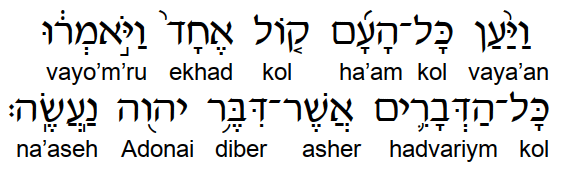
View whole verse and interlinear translation ...
The wider context for our text is that of ratifying the covenant
just given by
The Name ...
HaShem: literally, Hebrew for 'The Name' - an allusion used to avoid pronouncing the Tetragrammaton, the so-called 'ineffable' name of G–d
HaShem at Mt. Sinai. While the people have
already indicated their full agreement to the covenant, whatever it might
contain - "All the people answered as one, saying, 'All that the L-RD has
spoken we will do!'" (Shemot 19:8, NJPS) - that was before the
Sinai theophany and words. It was certainly before the much longer and
detailed set of commandments that arrived in the following three chapters!
Now Moshe is vitally involved in making sure that the people are still in
agreement with the covenant terms and commitments. To secure the covenant,
for both sides to be able to hold the other responsible for meeting their
obligations, HaShem is looking for informed consent; both sides must know
what they have signed up to do and willingly agree - not under duress - to do
it. On the one hand, Walter Brueggemann reports that "Moshe is now
preoccupied with binding Israel in fidelity to the rule of G-d, There is
nothing here of 'presence', but only of sovereign will."1 On the
other hand, Everett Fox writes, "This is no imposing of laws by a dictator,
but a freely accepted agreement cemented by blood, the signifier of life
itself."2
Our text opens with the verb וַיַּעַן the Qal 3ms
prefix form of the root עָנָה, to answer or respond, here with
a vav-conversive signifying past tense narrative: "and he responded".
Its subject - the next two words, כָּל־הָעָם, all the people - is
a corporate or collective singular, representing the whole of the Israelite
people.
Who Is ...
Abraham Ibn Ezra: (1089-1167 CE), born in Tudela, Spain; died in the South of France after wandering all around the shores of the Mediterranean and England; a philosopher, astronomer, doctor, poet and linguist; wrote a Hebrew grammar and a commentary on the Bible
Ibn Ezra explains that "the language suggests that they
responded 'as if they were a single man.'" A modern commentator,
Gunther Plaut, says simply 'unanimously'. This technique - of
using a singular verb with what is obviously a
plural-but-expressed-as-singular subject - is well known within biblical
Hebrew as a way of showing that something was done together although actually
done by a definitely more than singular group. Often, as here, the next verb
switches to a plural expression to show how the individual people are
involved in the action. After responding as one man, with a single voice,
the verb וַיֹּאמְרוּ - the Qal 3mp form of the root
אָמַר, to say, with a vav-conversive, is rendered as
"and they said" rather than staying with the singular expression. The people
can respond together, but if you had heard them, you would have heard the
many voices of different pitches and tones, styles and accents that made up
the Jewish people. They spoke as one, using the same words as each other,
but articulated those words in their own timbre.
We can see another example of this technique in the story of the battle between Elijah and the priests of Ba'al at Mt. Carmel in 1 Kings 18. At the climax to the story, after calling for his sacrifice and wood to be drenched in water three times, Elijah prays to HaShem and calls down fire from heaven to consume his sacrifice. Then, as the text tells us, "fire from the L-RD descended and consumed the burnt offering, the wood, the stones, and the earth; and it licked up the water that was in the trench" (1 Kings 18:38, NJPS). Amazing: a palpable miracle, a tangible sign of G-d; not in fact, so very different in that way from Mt. Sinai. The text now reports how the people responded: "When they saw this, all the people flung themselves on their faces and cried out: 'The LORD alone is God, The LORD alone is God!'" (v. 39, NJPS).
Lost in translation is that the Hebrew text starts, וַיַּרְא כָּל־הָעָם, just like our text, only with the singular verb וַיַּרְא "and he saw". All the people on Mt. Carmel, without exception, as one man, saw the fire fall from heaven. The verb וַיִּפְּלוּ is plural - "and they fell" - to show us that while some hit the ground immediately, some had a touch of gout or arthritis so took a little longer to get down. Others, on the other hand were openly reluctant, looked around to see if they could possibly avoid it and only crouched in a token sort of way. Finally, the same verb of acclamation, וַיֹּאמְרוּ, "and they said" is also plural reflecting the multiplicity of tones, pitches and regional accents that would have been heard as the people shouted.
While often less obvious in the Apostolic Writings, the same thing can be seen when Pilate tries to release Yeshua. "Pilate then called together the chief priests and the rulers and the people" (Luke 23:13, ESV) and attempts to reason with them to let him release an innocent man. But, Luke reports, "they all cried out together, 'Away with this man, and release to us Barabbas'" (v. 18, ESV). While the verb "they cried out" are is plural, Luke uses the adverb pamplhqei., all together, to stress their unity: many voices, but all shouting in unison for Yeshua to be crucified.
Returning to our text, Umberto Cassuto comments that "[the people] accepted, by solemn declaration, all the ordinances, instructions and admonitions that they had heard from Moshe."3 Yes, we will do it. Leon Kass is equally positive: "all the people, in one voice and without hesitation, agree to do as they have been commanded."4 Yes, we will really do it. And this is not for the first time, as Peter Enns observes: "Now for a second time, the people respond in almost the exact same words of utter enthusiasm as before."5 Everything, really everything! The enthusiasm and commitment of the people is absolute: they swear full allegiance; "Israel swears to obey everything G-d has said, even that which Moshe may yet tell them."6 The people are united, speaking with one voice - although that is who they are, they have become more than just the Children of Israel, they sense a calling and a purpose as a people group - as a nation, even - under the hand of G-d. Israel is forming a new identity that is bound up in and defined by what G-d has said, in the behaviour He has specified, in the life to which they are called as a witness to the existence and character of G-d.
Yeshua calls us to be committed to Him in the same way. He forms in us a new identity that is bound up in and defined by His words to us. He tells the disciples, "If you love Me, you will keep My commandments" (John 14:15, ESV), setting obedience to His word as the key way in which we demonstrate and work out our relationship with Him. To the scribe who offered to follow Him wherever He went, Yeshua said, "Foxes have holes, and birds of the air have nests, but the Son of Man has nowhere to lay His head" (Matthew 8:20, ESV), challenging assumptions about lifestyle and indicating the cost of being a disciple. Yeshua consistently modelled the life of witness to the kingdom of G-d: He healed, taught, blessed and rebuked, at almost every hour of the day and night, staying up all night to pray, coping with the crowds and constant lack of privacy. He demonstrated a deep love and compassion not only for His disciples but also for those who came to Him for help and advice, telling His followers, "just as I have loved you, you also are to love one another" (John 13:34, ESV), because that is how everyone else will know we are His disciples - that is our witness.
When we first turned to Yeshua, we made a profession of faith and a commitment to follow Him. Although we were very enthusiastic, like the ancient Israelites it was a rather open-ended commitment, since we had little idea of exactly what walking with Yeshua would really entail or require. But in the same way that Moshe read the words of the covenant over again to the people and kept asking them whether they were sure they knew what they were doing - working for informed consent - the Spirit has been at work in our lives, explaining more about who Yeshua is, how we follow Him, the costs and benefits involved, guarding us around and all the while building informed consent so that we continue to say "We will do everything that Yeshua says" and walk in His ways. We too live in the tension between G-d's will - "those whom He foreknew He also predestined to be conformed to the image of His Son, in order that He might be the firstborn among many brothers" (Romans 8:29, ESV) - and human choice: "Strive to enter through the narrow door. For many, I tell you, will seek to enter and will not be able" (Luke 13:24, ESV).
Every day we are called on to make that choice afresh, to re-affirm our commitment to Yeshua. We are invited to respond - one voice - and confirm that we are still on the 'bus and are still following the One who has the words of eternal life. Some days we'll have more enthusiasm than others; some days, metaphorically speaking, we'll have been serving the kingdom all day and then been up half the night. But the question is always before us as the Spirit gently corrals us and encourages us to speak up - even in the weakest of whispers - that everything Yeshua says we will do. Are you up for that today?
1. - Walter Brueggemann, "Exodus", in The New Interpreter's Bible Commentary Vol I, edited by Leander E. Keck, (Nashville, TN: Abingdon Press, 2015), page 439.
2. - Everett Fox, The Five Books of Moses The Schocken Bible Vol 1, (New York, NY: Schocken Books, 1995), page 388.
3. - Umberto Cassuto, A Commentary on the Book of Exodus, (Magnes Press, Jerusalem, 1983), page 311.
4. - Leon R. Kass, Founding G-d's Nation - Reading Exodus (New Have, Yale University Press, 2021), page 433.
5. - Peter Enns, Exodus, The NIV Application Commentary, (Grand Rapids, MI: Zondervan, 2000), page 489.
6. - Brueggemann, ibid.
Further Study: John 14:23-24; Philippians 3:12-15; 1 Timothy 6:12-16
Application: When did you last look Yeshua square in the eye and tell Him that you are still all sold out for Him? He wants to hear you say that with all your heart, to affirm the covenant between you and to be secure is His grip, knowing that nothing can take you out of His hand.
Comment - 14:40 05Feb24 Caz Jones: Super and encouraging drash. Thank you!
Buy your own copy of the Drash Book for Exodus/Shemot now at Amazon US or Amazon UK.
© Jonathan Allen, 2024
| Messianic Trust Home Page | Join Weekly Email | More Weekly Drashot |
| Last Week |
Support the work of producing this weekly commentary
|
Next Week |
| Last Year - 5783 | Scripture Index | Next Year - 5785 |
|
Your turn - what do you think of the ideas in this drash ? Like most print and online magazines, we reserve the right to edit or publish only those comments we feel are edifying in tone and content. |