

|
Mattot/Masa'ei (Num 30:2(1) - 36:13) |

| Messianic Education Trust | ||||||
|
|
Living in Exile
|
|
||||
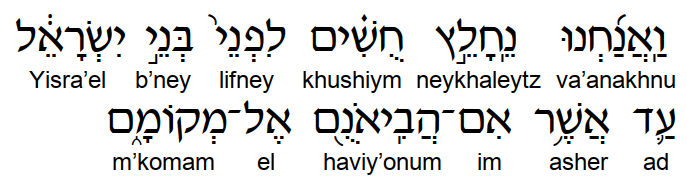
B'Midbar/Numbers 32:17 And we will arm ourselves swiftly before the Children of Israel until we have brought them to their place
View whole verse and interlinear translation ...
Reuben and Gad, tribes who owned large numbers of cattle, saw the territory of Sihon and Og, the two Amorite kings east of the Jordan, and thought it would be a natural fit for their livestock programs. They perceived it as a G-d-given opportunity and put their idea to Moshe, Eleazar and and the other tribal chiefs: "the land that the LORD has conquered for the community of Israel is cattle country, and your servants have cattle" (B'Midbar 32:4, NJPS). "What do you think," they asked, "can we have it?" We can guess how horrified they were about the way their request was interpreted and immediately rushed to correct the misapprehension under which they felt that Moshe and the others were labouring. "No, no, you don't understand," they might have begun, "we will do just enough work here to make this territory safe for our families and animals, before coming with the rest of you to secure your inheritance on the west of the Jordan and won't come back here to settle down until that is done."
Beginning with the Hebrew text, we can see that the verse starts
with וַאֲנַחְנוּ, the 1cp subject pronoun, 'we'. Strictly not
necessary because the action verbs both already contain their subject
pronouns, this should be read as "and we ourselves": an emphatic introduction
that governs the whole text. Far from a scheme to avoid having to go into
the land and fight, as Moshe seemed to suggest, Reuben and Gad want to stress
that they will put their own lives on the line to stand and fight alongside
the other tribes. Indeed, as
Who Is ...
Rashi: Rabbi Shlomo Yitzchaki (1040-1105 CE), French rabbi who wrote commentaries on the Torah, the Prophets and the Talmud, lived in Troyes where he founded a yeshiva in 1067; focuses on the plain meaning (p'shat) of the text, although sometimes quite cryptic in his brevity
comments
Rashi comments, they will go at
the head of the invading armies. Jacob Milgrom points out
that "without their families and possessions, they have greater mobility than
the other tribes and can therefore undertake commando assignments." They can
therefore go first as the vanguard to lead the other tribes.
Who Is ...
Chizkuni: Rabbi Hezekiah ben Manoah (13th century), French rabbi and exegete; his commentary on the Torah was written about 1240 in memory of his father, based principally on Rashi, but using about 20 other sources
Chizkuni agrees: "Since the two tribes would leave their
families and flocks behind on the east side of the Jordan, they would be able
to travel more speedily to the battle-front than the other tribes and advance
in front of them."
The next two words in the text, נֵחָלֵץ חֻשִׁים, the
Nif'al 1cp prefix form of the root חָלַץ and the
Qal mp passive participle from the root חוּשׁ, have been
translated in a number of ways. The NJPS offers "we will hasten as
shock-troops", while the NIV suggests "we are ready to arm ourselves
and go"; the ESV goes for "we will take up arms, ready to go" and
the CJB paraphrases slightly to produce "we will be armed and ready for
action to march". Rabbi
Who Is ...
Hirsch: Rabbi Samson Raphael Hirsch (1808-1888 CE), German rabbi, author and educator; staunch opponent of the Reform movement in Germany and one of the fathers of Orthodox Judaism
Hirsch reports that the root
חלץ has the idea of pushing, as if against resistance,
towards a goal or objective. Modern Hebrew uses the word
חָלוּצִים to name pioneers: those who scout ahead of the main
party - carve out a new trail, engage in the first skirmishes, map the
territory, break ground - before bringing the rest of the people into the
territory. We see this in the final words of our text,
הֲבִיאֹנֻם אֶל־מְקוֹמָם, we will bring them to their place.
הֲבִיאֹנֻם, the Hifil affix voice of בּוֹא,
literally "we have caused them to come", is prefaced by עַד,
'until', marking both the purpose and the end-point of the pioneering
project. Reuben and Gad are not fighting alongside or in front of the other
tribes just for the sake of fellowship; their objective is see them settled
in their inheritance west of the Jordan as they themselves are settled on the
east.
A little later, in his address to the Israelites on the plains of Moab, Moshe will remind these tribes of the pledge: "The L-RD your G-d has given you this land to possess. All your men of valor shall cross over armed before your brothers, the people of Israel" (D'varim 3:18, ESV), and the Israelite historian records that as the people crossed the Jordan, "The Reubenites, the Gadites, and the half-tribe of Manasseh went across armed in the van of the Israelites, as Moshe had charged them" (Joshua 4:12, NJPS). Just as they had promised, they did. Looking at the account of the conquest of Jericho - "the seven priests bearing the seven ram's horns marched in front of the Ark of the L-RD, blowing the horns as they marched. The vanguard marched in front of them, and the rear guard marched behind the Ark of the L-RD, with the horns sounding all the time" (6:13, NJPS) - Drazin and Wagner observe that 'vanguard' here "refers to the tribes of Reuben and Gad." They kept their word; they honoured their commitment.
We need to look back in the surrounding words to our text to understand an important part of the pledge that Reuben and Gad made. They preface the promise to lead the fight on the west of the Jordan with "We will build here sheepfolds for our flocks and towns for our children" (B'Midbar 32:16, NJPS) and follow it with "while our children stay in the fortified towns because of the inhabitants of the land" (v. 17, NJPS). Reuben and Gad are not proposing to just abandon or walk out on their families and children; they - and Moshe and the other leaders would understand this full well - are in potentially hostile territory from which the Israelites have only just displaced the Amorites. They cannot leave their families at the mercy of other surrounding tribes or people groups who, sensing the vacuum and the potential weakness of the women, children and older people totally occupied in looking after "cattle in very great numbers" (v. 1, NJPS), might sweep in and seize the lot. The Reubenites and Gadites need to be sensible and responsible; Rashi comments "our children will dwell - while we are with our brothers - in the fortified cities that we will build now."
When Elijah was sent to select Elisha to train as his successor, he found him ploughing with twelve yoke of oxen. Elijah threw his mantle over him, but running after him Elisha said, "Let me kiss my father and mother good-by, and I will follow you" (1 Kings 19:20, NJPS). "Go ahead," Elijah replied; "I can wait." So Elisha "took the yoke of oxen and slaughtered them; he boiled their meat with the gear of the oxen and gave it to the people, and they ate. Then he arose and followed Elijah and became his attendant" (v. 21, NJPS). There were important things that Elisha had to do before he walked away from his parents and disappeared from their lives. Nevertheless, he did not shrink from obeying Elijah's call to ministry. Elijah himself had been given a list of things to do by HaShem at the close of his ministry: "anoint Hazael as king of Aram. Also anoint Jehu son of Nimshi as king of Israel, and anoint Elisha son of Shaphat of Abel-meholah to succeed you as prophet" (vv. 15-16, NJPS). It was his job to get Elisha ready to be HaShem's prophet in Israel before he was taken up to heaven by the fiery chariot and horses.
Our season in exile has the same urgency as the pledge of Reuben and Gad and Elijah's commission. We are charged to dwell here - in exile - while we labour to make a way for others to move forward into the kingdom. Sometimes, our job looks like evangelism, telling the stories of Yeshua and introducing Him to people so that He can invite them to become His disciples like us; at other times, we encourage our fellow exiles by reminding them about the promises of home, of our citizenship in heaven and of the enduring presence of Yeshua - by His Spirit - dwelling within us. At still other times, we are called to challenge those whose love for Yeshua has grown cold, or those who have become trapped in the institutional church so that they no longer talk about home or expect to get there, by singing the songs of the kingdom so that the Spirit may re-ignite the spark of life in their hearts. This is the role of pioneers in exile: that we ourselves should be armed and go ahead until we have brought them to their place.
Here's the point: while it is imperative that we take care of those for whom we are responsible and make sensible provision for their continued growth and well-being, the land will not be taken unless we get out of our fortified cities and pioneer, fully armed and leading the way into enemy territory. Out of our comfort zones, engaging with others of little or no faith, bringing the good news of the kingdom, each of us is called to blaze a trail and, guided by the Spirit, to help others to find their rightful place in Yeshua, calling them to follow in our footsteps as we follow Him. Rav Sha'ul put it this way: "Take me as your pattern, just as I take Messiah for mine" (1 Corinthians 11:1, NJB). Often we will work together, aligning ourselves with those others who are on the same journey or in the same mission: "Brothers, join in imitating me and keep your eyes on those who walk according to the example you have in us" (Philippians 3:17, ESV). Often it will be just us - the Spirit and me - cutting a path through the undergrowth, beckoning to those behind us and calling others to join us in the light.
It is easy, as exiles away from home and feeling isolated in the culture around us, to focus entirely on holding the ground we have, keeping the wagons in a tight circle and not letting anyone expose themselves to live ammunition fire. But G-d has given us His armour so that we may do more than simply exist, but break out of the restraints the enemy tries to impose upon us, to reach others and to see the kingdom of G-d growing and flourishing in these days. As exiles we are uniquely placed: knowing the truth and being already equipped to share and proclaim it so that the whole world may know. We are in that unique place for a purpose: to join the heavens in witnessing clearly to the greatness of G-d, to share His love and His word with all those who ask and to offer to introduce Yeshua to everyone He brings into our path - swiftly and soon!
Further Study: Ephesians 5:1-2
Application: Where are you today? Are you always busy with family, little ones and the sheep or are you armed with the armour of G-d, pushing back the boundaries of the kingdom, pioneering to cut new ground and bring the people around you into their place in Yeshua?
Comment - '10:02 26Jul25' Kelila Hunter: Just to say, again the relevance of our lives today co-exist with the lives of those who have gone before us. You always make the words of The Torah come alive.
Buy your own copy of the Drash Book for Numbers/B'Midbar now at Amazon US or Amazon UK.
© Jonathan Allen, 2025
| Messianic Trust Home Page | Join Weekly Email | More Weekly Drashot |
| Last Week |
Support the work of producing this weekly commentary
|
Next Week |
| Last Year - 5784 | Scripture Index | Next Year - 5786 |
|
Your turn - what do you think of the ideas in this drash ? Like most print and online magazines, we reserve the right to edit or publish only those comments we feel are edifying in tone and content. |