

|
Korah (Num 16:1 - 18:23) |

| Messianic Education Trust | ||||||
|
|
|
|
||||
B'Midbar/Numbers 18:29 From all your gifts you shall offer the whole gift of the L-rd: from all its fat, the holy part of it.
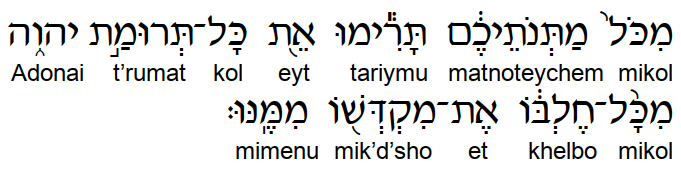
View whole verse and interlinear translation ...
Our text falls in the middle of the block of verses (B'Midbar 18:8 to the end of the chapter) dealing with the disposition of the various categories of gifts and sacrifices brought to the sanctuary. Verses 8-20 speak to the offerings, first-fruits and first-born gifts - these belong to the priests. Verses 21-32 address the annual first tithe that Israel brings to the sanctuary: these are given to the Levites "as their share in return for the services that they perform" (B'Midbar 18:21, NJPS). Essentially, this covers two things: wages for the work that the Levites do and compensation for having no land inheritance with Israel in the Land - they were allocated just forty-eight villages, six of which were the cities of refuge, throughout the Land. As income, therefore, just as Israel gave a tithe to the Levites, the Levites are commanded: "set aside a gift for the L-RD from all the tithes that you receive from the Israelites; and from them you shall bring the gift for the L-RD to Aharon the priest" (v. 28, NJPS).
Our text also provides the solution to a critical issue: the
sanctity of the tithe and therefore where it can be consumed, in what state
of ritual purity and by whom. When the tithe is given, the Torah uses
the phrase, "I have given to the Levites the tithes that the sons of
Israel offer as a gift to the L-rd" (v. 24). The verb
'offer' - יָרִימוּ, the Hif'il 3mp prefix form of the
root רוּם, "to be high or lifted up"1 - and the
noun 'gift' - תְּרוּמָה, a feminine abstract noun from the same
root, "offering, contribution"2 - are both official cult words.
By being brought and given to
The Name ...
HaShem: literally, Hebrew for 'The Name' - an allusion used to avoid pronouncing the Tetragrammaton, the so-called 'ineffable' name of G–d
HaShem in response to His
command, the profane becomes holy, the produce of the threshing floor and the
wine vat become holy things. "All tithes from the land, whether seed from
the ground or fruit from the tree, are the L-RD's; they are holy to the L-RD"
(Vayikra 27:30, NJPS). These can only be consumed by people who
are both themselves holy and ritually clean, in a holy place: priests in the
Temple. That isn't much use for the Levites who although set apart, were not
consecrated to the same level of holiness as the priests and needed the tithe
to feed their wives and families back home in their cites and villages all
over Israel.
However, we can see the same words being used again in our verse: תָּרִימוּ, here the Hif'il 2mp prefix form of the root רוּם and תְּרוּמָת, the feminine abstract noun from the same root, now in construct form. By this second act of tithing, the Levites 'offer' their 'gift' to the priests and desacralise3 the nine-tenths of the original Israelite tithe that they then keep. The holy has become profane; the holy things have once more resumed the status of the produce of the threshing floor and the wine vat, so that "you and your households may eat it anywhere" (B'Midbar 18:31, NJPS). It is again wages for work done and may be bought and sold, eaten by anyone at any time, whether ritually clean or unclean. Until the Levitical tithe is removed, the whole Israelite tithe is holy because it was given not to the Levites but to HaShem. It contains - as its 'fat' or best part - the holy portion that belongs to HaShem and will be given to the priests. This is like the memorial portion of the grain offerings - the fist-full of flour and all the incense - that the priests burn on the altar. HaShem, in turn, gives the rest of the grain offering to the priests and gives the balance of the Israelite tithe to the Levites.
The Apostolic Writings also address the need for the community of believers to support leaders, preachers and teachers in their work of spreading the gospel and taking the role of shepherds in the kingdom of G-d. Yeshua demonstrated this when He sent out his disciples to proclaim the good news. Matthew reports that He told them, "Acquire no gold nor silver nor copper for your belts, no bag for your journey, nor two tunics nor sandals nor a staff, for the laborer deserves his food" (Matthew 10:9-10, ESV). Yeshua tells the disciples not to take their own resources, but to rely upon people in the community: they are working for the kingdom and they will be paid by the kingdom. In Luke's account, Yeshua is more specific; board and lodging will be provided in each place they go: "Remain in the same house, eating and drinking what they provide, for the laborer deserves his wages" (Luke 10:7, ESV). Dennis Olson comments, "Yeshua sends them out without any money so that they might be dependent on the offering of hospitality from the towns they visit."4 This is as important for the people of the towns as villages as it is for the disciples.
Rav Sha'ul makes quite a defence of the need for the community to support its leaders and teachers in his letter to the Corinthians. Asking, "Who plants a vineyard without eating any of its fruit? Or who tends a flock without getting some of the milk?" (1 Corinthians 9:7, ESV), he specifically refers to the Levites and the priests when he explains that "those who are employed in the temple service get their food from the temple, and those who serve at the altar share in the sacrificial offerings" (v. 13, ESV), before declaring that "in the same way, the Lord commanded that those who proclaim the gospel should get their living by the gospel" (v. 14, ESV). This may be a reference to Yeshua's words from the gospels (above) or it may be a more specific logion (saying) of Yeshua to His disciples that Sha'ul learned from them in Jerusalem, but the principle is clear enough. Olson explains: "The special calling of priests and proclaimers of the gospel entails living in profound trust in G-d's providential case and working in diligent obedience to the call and will of G-d. The community of faith, in turn, is likewise called to diligent support of those who lead and guide the community in its life of worship and service."5
Can you see what is going on here? In the same way that Israel, the Levites and the priests are bound together in the covenant that G-d made with His people, so the wider Body of Messiah, their ministers and teachers are also bound together in the covenant that G-d has made with His people. Just as Israel received benefit from the work of the Levites, serving and facilitating to keep the temple service in safe operation on behalf of all the people, and - via the tithe, at G-d's hand - paid them the due wages for their work, so believers today receive benefit from the evangelists, pastors, teachers and others working for the gospel in their midst and further afield and must give them their wages for that work so that they too can feed their families, pay their bills and keep a roof over their heads.
We need to understand that there is a mutuality at work here that enables all the parts of HaShem's people to fulfil their calling together. Israel - the non-Levite tribes - needed to support the Levites as part of their covenant obligation before HaShem; if they failed to do so, then both they and the Levites suffered because neither were keeping the covenant correctly. In just the same way, the Body of Messiah needs to support their ministers, workers and teachers as part of their covenant obligation in Yeshua; if they fail to do so then both groups suffer because neither are able to carry out the work of the kingdom as God intends. This is a duty that should be undertaken seriously but joyfully, rejoicing in the freedom that we have to bless others and to participate in the work of the kingdom both locally and remotely in a way that we might not otherwise be able to do. Those who receive are released from the twin difficulties of being permanently under-resourced and having to ask others to meet their needs by fund-raising.
Attitude is also important. Although our text doesn't mention attitude directly, it is clear that the Levitical tithe is to come from the 'fat', the best parts of the produce. This implies two things: firstly, that the act of tithing is to be intentional rather than haphazard; it must be done as soon as the produce arrives, before the best is taken or consumed by the Levites, and it must be taken out or separated so that it is not damaged or neglected. Secondly, it indicates that care and choice must be exercised in the selection; it must be done willingly - to bless HaShem and to honour the priests - and to select the produce that will be a blessing to the recipients: putting others before self. Rav Sha'ul speaks to exactly these issues in his letters to the early congregations of disciples. He tells the community in Philippi, about the need to share the blessings of the kingdom: "Let each of you look not only to his own interests, but also to the interests of others" (Philippians 2:4, ESV.
Finally, in the same way as the Levites desacralised the Israelite tithe by offering their tithe in turn to the priests via HaShem, those who are supported in ministry by the gifts of others - be that financial or in kind - must remember to play their part in the kingdom economy by joyfully and deliberately giving a proportion of their support to yet others in the work of the kingdom. This pleases our Father, of whose resources we are all only stewards, and gives much opportunity to bless the name of Yeshua.
1. - David J. A. Clines (ed.) The Concise Dictionary of Classical Hebrew, (Sheffield: Sheffield Phoenix Press, 2009), page 416.
2. - Clines, 495.
3. - desacralise - to remove the religious or sacred status or significance from something. Oxford Dictionary of English.
4. - Dennis T. Olson, Numbers, Interpretation, (Louisville, KY: Westminster John Knox Press, 2012), page 116.
5. - Olson, 117.
Further Study: Isaiah 55:10-12; Hosea 10:12; 2 Corinthians 9:10-12; 1 Timothy 5:17-18
Application: How could you empower or enable the work of the kingdom to grow by blessing others with a gift - regular, occasional or unexpected - from the blessings you have received? Ask the Master whether He has someone or some situation in mind right now and rejoice with them that the Father has provided for both.
Buy your own copy of the Drash Book for Numbers/B'Midbar now at Amazon US or Amazon UK.
© Jonathan Allen, 2024
| Messianic Trust Home Page | Join Weekly Email | More Weekly Drashot |
| Last Week |
Support the work of producing this weekly commentary
|
Next Week |
| Last Year - 5783 | Scripture Index | Next Year - 5785 |
|
Your turn - what do you think of the ideas in this drash ? Like most print and online magazines, we reserve the right to edit or publish only those comments we feel are edifying in tone and content. |