

|
Ki Tissa (Ex 30:11 - 34:35) |

| Messianic Education Trust | ||||||
|
|
Always Being ready
|
|
||||
Shemot/Exodus 32:11 And Moshe sought the face of the L-rd his G-d and he said, "Why, O L-rd, should your anger burn against your people ..."
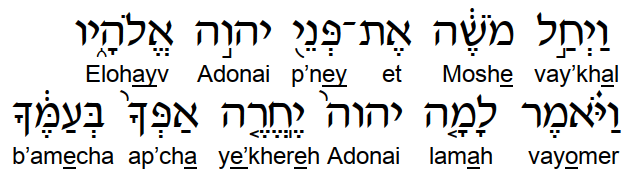
View whole verse and interlinear translation ...
Does
The Name ...
HaShem: literally, Hebrew for 'The Name' - an allusion used to avoid pronouncing the Tetragrammaton, the so-called 'ineffable' name of G–d
HaShem change His mind? No, of course not;
from which ever tradition we come, we have been schooled that He would never
do such a thing. In the Hebrew Scriptures, Bil'am told King Balak of Moab
that, "G-d is not man to be capricious, or mortal to change His mind.
Would He speak and not act, promise and not fulfill?" (B'Midbar 23:19,
NJPS), and the prophet echoes: "For I the LORD do not change;
therefore you, O children of Jacob, are not consumed" (Malachi 3:6,
ESV). The Apostolic Writings follow suit, with the apostle James
telling us that "Every good gift and every perfect gift is from above,
coming down from the Father of lights with whom there is no variation or
shadow due to change" (James 1:17, ESV), while the writer to the
Hebrews reminds us that "Yeshua the Messiah is the same yesterday and
today and forever" (Hebrews 13:8, ESV). HaShem's consistency and
constancy are essential qualities of His character on which we depend. Yet,
on this occasion, it seems that He is prepared to change His mind: HaShem
declares that He will destroy the people (Shemot 32:10); Moshe
intercedes (v. 11); and HaShem relents (v. 14).
Our text comes from Mt. Sinai, where Moshe has just been told that - in his absence, while he was up the mountain with HaShem - the Israelites have made a molten image of a calf and offered worship to it: rank idolatry! HaShem commands Moshe, "Now, let Me be, that My anger may blaze forth against them and that I may destroy them, and make of you a great nation" (Shemot 32:10, NJPS). Since this section started (in verse 7), Moshe has not said a word although his face may well have been distinctly mobile as he comprehends what HaShem is saying! HaShem announces His intention to destroy the Israelites completely, preserving only Moshe from whom He will start again. Umberto Cassuto writes that "Moshe, however (the greatness of the faithful shepherd is seen here in all its glory), does not retreat before the L-rd's burning anger, but, as soon as he is able to utter a word, he endeavours to shield his people."1 Leon Kass pats Moshe on the back: "To his great credit, Moshe rises to the occasion. Refusing to do as he is told, Moshe treats the L-rd's order to leave Him alone as an invitation to do the opposite and he immediately takes up the people's defence."2
How did Moshe dare to challenge HaShem in this? Cassuto again: "In
HaShem's words 'Let Me alone' Moshe discerns that also in the L-rd's mind
there is an element of doubt, as it were, and that even in the moment of His
anger G-d feels love for His people, and hints, so to speak, that there is
still a possibility not to let His anger continue to burn."3
Moshe had not even begun to pray for the people, yet when HaShem said: 'Leave
Me alone', that gave Moshe an opening and informed him that the matter
depended on him. If he prayed for them, He would not destroy them. On the
other hand, the
Who Is ...
Ramban: Rabbi Moshe ben Nachman Girondi or Nachmanides (born in Gerona, 1194; died in Israel 1270), Spanish rabbi, author and physician; defended Judaism in the Christian debates in Barcelona before making aliyah
Ramban suggests that Moshe's response is more
instinctive than reasoned: "When HaShem said, 'Let Me be, that My anger may
blaze ...' (v. 10), Moshe responded immediately, fearing that, if he did not,
the plague would break out at once. Terence Fretheim comments that "the
boldness of [Moshe's] reply indicates something of the nature of the
relationship between G-d and Moshe. G-d has so entered into this
relationship that such dialogue is invited, indeed welcomed: G-d is not
the only one who has something important to say."4
What exactly is there in Moshe's words that causes HaShem to recant?
We can see that Moshe reflects HaShem's own language about "burning anger"
back to Him.
Who Is ...
Rashi: Rabbi Shlomo Yitzchaki (1040-1105 CE), French rabbi who wrote commentaries on the Torah, the Prophets and the Talmud, lived in Troyes where he founded a yeshiva in 1067; focuses on the plain meaning (p'shat) of the text, although sometimes quite cryptic in his brevity
Rashi proposes that HaShem's anger is irrational:
"Why should your anger burn? Is a wise man jealous of any but a wise man? A
strong man of [any but] a strong man?" Israel was at that time neither wise
nor strong! The Midrash would have Moshe reply, "They are your
people. You cannot disown them. Make Your peace with them, for they are Your
children" (Shemot Rabbah 46:4), while the
Who Is ...
Isaac Arama: Rabbi Isaac ben Moshe Arama (c. 1420-1494 CE); Spanish rabbi and author; at first the principal of a rabbinic academy, then a community rabbi and preacher, finally head of a Talmudic academy. He left Spain in the explusion of 1492 and settled in Naples until his death. Author of "Akedat Yitzkhak", a lengthy philosophical commentary on the Torah, and other commentaries
Akedat Yitzkhak
applies logic: "You are just, O L-rd, in not having given vent to your anger
as yet. Henceforth, too, you have no justification in so doing." That is,
having controlled Your anger until now - as HaShem must have been aware of
what was going on in the camp for some time - there can be no reason to lose
that control at this point. Rabbi Hirsch asks a different question, taking
"why?" to mean "for what purpose?". He admits that "the reason for the anger
here was quite clear. But Moshe asked to be shown what purpose is to be
achieved by it." What would HaShem's anger really accomplish?
Pointing to the means of delivery rather than the words, the Talmud reports that "Rabbi Eliezer the Great says: the verb וַיְחַל teaches that Moshe stood in prayer before the Holy One, blessed be He, until he was was seized by achilu. What is achilu? Rabbi Elazar said: fire of the bones. And what is fire of the bones?" (b. Berachot 32a). Moshe prays with such fervency that he starts to show physical distress. Aviva Zornberg explains that, "וַיְחַל is decoded to register a fiery intensity that affects Moshe's very bones: he becomes 'ill with prayer.' This intimate fever is Moshe's response to the fever of G-d's anger. The fire in Moshe's bones proclaims his humanity, his sense of identity with his people."5 Thomas Dozeman points out that "when combined with reference to the divine face (panim) the phrase indicates persuasive prayer."6
Returning to our initial question, we still need to determine whether HaShem changed His mind. The Psalmist writes, "Therefore He said He would destroy them -- had not Moshe, His chosen one, stood in the breach before Him, to turn away His wrath from destroying them" (Psalm 106:23, ESV). The prophet Amos is shown a series of three visions in which HaShem threatens the well-being of His people. After the first, a plague of locusts to destroy the crops, and the second, a great drought to burn up the fields, the prophet intercedes - "Oh, L-rd G-D, refrain! How will Jacob survive? He is so small" (Amos 7:5, NJPS) - and HaShem relents: "The L-RD relented concerning this. 'It shall not come to pass,' said the L-RD" (v. 3, NJPS). Only after the third vision, when HaShem makes it clear - "I am going to apply a plumb line to My people Israel; I will pardon them no more" (v. 8, NJPS) - that He will not relent from judgement, does Amos not intercede again. We can see here that HaShem shows the visions of destruction as a means of provoking the prophet to pray and to intercede for the people.
On that basis, it seems reasonable to conclude that HaShem's expression of anger against the people involved in the sin of the calf was also a foil, generated to see how Moshe would respond. If so, then - although the words might seem to indicate otherwise - HaShem did not change His mind. He expressed an intention against which Moshe immediately pushed back, arguing that such an action would be inconsistent with HaShem's previous promises and declarations. Accepting the argument, "the L-RD relented from the disaster that He had spoken of bringing on His people" (Shemot 32:14, ESV). He had only spoken of it, but had never made up His mind to it, in the same way as Amos's first two visions show worked examples rather than firm committed intent. Interestingly, Gunther Plaut tells us that "verses 11-14 form part of the traditional Torah reading for the afternoon of Tisha B'Av (along with Shemot 34:1-10). Since the words of Moshe saved his people in ancient times, they were considered especially suited for the urgent petitions of later generations."
However, Scripture shows a consistent record of HaShem's people interceding for others. Avraham interceded for the people of Sodom, bargaining HaShem down from fifty to ten righteous people to save the city; HaShem concedes, "I will not destroy, for the sake of the ten" (B'resheet 18:32, NJPS). Jeremiah reminds HaShem how he has interceded for his adversaries: "Remember how I stood before You to speak good for them, to turn away Your wrath from them" (Jeremiah 18:20, ESV). Yeshua prayed for those who crucified Him, "Father, forgive them, for they know not what they do" (Luke 23:34, ESV) as does Stephen when he is being stoned: "Lord, do not hold this sin against them" (Acts 7:60, ESV). It would seem that this is a basic requirement of kingdom life. Yeshua told His followers to "Love your enemies and pray for those who persecute you" (Matthew 5:44, ESV), while Rav Sha'ul told Timothy, "I urge that supplications, prayers, intercessions, and thanksgivings be made for all people, for kings and all who are in high positions, that we may lead a peaceful and quiet life, godly and dignified in every way" (1 Timothy 2:1-2, ESV). The writer to the Hebrews uses Yeshua as our example - "He always lives to make intercession" (Hebrews 7:25, ESV) - we should be like Him.
What, then do you do when you see others behaving badly, speaking foolishly or acting aggressively - whether that is a direct threat to you or not? Heaven knows it is happening all around us and the world media seems to delight in bring ever more of it to our door every day. Do you criticise them or pray for them? Do you judge them or intercede for them that G-d may have mercy on them? Do you ask Yeshua to soften their hearts so that they might repent and be like the men of Nineveh: "Who knows? G-d may turn and relent and turn from his fierce anger, so that we may not perish" (Jonah 3:9, ESV)? We must always be ready to intercede for others - whether prophetically, scripturally or physically seen - and, like Moshe, to be serious about our engagement in that intercession for that is part of call of the kingdom on our lives in Yeshua!
1. - Umberto Cassuto, A Commentary on the Book of Exodus, (Magnes Press, Jerusalem, 1983), page 415.
2. - Leon R. Kass, Founding G-d's Nation - Reading Exodus (New Haven, Yale University Press, 2021), page 538. FootNotetext(3) Cassuto, ibid.
4. - Terence E. Fretheim, Exodus, Interpretation, (Louisville, KY: Westminster John Knox Press, 2010), page 285.
5. - Aviva Zornberg, The Particulars of Rapture: Reflections on Exodus, (New York, NY: Doubleday, 2001), page 417.
6. - Thomas B. Dozeman, Exodus, Eerdmans Critical Commentaries, (Grand Rapids, MI: Eerdmanns, 2009), page 706.
Further Study: Joel 2:12-16; 1 Peter 3:8-12
Application: Recognise that Mordechai's challenge to Esther applies to you today - "Who knows whether you have not come to the kingdom for such a time as this?" (Esther 4:14, ESV) - as the Spirit places you in situations and among people so that you can pray and intercede for them. Yeshua is inviting you into dialogue with Him about His world and you too have something important to say!
Buy your own copy of the Drash Book for Exodus/Shemot now at Amazon US or Amazon UK.
© Jonathan Allen, 2025
| Messianic Trust Home Page | Join Weekly Email | More Weekly Drashot |
| Last Week |
Support the work of producing this weekly commentary
|
Next Week |
| Last Year - 5785 | Scripture Index |
|
Your turn - what do you think of the ideas in this drash ? Like most print and online magazines, we reserve the right to edit or publish only those comments we feel are edifying in tone and content. |