

|
Ki Tetze (Deut 21:10-25:19) |

| Messianic Education Trust | ||||||
|
|
Always Being Ready
|
|
||||
D'varim/Deuteronomy 24:29 When you harvest your harvest in your field and you forget a sheaf in the field, you shall not return to take it; it is for the stranger, the orphan and the widow
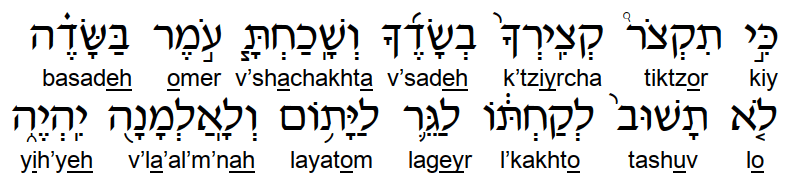
View whole verse and interlinear translation ...
Our text starts a little block of three commands covering cereals, olives and grapes. In all three cases, the farmer is forbidden from going back to make sure that none of the crop is lost but, instead, that it is to be left for the stranger, the orphan and the widow. This is not new legislation; it has already been given in Vayikra, 19:9-10 and 23:22, but is being restated here for the entry generation as they are the first generation of Israelites who will actually be able to put it into practice on their own land in Eretz Yisra'el, the land of Israel. These commands are different from the connected verses, "When you enter another man's vineyard, you may eat as many grapes as you want, until you are full, but you must not put any in your vessel. When you enter another man's field of standing grain, you may pluck ears with your hand; but you must not put a sickle to your neighbour's grain" (Dvarim 23:25-26, NJPS), which grant the right to glean, because they mandate an obligation to give.
Much ink has been spilled by the rabbinic commentators, debating
exactly where the lines of these stipulations are drawn. For example, the
Tosefta says that "two distinct bundles are the forgotten sheaf; three
bundles are not, because we assume that they contain such a large amount of
produce that the householder could not forget them" (t. Peah 3:5).
Not so, claims the Mishnah, which reports that "the House of Shammai
say, 'Three measures of produce left in a field might have been forgotten and
so belong to the poor, while four measures were certainly not forgotten and
so belong to the householder'" (m. Peah 6:5).
What Is ...
Sifrei: An early composite midrash/commentary on B'Midbar and D'varim; probably composed around the time of the Mishna (200CE); known and referenced in the Talmud; the B'Midbar portion from the school of R. Simeon, the D'varim portion from that of R. Akiva
Sifrei changes the words slightly and says that "A
sheaf, but not a stack of sheaves. Two sheaves may be considered forgotten,
but three may not" (Sifrei 283). That's all before we start thinking
about exactly what a 'sheaf' is!
We can see in our text - particularly the first phrase (the first
line of the text as presented above) - the predominance of 'you':
תִקְצֹר, the Qal 2ms prefix form of the root
קצר, "to harvest, reap, gather",1you
will harvest; קְצִירְךָ, the ms noun from the same root, "harvest
season, crop",2 with a 2ms possessive pronoun, your
harvest; בְשָׂדֶךָ, the ms noun "portion of ground, field,
cultivated ground",3 with the same 2ms possessive pronoun,
your field. Rabbi
Who Is ...
Hirsch: Rabbi Samson Raphael Hirsch (1808-1888 CE), German rabbi, author and educator; staunch opponent of the Reform movement in Germany and one of the fathers of Orthodox Judaism
Hirsch comments, "You are standing now
on your own soil, here Nature has worked for you, you have worked and
cultivated it, yours is the blessed result which you are about to garner with
your own strength or that of those in your service. It is just this proud
feeling of ownership that must admonished by your duty to give
tz'dakah from your fields for those who have no land of their own."
From this we can see something of the motivation for this command.
Citing the Psalmist, "He gives food to all flesh" (Psalm 136:25), the
Who Is ...
Gersonides: Rabbi Levi ben Gershom, Gersonides or Ralbag (1288-1344 CE); famous rabbi, philosopher, mathematician and astronomer/astrologer; born at Bagnols in Languedock, France; wrote a commentary on the Torah and a parallel to Maimonides' Guide For The Perplexed
Ralbag says that "He has made you an instrument by which He
feeds the poor." But is this enough? Does this really explain why this
command is here? Jeffrey Tigay suggests that "what was
forgotten should be left for the alien, the orphan and the widow. This will
enable them to harvest some crops for themselves, thereby sparing them the
indignity of appealing to others for a handout." Yes, yes, that's true and,
of course, it plays some part in the reasoning:
The Name ...
HaShem: literally, Hebrew for 'The Name' - an allusion used to avoid pronouncing the Tetragrammaton, the so-called 'ineffable' name of G–d
HaShem wants
to allow the poor to retain some dignity and self-esteem. But have we really
got to the bottom of this yet? Why aren't the verses granting permission to
glean enough?
Who Is ...
Nechama Leibowitz: (1905-1997 CE), born in Riga, graduate of the University of Berlin, made aliyah in 1931; professor at Tel Aviv University; taught Torah for over 50 years
Nechama Leibowitz explains that "the precept is
not specifically aimed at benefiting the poor, but rather at educating the
man of means. There is no better example of generosity that the one who
gives to the poor without knowing to whom he gives it and without the
recipient knowing from whom it comes."
The last few words of our text - לַגֵּר לַיָּתוֹם וְלָאַלְמָנָה יִהְיֶה, literally: "to the stranger, to the orphan and to the widow it (referring to the forgotten sheaf) shall be" - give us the clue. Christopher Wright explains that "'to the alien ... it shall be' is an expression normally used to indicate ownership. The sense is therefore, 'Do not pick the forgotten sheaf, the remaining olives and grapes, they belong to the alien, orphan and widow.' The remainder of the harvest is theirs; they have every right to do the final harvesting themselves."4 Gordon McConville adds: "The underlying idea is that all members of the covenant society have rights, in principle, to a share in the blessings of the land, which is ultimately Yahweh's gift to the people as a whole"5 rather than simply to some individuals. So much so indeed that taking the gleanings - such as going back to pick up the sheaf that was forgotten - is classed as theft: "He who withholds what is due to the poor affronts his Maker; He who shows pity for the needy honours Him" (Proverbs 14:31, NJPS).
We can see that this means, as Gunther Plaut points out, that "G-d 'personally' demands justice for the disadvantaged, who thus ground their claim in more than human charity." It is not that the poor depend on the farmers leaving, or forgetting, a portion of the harvest in the field to be gleaned - that would be precarious indeed; rather it is that they depend upon HaShem for their provision and He has commanded the community do it this way: "... a way of providing some assistance for the poor that enabled them to share in both the workload of harvest and in its rejoicing and fruits. The community was ultimately seen as the single entity that could prosper as a whole, but in which even the least fortunate were to participate."6 By doing their own 'harvest', gleaning the left-over or forgotten grain, olives and grapes, the poor join in the labour of the ingathering, are entitled to own what they have harvested and - as they have shared in the process of labour - can share in the blessing of the Land's richness and bounty.
It seems, then, that there is an obligation placed on those who have or generate wealth to share it with the poor. Yeshua told the rich young ruler who asked Him about eternal life, "If you would be perfect, go, sell what you possess and give to the poor, and you will have treasure in heaven; and come, follow me" (Matthew 19:21, ESV). What, all of it? In his particular case, that appears to be exactly what Yeshua said: sell everything and give it all away, then join Me on the journey. Knowing Yeshua is worth more than life itself! In Shir HaShirim Rabbah 8:7 the narrator records Rabbi Yoḥanan walking with Rabbi Ḥiyya bar Abba from Tiberias to Tzippori, during which they pass an agricultural estate, a vineyard and an olive grove. Rabbi Yoḥanan tells his student that these were his inheritance from his parents, all of which in turn he sold to fund his study. Rabbi Yoḥanan felt that possession of the Torah was worth much more than physical wealth and riches.
Reporting what happened in the first Yeshua-following congregations in Jerusalem, Luke tells us that "all who believed were together and had all things in common. And they were selling their possessions and belongings and distributing the proceeds to all, as any had need" (Acts 2:44-45, ESV). As well as practical community welfare, this was a powerful witness that gained favour with all the people, so that "the Lord added to their number day by day those who were being saved" (v. 47, ESV). Nevertheless, this is not a sustainable situation for the kingdom of G-d. When all the disciples have sold of their possessions, their land and their businesses and divested themselves of all their ability to earn money and generate wealth, who will have the resources and be able to meet the needs of the community?
Rav Sha'ul provides some important limits and guidelines for the community, saying, "If anyone is not willing to work, let him not eat. For we hear that some among you walk in idleness, not busy at work, but busybodies. Now such persons we command and encourage in the Lord Yeshua the Messiah to do their work quietly and to earn their own living" (2 Thessalonians 3:10-12, ESV). Unless unable to work - discerning between those who cannot and those who will not - or specifically called into supported ministry within the community such as teaching or shepherding, those who can work and support themselves and others should do so. This include both those who earn by their own labour and those who operate businesses and generate wealth.
Without denying the more occasional one-off cases who are called to give up everything, Yeshua Himself provides a more general application for the rest of us: "When you give to the needy, do not let your left hand know what your right hand is doing, so that your giving may be in secret" (Matthew 6:3-4, ESV). What does He mean? Firstly, and the move obvious from the immediate context, He means do not give in a public way so that others see what you are doing and praise you; instead, give quietly, discretely, covertly, so that just Father G-d knows what you are doing. Secondly, but just as importantly, He means that our giving should where possible be indirect so that the recipient does not know where their gift has come from. This can be taken one more stage on by giving in a way that the donor does not know where their gift is going. This last will require the involvement of a third-party, an intermediary who knows both the giver and the recipient but preserves the integrity of both. And, as Sha'ul wrote, "each one must give as he has decided in his heart, not reluctantly or under compulsion, for G-d loves a cheerful giver" (2 Corinthians 9:7, ESV); this should be a joy and not a burdensome obligation. We should always be ready to give and leave for the poor.
1. - David J. A. Clines (ed.) The Concise Dictionary of Classical Hebrew, (Sheffield: Sheffield Phoenix Press, 2009), page 400.
2. - Clines, page 399.
3. - Clines, page 434.
4. - Christopher J. H. Wright, Deuteronomy (Grand Rapids, MI: Baker, 2012), page 261.
5. - J. G. McConville, Deuteronomy, Apollos Old Testament Commentary, (Leicester, Apollos, 2002), page 364.
6. - Ronald E. Clements, "Deuteronomy" in The New Interpreter's Bible Commentary Vol I, edited by Leander E. Keck, (Nashville, TN: Abingdon Press, 2015), page 1005.
Further Study: Shemot 25:1-9; 2 Corinthians 9:10-12; 1 Timothy 6:17-19
Application: Where do you draw the line on giving to the poor? Do you feel the need to assess whether the gift is needed before you give, or do you allow the Spirit to point you at people and causes where kingdom funds are required? Are you always ready to share some of the abundance that you have been given to help others?
Buy your own copy of the Drash Book for Deuteronomy/D'varim now at Amazon US or Amazon UK.
© Jonathan Allen, 2026
| Messianic Trust Home Page | Join Weekly Email | More Weekly Drashot |
| Last Week |
Support the work of producing this weekly commentary
|
Next Week |
| Last Year - 5785 | Scripture Index |
|
Your turn - what do you think of the ideas in this drash ? Like most print and online magazines, we reserve the right to edit or publish only those comments we feel are edifying in tone and content. |