

|
Ki Tetze (Deut 21:10-25:19) |

| Messianic Education Trust | ||||||
|
|
Living in Exile
|
|
||||
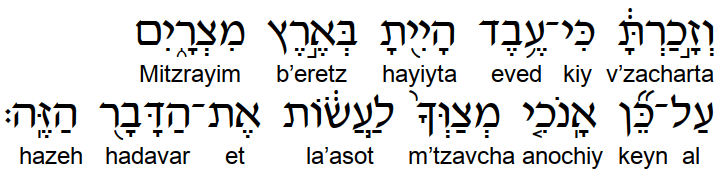
D'varim/Deuteronomy 24:22 And you shall remember that you were a slave in the land of Egypt; therefore I am commanding you to do this thing.
View whole verse and interlinear translation ...
Coming as the closing verse of a short section (D'varim 24:17-22) that deals with the duty to protect the strangers, the orphans and the widows - which in those days would have been many - our text provides the motivation for providing a social welfare net for the disadvantaged and disenfranchised in Israelite society: you have been there, you know how it feels. Jeffrey Tigay reports that "concern for the welfare of resident aliens, the fatherless and widows is a recurrent theme in the Bible. Their economic and social disadvantages exposed them to exploitation." Israel is not to take advantage of the poor, as was frequently done in the surrounding cultures, but is instead to provide for them through a series of both direct and indirect measures that allow them to live and function in society with a modicum of dignity, rather than being totally dependent on hand-outs and concessions. They are to be guaranteed a fair hearing in court without discrimination, positive or negative, equal to any citizen of the land, rich or poor; they are to be allowed to glean from the fields, trees and vineyards - which the citizenry must not pick bare - so working and labouring just like any other member of society; and - elsewhere, several times - they are to be invited to, and provided for at, the feasts and festivals (16:11) with the second tithe being set apart for them every three years (14:28-29).
The first word of our text, וְזָכַרְתָּ, the Qal
2ms affix form of the root זכר with a vav-reversive,
to remember, occurs in this exact configuration only eight times in
Tanakh; seven of them are in D'varim, five of them in an almost
identical phrase to our text: "And you shall remember that you were slaves in
Egypt ..." (Even-Shoshan). The root זכר is
used 15 times in D'varim, in a combination of affix, infinitive,
imperative and prefix forms.1 The significance of the affix
vav-reversive combination is that while the imperative form is a
command that needs to be actioned, the affix form is already a completed
action to be performed in the future. The memory itself is complete, it is
to be recalled in parallel with the accompanying charitable action, whenever
the acts of benevolence are performed. This mirrors the actions of
The Name ...
HaShem: literally, Hebrew for 'The Name' - an allusion used to avoid pronouncing the Tetragrammaton, the so-called 'ineffable' name of G–d
HaShem Himself, who "upholds the cause of the fatherless
and the widow, and befriends the stranger, providing him with food and
clothing. You too must befriend the stranger, for you were strangers in the
land of Egypt" (10:18-19, NJPS).
But perhaps - important though social and national history may be -
perhaps we can hear an echo of identity at work in our text and the other
almost identical instructions to remember (see, for example, 5:15, 15:15 and
24:18). Israel is commanded not only to remember the poor, but in doing so,
to remember themselves, who they are. The classical Jewish commentators were
not blind to this; the
Who Is ...
Sforno: Rabbi Ovadiah Sforno (1470-1550 CE), Italian rabbi, philosopher and physician; born in Cesena, he went to Rome to study medicine; left in 1525 and after some years of travel, settled in Bologna where he founded a yeshiva which he conducted until his death
Sforno reminds Jewish people that "in
Egypt you also needed gleanings at harvest time."
Who Is ...
Ramban: Rabbi Moshe ben Nachman Girondi or Nachmanides (born in Gerona, 1194; died in Israel 1270), Spanish rabbi, author and physician; defended Judaism in the Christian debates in Barcelona before making aliyah
Nachmanides,
Who Is ...
Abraham Ibn Ezra: (1089-1167 CE), born in Tudela, Spain; died in the South of France after wandering all around the shores of the Mediterranean and England; a philosopher, astronomer, doctor, poet and linguist; wrote a Hebrew grammar and a commentary on the Bible
Ibn Ezra and
Who Is ...
Chizkuni: Rabbi Hezekiah ben Manoah (13th century), French rabbi and exegete; his commentary on the Torah was written about 1240 in memory of his father, based principally on Rashi, but using about 20 other sources
Chizkuni explain that the Israelites
were once slaves who needed help, therefore they should treat strangers with
compassion. Tigay points out that "Israel's experience of
slavery should lead to empathy not only with slaves, whose experience is
identical to theirs, but with all the disadvantaged." We remind ourselves
about this every year at Pesach when we all say together, "Once we
were slaves, but now we are free." That freedom is priceless, but part of
valuing our freedom is also to remember that we were once slaves.
Yosef Yerushalmi tells us that "only in Israel and nowhere else is the injunction to remember felt as a religious imperative to an entire people."2 We are told to "Remember the days of old, consider the years of ages past; ask your father, he will inform you, your elders, they will tell you" (32:7, NJPS), but Yerushalmi suggests that actually this has little to do with curiosity about the past: "Israel is told only that it must be a kingdom of priests and a holy people; nowhere is it suggested that it become a nation of historians." This is because the important things to remember are the times when HaShem intervenes in our world and how we respond to them. Memory was created, carried and preserved through ritual and recital: performing commemorative acts and telling the story. The modern Israeli state has crafted a national identity in precisely that way: Masada, the Bar Kokhba revolt and the battle of Tel Ḥai were major turning points that were used by the Zionist movement "to shape its collective identity in relation to the past as well as Jewish society outside Palestine."3
The rabbis say,"Do not lord it over the poor"
(
What Is ...
Sifrei: An early composite midrash/commentary on B'Midbar and D'varim; probably composed around the time of the Mishna (200CE); known and referenced in the Talmud; the B'Midbar portion from the school of R. Simeon, the D'varim portion from that of R. Akiva
Sifrei 284) and point to the Mishnah where the
sages say, "One who does not allow the poor freely to collect gleanings, or
if he allows one but not another, or if he assists one of them, is robbing
the poor" (m. Peah 5:6). The Mishnah likens that to one who
removes the landmark - the produce - of the poor, a word-play on "Do not
remove the ancient boundary stone" (Proverbs 22:28, NJPS). Moving
boundary stones - forbidden by the Torah: "You shall not move your
countryman's landmarks, set up by previous generations" (D'varim 19:14,
NJPS) - destroys the physical memory of an ancestral land
inheritance; that in turn erases the identity of a piece of land and the
identity of its owner. Part of the identity of the poor is their right to
glean, and part of the identity of the farmer is the duty to provide for the
poor by leaving crops that can be gleaned. That is who they both are. By
denying gleaning or interfering in how it is done, the land-owner steals the
identity of the poor, forgetting that he himself was once poor when we were
in Egypt.
It is because we remember who we were that we are compelled to respond in a positive way to those who are less fortunate than ourselves in these days. It is the memory of where we came from that enables us to calibrate our response, our charity, our words, against being a slave rather than being a reasonably well-off or at least comfortable citizen of western society. We know - or, more correctly, we collectively remember - what being a slave is like, so that those who are in a similar position can be met with compassion and understanding, rather than being dismissed or disrespected by those who have no idea at all what that is like. Our current position as exiles, whether geographically or socially dislocated, should evoke sympathy for all those who find the demands and expectations of modern society difficult, uncomfortable or impossible - as we do ourselves at times. Our origins and our memory of them provide perspective to see the challenges that others face - in the same position as ourselves, strangers and exiles in an increasingly strange land - and reach out to them in a positive way, offering good news, hope and comfort as needed. That is our mission: "How beautiful upon the mountains are the feet of him who brings good news, who publishes peace, who brings good news of happiness, who publishes salvation, who says to Zion, 'Your G-d reigns'" (Isaiah 52:7, ESV).
While in Messiah we are "a new creation" (2 Corinthians 5:17), Rav Sha'ul wants to make sure that Yeshua's disciples don't lose sight of where they came from. In what today we might think of as his curriculum vitae (or résumé), he claims that he is "circumcised on the eighth day, of the people of Israel, of the tribe of Benjamin, a Hebrew of Hebrews; as to the law, a Pharisee; as to zeal, a persecutor of the church; as to righteousness under the law, blameless" (Philippians 3:5-6, ESV). Although in the next breath he says, "whatever gain I had, I counted as loss for the sake of Messiah" (v. 7, ESV), he never forgets any of those attributes - good or bad - and constantly uses them in his argumentation and proclamation of the good news. In the middle of all that intense, vibrant Jewish life, Yeshua met him on the Damascus road and turned his life upside down: He called him to be a disciple, to follow the one he had been persecuting. Yeshua made him an exile among his own people and every one of those attributes, skills and experiences are utilised to the full for Sha'ul's new calling as the apostle to the Gentiles. It is precisely the memory of all that he was and all that he did that makes Sha'ul so powerful and effective in his preaching and teaching, as Yeshua told Ananias: "[Sha'ul] is a chosen instrument of mine to carry My name before the Gentiles and kings and the children of Israel" (Acts 9:15, ESV). He is a glorious example of Solomon's proverb: "Do you see a man skillful in his work? He will stand before kings; he will not stand before obscure men" (Proverbs 22:29, ESV).
Now, here's the point. We have all come from a place of being at odds with our Maker - "G-d, being rich in mercy, because of the great love with which He loved us, even when we were dead in our trespasses, made us alive together with Messiah" (Ephesians 2:4-5, ESV) - and we must never forget it. Although we are now saints, filled with the Ruach and given "confidence to enter the holy places by the blood of Yeshua" (Hebrews 10:19, ESV), it is precisely our past experiences before knowing Yeshua that provoke us to empathise with the lost sheep - as we were - all around us. It is because we are exiles that we recognise those others who are searching or troubled, those whose heart Yeshua is stirring. Out of that empathy, fired by the Spirit and the passion of hearing G-d's heart, we are uniquely called and equipped to reach out, to come alongside, to comfort and challenge the other wanderers still looking to start their journey with Yeshua, those hungry folk clustered around the wicket gate, who need to choose the narrow way that leads to life (Matthew 7:14).
Further Study: Matthew 7:13-14; Romans 5:8 1 Corinthians 6:19-20
Application: Can you remember how much you needed to find Yeshua before He reached out and touched you? Let that memory provoke you to find others who look just like you did and help them to get their questions answered and start their journey with Yeshua today.
1. - George V. Wigram, The Englishman's Hebrew Concordance of the Old Testament, (Peabody, MA: Hendrickson, 1999), pages 385-387.
2. - Yosef Hayim Yerushalmi, Zakhor - Jewish History and Jewish Memory, (Seattle, WA: University of Washington Press, 1996), page 9.
3. - Yael Zerubavel, Recovered Roots - Collective Memory and the Making of Israeli National Tradition, (Chicago, IL: University of Chicago Press, 1995), page 35.
Buy your own copy of the Drash Book for Deuteronomy/D'varim now at Amazon US or Amazon UK.
© Jonathan Allen, 2025
| Messianic Trust Home Page | Join Weekly Email | More Weekly Drashot |
| Last Week |
Support the work of producing this weekly commentary
|
Next Week |
| Last Year - 5784 | Scripture Index | Next Year - 5786 |
|
Your turn - what do you think of the ideas in this drash ? Like most print and online magazines, we reserve the right to edit or publish only those comments we feel are edifying in tone and content. |