

|
Ki Tetze (Deut 21:10-25:19) |

| Messianic Education Trust | ||||||
|
|
|
|
||||
D'varim/Deuteronomy 24:16 Fathers shall not be put to death on account on sons and sons shall not be put to death on account of fathers; each man should be put to death for his [own] sin.
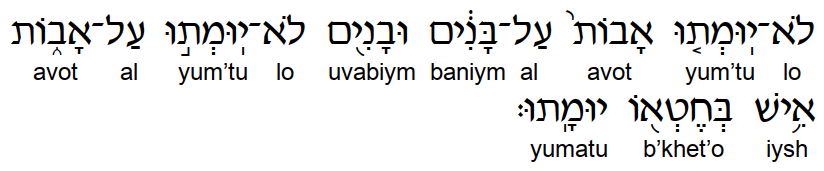
View whole verse and interlinear translation ...
What is it that Scripture wishes to teach us here? asks
What Is ...
Sifrei: An early composite midrash/commentary on B'Midbar and D'varim; probably composed around the time of the Mishna (200CE); known and referenced in the Talmud; the B'Midbar portion from the school of R. Simeon, the D'varim portion from that of R. Akiva
Sifrei, "that fathers are not to be executed because of
their children?" No, no, the ancient sages say, on the contrary - and without
the testimony of any relatives - "fathers shall die for their own sin and
children for their own sin" (Sifrei 280). This introduces us to an
ancient puzzle that the rabbis have been debating for centuries! The problem
starts with
The Name ...
HaShem: literally, Hebrew for 'The Name' - an allusion used to avoid pronouncing the Tetragrammaton, the so-called 'ineffable' name of G–d
HaShem's words to Moshe during the private (well,
at the time) revelation at Mt. Sinai when He put Moshe in a crack of the
rock and passed by him reciting the Thirteen Middot (Attributes of
Mercy): "The L-RD! the L-RD! a G-d compassionate and gracious, slow to
anger, abounding in kindness and faithfulness, extending kindness to the
thousandth generation, forgiving iniquity, transgression, and sin; yet He
does not remit all punishment, but visits the iniquity of parents upon
children and children's children, upon the third and fourth generations"
(Shemot 34:6-7, NJPS). That clearly seems to be saying that the
sins of the parents will ripple down through the following three of four
generations, while here Moshe seems very definite that "a person shall be
put to death only for his own crime" (D'varim 24:16, NJPS). How
are we to reconcile this apparent contradiction?
One of the ways this is approached is by observing that the verb that is used three times in the verse - יומתו, pointed twice as יוּמְתוּ and once (in pause) as יוּמָתוּ, the Hof'al 3mp prefix form of the root מוּת, to die, so literally "they shall not be caused to die", more easily "they shall not be put to death" or "they shall not be executed" - is a judicial or human court verb. Jeffrey Tigay explains that "although it is recognised in 'I the L-RD your G-d am an impassioned G-d, visiting the guilt of the parents upon the children, upon the third and upon the fourth generations of those who reject Me' (D'varim 5:9, NJPS) that G-d punished descendants for their ancestors' wrongs, that is solely a divine prerogative: human authorities may not act likewise." He adds, "that the verse here refers to execution by human judicial authorities is clear from the verb יוּמָתוּ, which always refers to judicial execution, not divine punishment." By that line of argument, this verse is referring solely to the earthly court system, which is here forbidden to act in this way, whereas HaShem - whose attributes of mercy and justice can be trusted to act in the right way - may act as He knows best.
Another approach broadens the scope of the verse to apply not only
to the responsibility for crimes or sin committed by one generation, but to
testimony that might be given in court.
What Is ...
Targum Onkelos: An early (1st-2nd Century CE) translation/paraphrase of the Torah into Aramaic; attributed to a Roman convert to Judaism, Onkelos; used in Babylonian synagogues during the Talmudic era
Targum Onkelos
inserts the word פּוּם so the text reads
עַל פּוּם בְּנִין, "by the mouth of sons".
What Is ...
Targum Pseudo Jonathan: An early (perhaps 4th Century CE) translation/paraphrase of the Torah into Aramaic; more properly called Targum Yerushalmi, but mislabeled Targum Jonathan by a printer; contains a lot of commentary and other material; originally used in Israel
Targum Pseudo Jonathan is even more explicit: "Fathers shall
not die either by the testimony or the crime of the children."
Tigay explains that "since it is clear enough from the final
clause of the verse that parents and children are not to executed for each
other's crimes, the first part of the verse must make a separate point:
people may not be executed or even convicted on the strength of a relative's
testimony and hence relatives may not even testify about each other." Rabbi
Who Is ...
Hirsch: Rabbi Samson Raphael Hirsch (1808-1888 CE), German rabbi, author and educator; staunch opponent of the Reform movement in Germany and one of the fathers of Orthodox Judaism
Hirsch quotes the Sages of the Talmud to say: "According
to the Gemarah (b. Sanhderin 27b) this proclaims the two
principles that neither the crimes or the testimony of close relations, such
fathers and sons, may be used to their disadvantage, not merely that fathers
should not suffer the death penalty for the crimes of their sons and vice
versa."
Nevertheless, there is at the same time, a strong focus of not just
the principle but the practice of HaShem acting to ripple the effects of sin
down through successive generations, albeit with an important qualification.
Who Is ...
Chizkuni: Rabbi Hezekiah ben Manoah (13th century), French rabbi and exegete; his commentary on the Torah was written about 1240 in memory of his father, based principally on Rashi, but using about 20 other sources
Chizkuni puts it this way: "HaShem visits the guilt of the
fathers upon rebellious children when the children continue to act improperly
as their fathers have done"; the Rashbam is very definite that, "the Holy One
certainly 'visits the guilt of the parents upon the children' when they
persevere in the same behaviour." He cites the text "Parents have eaten
sour grapes and children's teeth are set on edge" (Jeremiah 31:29, Ezekiel
18:2) and applies it by saying, "because they lose their parents'
inheritance." Making a poignant contemporary comment,
Who Is ...
Nechama Leibowitz: (1905-1997 CE), born in Riga, graduate of the University of Berlin, made aliyah in 1931; professor at Tel Aviv University; taught Torah for over 50 years
Nechama Leibowitz adds: "We see in the everyday reality around
us how the criminal behaviour of parents, their irresponsibility and licence
has had its tragic repercussions on their children, demoralised by parental
example. What greater punishment can there be for children for their
parents' transgressions?"
We can see a clear progression through Scripture as the texts interpret and clarify the matter. From our starting point of an apparently multi-generational cascade, the prophets offer several levels of refinement. First we have "You show kindness to the thousandth generation, but visit the guilt of the fathers upon their children after them ... whose eyes observe all the ways of men, so as to repay every man according to his ways, and with the proper fruit of his deeds!" (Jeremiah 32:18-19, NJPS), as Jeremiah echoes the Sinai edict, but then stresses the "each man" phrase from our text. Next we have "The person who sins, he alone shall die. A child shall not share the burden of a parent's guilt, nor shall a parent share the burden of a child's guilt; the righteousness of the righteous shall be accounted to him alone, and the wickedness of the wicked shall be accounted to him alone" (Ezekiel 18:20, NJPS), as Ezekiel makes it clear that there is no transfer between the generations and that responsibility for sin is a matter for the person who sinned alone. Unsurprisingly, we hear Yeshua confirming this, while alluding to Proverbs 24:12 and Psalm 62:13, when He talks about the coming judgement: "The Son of Man is about to come in the glory of His Father with His angels and then 'He will repay everyone according to his deeds'" (Matthew 16:27, TLV).
Finally, Rav Sha'ul tells the congregations in Rome that "[G-d] will render to each one according to his works: to those who by patience in well-doing seek for glory and honor and immortality, He will give eternal life; but for those who are self-seeking and do not obey the truth, but obey unrighteousness, there will be wrath and fury" (Romans 2:6-8, ESV). This has come down to a totally individual matter. Neither is this as isolated reference, for Sha'ul touches on it several times, once in a very direct and personal way: "Alexander the coppersmith did me great harm; the Lord will repay him according to his deeds" (2 Timothy 4:14, ESV). We are all responsible before the Master for the way we behave and the way we represent Him before others in this world. What is more, despite the good intentions of Job offering sacrifices on behalf of his children - "It may be that my children have sinned, and cursed G-d in their hearts" (Job 1:5, ESV) - it is something that only we can address. No-one can make peace with Yeshua on your behalf and you cannot obtain forgiveness for anyone else. Just as the sin or misbehaviour is yours, so is its remedy. We have to turn to Yeshua, to confess our sin and seek His forgiveness.
We should rejoice every day that, in G-d's mercy, we will not be held responsible for anyone else's misdemeanours - that is down to them. If someone has wronged you then provided that you have forgiven them, you are free. Baruch HaShem! Resolving and repenting of that wrong, with you and with HaShem is entirely their business, although you may have to be involved in facilitating that as necessary and appropriate. On the other hand, we should walk daily in fear and trembling lest we have failed to clear our offences, both with those we have offended and with Yeshua. The writer to the Hebrews is only too well aware of the danger when he warns us that "It is a fearful thing to fall into the hands of the living G-d" (Hebrew 10:31, ESV). The Spirit guides us in our inventory, prompting of those things that we may have forgotten or been slow to process. Rapid attention enables us speedily to restore fellowship with each other and with the Father and bring glory to His name.
Lift up your head and walk tall in the certainty of G-d's love and care for you - "neither death nor life, nor angels nor rulers, nor things present nor things to come, nor powers, nor height nor depth, nor anything else in all creation, will be able to separate us from the love of G-d in Messiah Yeshua our Lord" (Romans 8:38-39, ESV) - firmly resolved to keep short accounts with Him so that we may all grow into the likeness of Yeshua, being conformed to Him in every way during our sojourn on this earth!
Further Study: 2 Corinthians 5:10; Ephesians 6:5-8; Colossians 3:23-25
Application: Be sure today that you have a clean slate before the heavenly tribunal. Ask the Spirit to remind you of anything that still needs attention and show you exactly what steps to take to get it resolved without delay.
Comment - 14:02 11Sep24 HR: It annoys me that "deliverance ministries" use such verses as Shemot 34:6-7 as proof of a generational curse/sin. Surely if one is forgiven by G-d through Yeshua then that person is no longer affected by that curse/sin. It is my understanding that because believers do not fully understand the completeness of Yeshua's sacrifice that they are then deceived by the enemy who will provide convincing circumstances to make them believe in what he says is true when all they need to do is rebuke him for lying to them and walk away in victory. Having said that there is no doubt that another persons sin can have an effect on those around them (see Jonah) until the sin of that person is dealt with or they separate themselves from that person.
Buy your own copy of the Drash Book for Deuteronomy/D'varim now at Amazon US or Amazon UK.
© Jonathan Allen, 2024
| Messianic Trust Home Page | Join Weekly Email | More Weekly Drashot |
| Last Week |
Support the work of producing this weekly commentary
|
Next Week |
| Last Year - 5783 | Scripture Index | Next Year - 5785 |
|
Your turn - what do you think of the ideas in this drash ? Like most print and online magazines, we reserve the right to edit or publish only those comments we feel are edifying in tone and content. |