

|
Khayiy Sarah (Gen 23:1 - 25:18) |

| Messianic Education Trust | ||||||
|
|
Always Being Ready
|
|
||||
B'resheet/Genesis 23:16 And Avraham listened to Efron and Avraham weighed out for Efron the silver that he spoke in the hearing of the sons of Khet
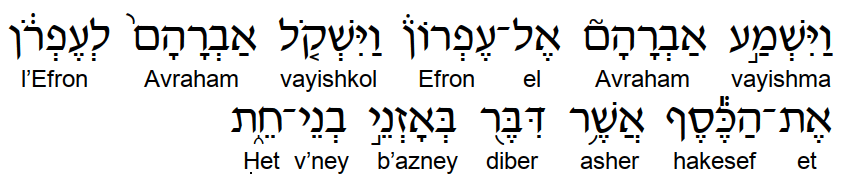
View whole verse and interlinear translation ...
Avraham's beloved wife Sarah has died. Although stricken with
grief, Avraham moves to procure a burial plot where Sarah's body can be
decently and safely buried. However, he is faced with an apparently
insurmountable problem: once a body was placed in a burial cave, it would be
left until only bones remained and the bones would be collected and put in a
box (an ossuary); the burial cave would then be re-used. To secure a burial
plot so that it would only be used by one family, the family needed to own -
not borrow or be lent as a gift - the burial site. Although
The Name ...
HaShem: literally, Hebrew for 'The Name' - an allusion used to avoid pronouncing the Tetragrammaton, the so-called 'ineffable' name of G–d
HaShem had given Avraham and his descendants the whole of the
land, in the eyes of the local population Avraham owned no land whatsoever
and they wanted to keep it that way: foreigners were not allowed to become
land-owners.
Negotiations for the site began in the normal way. Although Avraham already knew the site that he wanted to purchase, he started in a circuitous way, simply outlining his need before the elders of the city: "I am a resident alien among you; sell me a burial site among you, that I may remove my dead for burial" (B'resheet 23:4, NJPS). He openly admits that he does not 'belong' to the local people - he is just a resident alien, a sojourner, of no fixed abode - but states his objective: to make outright purchase of a burial site for permanent use and possession. By so doing, he would become a land-owner and entitled to a voice among the elders as an equal. The Hittites, as a group, reply in a generic way: "Hear us, my lord: you are the elect of G-d among us. Bury your dead in the choicest of our burial places; none of us will withhold his burial place from you for burying your dead" (v. 6, NJPS); we will lend you any of our burial places, but you may not purchase land among us. The offer to loan a site for burial is intended to make a purchase unnecessary while remaining gracious.
Refusing to be put off, Avraham tries again. Knowing perfectly well that the current owner is present among the group of elders, he identifies the site he wants to buy and asks the group - if they are serious in their expression of intent to help him - to speak to the owner and ask his to sell the plot of land. He dangles the incentive that he will not argue about a valuation, but will pay the full market price of the land. Efron - for he is the current owner of the Machpelah cave and its surrounding fields and woodland - responds with what sounds like a generous, compassionate gesture: "I give you the field and I give you the cave that is in it; I give it to you in the presence of my people. Bury your dead" (v. 11, NJPS). What this really meant, however, was only the gift of the field for one burial and that not on an exclusive basis: if Efron and his family needed to bury a member of their family, they would go ahead and do that using the same site.
Attempting to move towards a purchase, Avraham is more focused. Speaking directly to Efron, he repeats his offer to pay; he needs an outright purchase not a loan or a temporary gift: "Let me pay the price of the land; accept it from me, that I may bury my dead there" (v. 13, NJPS). The burial process - which everyone knows must be done promptly - depends on a full purchase. Backed into a corner in public by Avraham's persistence, Efron then names a price: "A piece of land worth four hundred shekels of silver -- what is that between you and me? Go and bury your dead" (v. 15, NJPS). While Gunther Plaut rightly points out that "differences in time and monetary value make comparisons difficult", there seems fairly unanimous consensus that four hundred shekels was a significantly inflated price. David will later buy the entire site for the Temple, "David bought the threshing floor and the oxen for fifty shekels of silver" (2 Samuel 24:24, NJPS), for much less and around the turn of the seventh/sixth centuries BCE, Jeremiah reports that "I bought the field at Anathoth from Hanamel my cousin, and weighed out the money to him, seventeen shekels of silver" (Jeremiah 32:9, ESV). Efron was using the price as his last tool to dissuade Avraham - after all, who knew that he even had that much money?
Nevertheless, our text tells us, Avraham agreed to Efron's terms and weighed out the named price right there and then, in public: "four hundred shekels of silver at the going merchants' rate" (B'resheet 23:16, NJPS). The verb וַיִּשְׁקֹל - the Qal 3ms prefix form of the root שׁקל, to weigh, weigh out, pay (Davidson) - and the derived noun שֶׁקֶל, the common unit of weight, record that Avraham paid for the purchase with legal tender: silver metal, weighed according to the current market value of silver among the merchants.1 Once this was done, "Efron's land in Machpelah, near Mamre -- the field with its cave and all the trees anywhere within the confines of that field -- passed to Abraham as his possession, in the presence of the Hittites, of all who entered the gate of his town" (v. 17, NJPS). Avraham had completed the purchase and now owned - outright - the burial plot of his choice where he could bury Sarah and be confident that her remains would not be disturbed. As a public transaction, conducted in the city gates, the whole neighbourhood would know that the land now belonged to Avraham and his heirs even though he was nomadic and might hardly ever be there.
What can we learn from this part of the Avraham narrative? That, despite personal, cultural and legal opposition, Avraham was ready to do whatever it might take to secure a permanent burial plot in which to place the body of his dear wife, Sarah. Claus Westermann comments that the narrator "is aware that it is so important for Avraham to gain unimpeachable possession of the burial place that he will pay any amount for it."2 Walter Brueggemann suggests that "securing the grave with a clear legal title is a symbolic but concrete guarantee of possession of the whole land ... this little piece of land signifies the whole land, certainly promised and undoubtedly to be possessed."3 Bruce Waltke puts it this way: "Both Avraham and Jeremiah buy land as a sign that the land has a future."4 Avraham is preparing for that future by establishing a foothold in the present.
Perhaps we can also hear that Avraham senses the focus of the spotlight moving to the next generation, from himself to Yitz'khak. Not only is he prepared for this to happen, but he facilitates the transition: he purchases "as a permanent holding a special place where the ancestors may always 'dwell' among the living, a place of memory and filial piety."5 Yitz'khak will bury his father in that place, reconnecting father and mother and recognising his own role standing in their lineage and walking in their ways. Avraham is not yet dead - indeed, the parasha will close with the story of another wife, Keturah, and a host of other sons - but he is ready to relinquish the baton to Yitz'khak and leave Yitz'khak with an anchor point for memory and ritual, both a physical and emotional place of belonging. Four hundred shekels was a lot of money, but Avraham was prepared to make that sacrifice in the present in order to be ready for future.
Yeshua too was ready to sacrifice in the present for the sake of the future. The prophets see a shadow of what will happen as Isaiah voices the fourth Servant Song: "Out of the anguish of His soul He shall see and be satisfied; by His knowledge shall the righteous one, My servant, make many to be accounted righteous, and He shall bear their iniquities" (Isaiah 53:11, ESV). Yeshua Himself explains this to the two disciples on the road to Emmaus, "Was it not necessary that the Messiah should suffer these things and enter into His glory?" And beginning with Moses and all the Prophets, He interpreted to them in all the Scriptures the things concerning Himself" (Luke 24:26-27, ESV) and Rav Sha'ul reports the way this has been captured in a fragment of early Messianic liturgy: "Being found in human form, He humbled Himself by becoming obedient to the point of death, even death on a cross" (Philippians 2:8, ESV). Yeshua understood what He was doing, knew exactly what was going to happen and was ready to make that sacrifice - in obedience to the will of the Father - to enable both the past and future generations of those who trust in Him and HaShem's faithfulness: "Yeshua, the founder and perfecter of our faith, who for the joy that was set before Him endured the cross, despising the shame, and is seated at the right hand of the throne of G-d" (Hebrews 12:2, ESV).
While it is by no means certain that all of us alive today will be called upon to be martyrs for our faith in Yeshua, many brave souls have done so in previous generations and many disciples today do find themselves perilously close to that line if not crossing over it, as Yeshua warns: "But be on your guard. For they will deliver you over to councils, and you will be beaten in synagogues, and you will stand before governors and kings for My sake, to bear witness before them" (Mark 13:9, ESV). What matters, however, in being ready is considering the possibility that we will - in some way or another - suffer for our faith as we stand up for the truth and proclaim the sovereignty of G-d again a world that wants to ignore Him. We need to consider and, having done that, decide that since Yeshua has promised us that "the Holy Spirit will teach you in that very hour what you ought to say" (Luke 12:12, ESV), we will not be afraid of what man can do, but be in awe of the One who holds our souls in His hand. Let us believe G-d and, like Avraham, have it credited to us as righteousness.
1. - There was no accepted coinage in those days, so metal - be that bronze, silver or gold - was weighed rather than counted. There were different weights of shekel, depending on use and context; the merchant's shekel was likely to be both the most widely accepted as "portable money" and the heaviest, so that it would pass all other standards.
2. - Claus Westermann, Genesis, Vol II Chapters 12-36, trans. J. J. Scullion, (London, SPCK, 1986), page 375.
3. - Walter Brueggemann, Genesis, Interpretation, (Atlanta, GA: John Knox Press, 1982), page 196.
4. - Bruce K. Waltke with Cathi J. Fredricks, Genesis: A Commentary, (Grand Rapids, MI: Zondervan, 2001), page 320.
5. - Leon R. Kass, The Beginning of Wisdom: Reading Genesis (Chicago, IL: Chicago University Press, 2003), page 366.
Further Study: Matthew 10:17-23; Luke 21:11-19; Titus 3:1-7
Application: What are you prepared to forgo in the present in order to prepare for and be ready for the future? When Yeshua returns, "will He find faith on earth?" (Luke 18:8, ESV). Are we a people set apart, washed by His word and ready to greet Him when He comes?
Buy your own copy of the Drash Book for Genesis/B'resheet now at Amazon US or Amazon UK.
© Jonathan Allen, 2025
| Messianic Trust Home Page | Join Weekly Email | More Weekly Drashot |
| Last Week |
Support the work of producing this weekly commentary
|
Next Week |
| Last Year - 5785 | Scripture Index | Next Year - 5787 |
|
Your turn - what do you think of the ideas in this drash ? Like most print and online magazines, we reserve the right to edit or publish only those comments we feel are edifying in tone and content. |