

|
Khayiy Sarah (Gen 23:1 - 25:18) |

| Messianic Education Trust | ||||||
|
|
Living in Exile
|
|
||||
B'resheet/Genesis 23:6 Hear us, my lord. You are a prince of God among us; in the best of our burial sites, bury your dead.
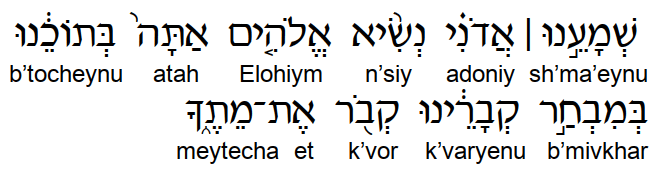
View whole verse and interlinear translation ...
Avraham's wife, partner and companion has died. Her body needs to be buried - with all due respect and courtesy, but with appropriate speed as the Sages will later teach: "regarding all deceased, he who hastens to inter them is praiseworthy" (b. Moed Katan 22a). This explains something of the pressure under which Avraham is operating, as well as his emotional distress and state of mourning. Nevertheless, in order to understand our text - which forms the first response of the Hittite landowners to Avraham's request for a burial site - we need first of all to understand something of ancient Middle East burial customs and then to go back a couple of verses and consider what Avraham says to start the conversation.
Burial sites, where the body is not directly interred in the ground,
took the form of caves - either formed naturally or with a little human
assistance, or carved from a suitable natural starting point. The interior
of the site would have two or more flat areas or shelves where a body could
be laid out. In the normal course of events, after due ceremony, a deceased
person would be laid to rest on one of the shelves and then left for the
normal process of decomposition to take place. After some time, typically
when another burial needed to happen, the bones of the last deceased would be
collected up and placed in an ossuary and moved to the rear of the cave, so
leaving the shelf free for the next occupant. Each family had their own
cave, where - over time - multiple people would be buried. The
Who Is ...
The Radak: Rabbi David Kimḥi (1160-1235 CE), rabbi, biblical commentator, philosopher and grammarian; born in Narbonne, France; best known for his commentaries on the Prophets, he also wrote a philosphical commentary on Bresheet that makes extensive use of the Targum of Jonathan ben Uzziel; influenced by a strong supporter of Ibn Ezra and Maimonides
Radak tell us that each such cave was called a
קֶבֶר, kever, not a grave as the word sometimes means,
but a burial site.
Expressing great politeness and deference, Avraham opens the negotiations with, "I am a resident alien among you; sell me a burial site among you, that I may remove my dead for burial" (B'resheet 23:4, NJPS). He uses two words for "resident alien" - גֵּר, >geyr, a sojourner, from the root גוּר, and תוֹשָׁב, toshav, an abstract noun from the root יָשַׁב, to sit or dwell, meaning someone who is temporarily dwelling somewhere. גֵר is much more common and denotuas foreigners living in an alien land, often on a permanent or at least semi-permanent basis. תוֹשָׁב is the rarer of the two terms and has the sense of somebody who is simply resident for a short time and although more than just a visitor, they may be staying only while the job lasts. They often appear together.
In modern terms, we might compare this to different classes of visa. The גֵר has a full green card and right of residence; the תוֹשָׁב has a two or three year work visa and the visitor has just a 90-day tourist visa. Gordon Wenham tells us that "while circumcised sojourners could participate in the Passover, the תוֹשָׁב could not, so they were even more on the fringe of society than sojourners."1 What is Avraham doing? Wenham says that he "introduces himself with a simple factual statement about his legal situation, which at the same time exposes his vulnerability and need."2Richard Elliott Friedman comments that "with the hendiadys3 of 'an alien and a sojourner', Avraham emphasises to the Hittites that he recognises that he is an outsider in their territory." Bruce Waltke agrees: "the hendiadys ... underscores that Avraham owns no land and ordinarily is not entitled to buy land."4
Returning to Avraham's words, he asks for not just a
קֶבֶר but אֲחֻזָּת־קֶבֶר, akhuzat kever, a
permanent or inheritable burial site, an ancestral landholding. The same
word is used in HaShem's promise to Avraham, "I assign the land you
sojourn in to you and your offspring to come, all the land of Canaan, as an
everlasting holding" (B'resheet 17:8, NJPS) and Yaakov's
recounting to his son Yosef of HaShem' words to him, "I will assign this
land to your offspring to come for an everlasting possession" (48:4,
NJPS). Why does this matter? Firstly, if Sarah is buried -
albeit with great honour - in a Hittite burial site, Avraham has no control
over when and where her bones are placed and has no burial rights for himself
or future generations. There is no place for pilgrimage, for remembrance and
for continuity. The
Who Is ...
Ramban: Rabbi Moshe ben Nachman Girondi or Nachmanides (born in Gerona, 1194; died in Israel 1270), Spanish rabbi, author and physician; defended Judaism in the Christian debates in Barcelona before making aliyah
Ramban paraphrases verse 8: "I do not want
to bury her in someone else's tomb. So you must help me to buy a burial
site." Hirsch explains that "akhuza is the act of permanent settling.
Avraham does not ask for permission just to bury his wife. He wants his wife
to rest in her permanent everlasting possession of her resting place."
Now let's turn to our text: the Hittite reply. They too are
carefully polite, calling Avraham, "mighty prince or 'elect of G-d'" (Plaut).
Who Is ...
Abraham Ibn Ezra: (1089-1167 CE), born in Tudela, Spain; died in the South of France after wandering all around the shores of the Mediterranean and England; a philosopher, astronomer, doctor, poet and linguist; wrote a Hebrew grammar and a commentary on the Bible
Ibn Ezra disagrees with that translation: "Not 'the elect of
G-d'; rather, '"a mighty prince' - using elohim as a superlative -
because you are a prophet." Nahum Sarna suggests that "the
title they give him is honorific and probably has no religious connotation."
The phrase "hear us" - which appears six times in the course of the dialogue
in one form or another - is characteristic of court proceedings, but the
outcome of the first round is clear: the Hittites give Avraham permission to
bury Sarah on their land, but are not willing to let him become a landowner.
They indicate their reluctance to transfer land to Avraham, for then he would
no longer be a landless sojourner. Moreover, none of the Hittites would want
to sell any of their ancestral land. If nothing else, owning land means
having a voice in the city gates, being a resident rather than a sojourner.
Nevertheless, after a few more exchanges, a deal is struck and after counting our four hundred shekels of silver - an outrageous price, even for those days - Avraham becomes the owner of the cave of Machpelah, the field that contains it and all the trees on the land. The sale is witnessed by the elders of the Hittites, sitting in the city gate near Mamre. It will belong to Avraham, to Yitz'khak and to Ya'akov, so that Ya'akov can tell Yosef, "there Avraham and his wife Sarah were buried; there Yitz'khak and his wife Rivka were buried; and there I buried Leah" (49:31, NJPS), before making his son swear that he too would be taken back and buried in the cave. The site provides a moment and a place of reconciliation - at least common ground - between Yitz'khak and Ishmael and between Ya'akov and Esav when burying their fathers. As Gerhard von Rad comments, "a very small part of the Promised Land - the grave - belonged to them; therefore they did not have to rest in 'Hittite earth' or in the grave of a Hittite, which Israel would have considered a hardship difficult to bear."5
Making another connection with our text, the
Who Is ...
Ba'al HaTurim: Rabbi Yaakov ben Asher (1269-1343 CE), born in Cologne, Germany; lived for 40 years in and around Toledo, Spain; died en route to Israel; his commentary to the Chumash is based upon an abridgement of the Ramban, including Rashi, Rashbam and Ibn Ezra; it includes many references to gematria and textual novelties
Baal HaTurim notices that the word מֵתֶךָ,
meytecha, "your dead", occurs just four times in Tanakh; three
times in this dialogue (twice in v. 6, once in v. 11) and once - as
מֵתֶיךָ (plural) - in Isaiah 26.19 "Your dead shall live;
their bodies shall rise. You who dwell in the dust, awake and sing for joy!"
(Isaiah 26:19). He sees an allusion here to the Sages' statement, "The
dead in the Land of Israel will be resurrected first" (y. Kilayim
9:3); while as followers of Yeshua, we hear Sha'ul proclaiming that "in
Messiah shall all be made alive. But each in his own order: Messiah the
firstfruits, then at His coming those who belong to Messiah" (1 Corinthians
15:22-23, ESV). We only sleep in the dust, awaiting Yeshua's
return and then, just as He has done, we shall rise to life eternal and
"we shall be like Him, because we shall see Him as He is" (1 John 3:2,
ESV).
Walter Brueggemann points to the incongruity between Avraham's self-effacing identity and the title the Hittite uses for Avraham. He suggests that, "for the narrative, it is the landless sojourner who is G-d's prince. It is the landless one who bears all the promises and lives in hope." A link that Martin Luther highlights to Rav Sha'ul's assurance to the Ephesians - "you are no longer strangers and aliens, but you are fellow citizens with the saints and members of the household of God" (Ephesians 2:19, ESV) - allows Brueggemann to claim that "the landless Avraham, by the power of the gospel, is made a fellow citizen. Avraham has fully acquired land and 'belongs' in a new way."6 Terence Fretheim joins him to assert that "in death, these Israelite ancestors are no longer strangers and aliens in the land, but heirs; they come to rest in the land promised them by their G-d."7 Thinking slightly outside the box, do we - as exiles in the world at this time until Yeshua returns - take full possession of our inheritance when we die or at the Second Coming? Is that in the back of Sha'ul's mind when he writes, "you were sealed with the promised Holy Spirit, who is the guarantee of our inheritance until we acquire possession of it, to the praise of His glory" (Ephesians 1:13-14, ESV)?
Exiles live in a permanent tension between what is and what will be. Every day, while on the one hand it is the roof over our heads, our current lives - the what is - grate against what will be: our life in Messiah and the fore-taste in our hearts of the kingdom of heaven. When we keep Shabbat but the world keeps on working and laughs at us for presuming to think that G-d will provide if we trust Him. We speak the truth and keep our word, while the world lives in lies, half-truths and campaign promises. We honour our wives and families, while the world changes partners and re-blends children as easily as stirring the porridge on the stove. We struggle to be honest, open and transparent while the world will take every opportunity to make a little ready cash on the side and feather their own nest when no-one is looking. Atnd yet we must engage with the world, for that is the only way to reach them with the gospel, the only time to share the hope we have and invite them to join the kingdom of G-d and know His peace instead of the relentless drive of endless consumerism.
Peter writes to the "exiles of the dispersion" (1 Peter 1:1), telling them to "keep your conduct among the Gentiles honorable, so that when they speak against you as evildoers, they may see your good deeds and glorify G-d on the day of visitation" (2.12, ESV). Avraham was called "a prince of G-d" because for years he had lived in that way: using honest measures, keeping his word, speaking well of people, seeking the common good, honouring pastureland boundaries, making good lost animals. In this age, as disciples and ambassadors of Yeshua in exile, we are called to the same standards; even though we may be mocked or laughed at, we live as examples of G-d's compassion and righteousness as living witnesses. This is our calling as witnesses in these days!
1. - Gordon J. Wenham, Genesis 16-50 Word Biblical Commentary, (Nashville, TN: Thomas Nelson), page 127.
2. - Wenham, 126.
3. - hendiadys - the expression of a single idea by two words connected with 'and', when one could be used to modify the other. Oxford Dictionary of English.
4. - Bruce K. Waltke with Cathi J. Fredricks, Genesis: A Commentary, (Grand Rapids, MI: Zondervan, 2001), page 317.
5. - Gerhard von Rad, Genesis Old Testament Library, (London, SCM Press, 1972), page 250.
6. - Walter Brueggemann, Genesis, Interpretation, (Atlanta, GA: John Knox Press, 1982), page 196.
7. - Terence Fretheim, "Genesis" in The New Interpreter's Bible Commentary, Vol I, edited by Leander E. Keck, (Nashville, TN: Abingdon Press, 2015), page 163.
Further Study: Matthew 5:14-16; Titus 2:7-8; 1 Peter 3:15-16
Application: Are you, like Avraham, known as a "prince of G-d" among your peers, family and community? If not, then perhaps you need to raise your game. Speak to the Boss today and ask Him how He wants you to honour Him in the place where He has planted you to bring glory to His name.
Buy your own copy of the Drash Book for Genesis/B'resheet now at Amazon US or Amazon UK.
© Jonathan Allen, 2024
| Messianic Trust Home Page | Join Weekly Email | More Weekly Drashot |
| Last Week |
Support the work of producing this weekly commentary
|
Next Week |
| Last Year - 5784 | Scripture Index | Next Year - 5786 |
|
Your turn - what do you think of the ideas in this drash ? Like most print and online magazines, we reserve the right to edit or publish only those comments we feel are edifying in tone and content. |