

|
Ha'azinu (Deut 32:1 - 52) |

| Messianic Education Trust | ||||||
|
|
|
|
||||
D'varim/Deuteronomy 32:46 Set in your hearts all the words that I am testifying against you today, that you command them to your children, to keep [and] to do all the words of this Torah.
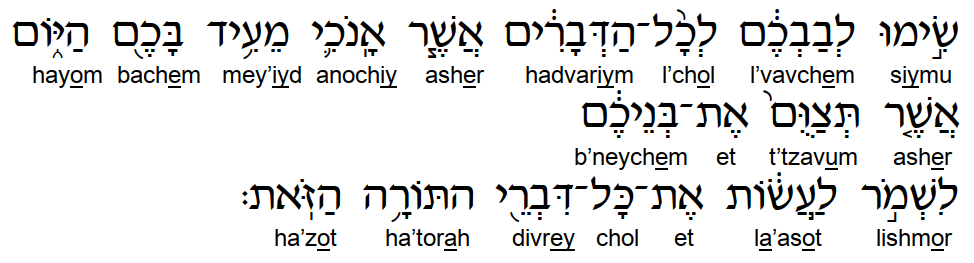
View whole verse and interlinear translation ...
After teaching the song Ha'azinu to the people and writing it down as well so that it will be a permanent part of the written record, Moshe, the passing leader, takes a few sentences with Joshua, the new leader, to try and make sure that the people do not dismiss the importance of obeying all the instructions that they have been taught. Coming up to the Jordan, crossing the river and entering the Land, receiving a land allocation and then taking possession of their inheritance - these are all big and exciting steps. It would be all too easy to simply get on with what needs to be done each day and leave everything else to worry about itself. Once in possession of the land, it needs to be cleared and farmed, houses need to be built, there is more than a full day's work to be done every day to cultivate and harvest the land and its crops, its vineyards and olive groves, its fields and its pasturelands. Finding time for study is difficult to justify when the immediate work seems so pressing; catch up with that later once things have settled down. And yet, Moshe and Joshua urge, "this is not a trifling thing for you: it is your very life; through it you shall long endure on the land that you are to possess" (D'varim 32:47, NJPS). You must get this right or you won't get to be on the land that you have just been given for very long.
The first question the commentators ask is exactly which words are being discussed. Twice the text talks about words: כָל־הַדְּבָרִים, "all the words ... that I am testifying against you today" and כָּל־דִּבְרֵי, "all the words of this Torah". Which words are these? Robert Alter takes one view: that Moshe and Joshua are talking only about the Ha'azinu song. He has a point; before teaching the song, Moshe instructs the Levites to "Gather to me all the elders of your tribes and your officials, that I may speak all these words to them" (31:28, NJPS) and the narrator tells us that "then Moshe recited the words of this poem to the very end, in the hearing of the whole congregation of Israel" (v. 30, NJPS). On the other hand, Jeffrey Tigay thinks that the use of the verb צוה, to command - here present as תְּצַוֻם, the Pi'el 2mp prefix form with a 3mp object pronoun suffix - makes it " clear from the rest of the verse that the words in question include commands and since the poem contains none, the 'words' must be those of the teaching as a whole"; it must include at least the book of D'varim, if not the whole of the Torah.
After all, as
Who Is ...
Nechama Leibowitz: (1905-1997 CE), born in Riga, graduate of the University of Berlin, made aliyah in 1931; professor at Tel Aviv University; taught Torah for over 50 years
Nechama Leibowitz explains, "there is
nothing superfluous in the Torah and no sliding scale of values
between its different portions. The seemingly most insignificant and prosaic
detail hidden in the folds of a story is of equal importance to its
philosophy and fundamental laws." Every word is important! It isn't as if
the people haven't heard this before. Gordon McConville astutely points out
that "Moshe's final charge to Israel returns to basic deuteronomic concepts:
taking Yahweh's words to heart, passing them on to future generations and the
basis in them of Israel's long life in the land."1 The very
generation that Moshe and Joshua are addressing watched their parents dying
and being buried in the wilderness, unable to enter the land that had been
promised, and should know all too well the cost of neglecting or disobeying
The Name ...
HaShem: literally, Hebrew for 'The Name' - an allusion used to avoid pronouncing the Tetragrammaton, the so-called 'ineffable' name of G–d
HaShem's Torah.
Another question that commentators ask is why the heart - a clever
but unintelligent organ whose purpose is to pump blood around the body -
involved in what is essentially an intellectual activity: remembering the
commandments and passing them on to the next generation. The early rabbis
assert that "it is necessary for a person that his eyes, ears and heart be
directed to words of Torah" (
What Is ...
Sifrei: An early composite midrash/commentary on B'Midbar and D'varim; probably composed around the time of the Mishna (200CE); known and referenced in the Talmud; the B'Midbar portion from the school of R. Simeon, the D'varim portion from that of R. Akiva
Sifrei 335) and
point to a parallel text in the prophets. At the beginning of his vision
about the new temple, Ezekiel is met by a man with a cord of linen and a
measuring rod in his hand, who tells him, "Son of man, look with your
eyes, and hear with your ears, and set your heart upon all that I shall show
you, for you were brought here in order that I might show it to you. Declare
all that you see to the house of Israel" (Ezekiel 40:4, ESV). If
he is to be an accurate and faithful witness to the people of Israel, to give
them hope and the assurance of a future for them in HaShem's plans, Ezekiel
needs to engage all his senses in remembering and understanding the vision.
Rabbi
Who Is ...
Hirsch: Rabbi Samson Raphael Hirsch (1808-1888 CE), German rabbi, author and educator; staunch opponent of the Reform movement in Germany and one of the fathers of Orthodox Judaism
Hirsch writes that "[this] designates an assiduous serious
devoting the whole depth of one's mind to grasp something." Learning and
remembering don't just happen, they have to be worked at, practiced,
rehearsed and polished.
A multi-generational aspect is clearly on Moshe's mind in our text.
Although Don
Who Is ...
Abravanel: Don Isaac Abravanel (1437-1508 CE), Statesman and biblical commentator; born in Lisbon, died in Venice; wrote commentaries on the whole of the Hebrew Scriptures
Abravanel sees things on a limited scale - "Let
the evil things foretold here not occur in your generation or that of your
children" - and the
Who Is ...
Sforno: Rabbi Ovadiah Sforno (1470-1550 CE), Italian rabbi, philosopher and physician; born in Cesena, he went to Rome to study medicine; left in 1525 and after some years of travel, settled in Bologna where he founded a yeshiva which he conducted until his death
Sforno points to the words
לִשְׁמֹר לַעֲשׂוֹת, to keep and to do, both Qal infinitives of
the roots שׁמר and עשׂה respectively, and
comments, "so that the children will observe and do them", others see this
being something that every generation is to teach the next, no matter how
many there have been. Children learn best by seeing their parents do
something, asking why and the joining in until they have got it right. Moshe
established this in the instructions for remembering Pesach every year
after we left Egypt: "When your children ask you, 'What do you mean by
this rite?' you shall say, 'It is the passover sacrifice to the L-RD" (Shemot
12:26-27, NJPS). Daniel Block writes: "Moshe emphasises how
seriously [the people] must take his instruction. From the inside out they
are to commit themselves to all the words with which he has admonished them,
and they are to pass on all his teachings to their children, charging them to
keep all the words of this Torah by doing them."2
Peter Craigie points out that "knowing the dangers of falling from the true faith, the Israelites should be diligent in instructing the younger generation in the true faith; the education of the new generation is an important theme running throughout Deuteronomy."3 Just take a look at these verses and see how many times teaching children is mentioned. Moshe started with "make them known to your children and to your children's children" (D'varim 4:9, NJPS), putting the multi-generational rule on the table from the beginning. Children are specifically mentioned in both the first and second paragraphs of the Sh'ma: "Impress them upon your children. Recite them when you stay at home and when you are away, when you lie down and when you get up" (6:7, NJPS) and "teach them to your children -- reciting them when you stay at home and when you are away, when you lie down and when you get up" (11:19, NJPS). Then in Moshe's instructions to the Levites when he gives them the written copy of the Torah to hold for the people and read to them regularly, he stresses that it is not just the adults who are to be gathered for the communal readings of the Torah but "their children, too, who have not had the experience, shall hear and learn to revere the L-RD your G-d as long as they live in the land that you are about to cross the Jordan to possess" (31:13, NJPS).
It has been tempting, throughout this cycle of reading the Torah together when our theme has been "Always Being Ready", to refer glibly to Peter's admonition that we should "always be ready to make a defense - that is, be prepared to give a reasoned answer - to everyone who asks you to give an account for the hope that is in you" (1 Peter 3:15), although we have resisted the temptation until now. We have also managed to avoid going to Rav Sha'ul's advice to Timothy - "What you have heard from me in the presence of many witnesses entrust to faithful men who will be able to teach others also" (2 Timothy 2:2, ESV) - more than once this year. These are important verses, but they must not become automatic, trotted out by rote and then ignored. It is essential that we are always ready to explain to other people why we have hope in this increasingly crazy world. It is also essential that we should institute a multi-generational approach to our teaching, making sure not only that we teach the people who are in front of us, but also that we impress on them the need to teach others and to include the warrant to keep on teaching others in the message.
However, every family unit, every church, congregation or fellowship group that has children has a much more immediate and pressing audience in front of them, not just on Shabbat but every day of the week, watching and learning from everything that we do and say. Even if they are rebellious children and end up rejecting everything that they are taught, we must fulfil the solemn obligation that HaShem has given us to make sure that they do have the opportunity to hear. Yeshua was indignant when the disciples tried to keep children away from Him, saying instead, "Let the little children come to Me and do not hinder them, for to such belongs the kingdom of heaven" (Matthew 19:14, ESV). Make sure that you hear that: the kingdom of heaven belongs to children! After rebuking the towns and villages where He had been and performed many miracles because they did not repent and believe Him, Yeshua prayed: "I thank You, Father, L-rd of heaven and earth, that You have hidden these things from the wise and understanding and revealed them to little children" (11:25, ESV). We ignore these words and the children in our midst at our peril!
1. - J. G. McConville, Deuteronomy, Apollos Old Testament Commentary, (Leicester, Apollos, 2002), page 460.
2. - Daniel I. Block, Deuteronomy, The NIV Application Commentary, (Grand Rapids, MI: Zondervan, 2012), page 769.
3. - P. C. Craigie, The Book of Deuteronomy, NICOT, (Grand Rapids, MI: Eerdmans, 1976), page 390.
Further Study: Psalm 78:1-7; Isaiah 54:13-14; Ephesians 6:4
Application: Do you need, on this Shabbat Shuvah, to repent of neglecting the teaching of your children or prioritising adults in a way that told the children they were unimportant? Ask the Spirit today to show you ways in which you can reach out to your children, grandchildren or others in your congregation with the practical, down-to-earth message that they matter to G-d as much as you do and that He wants to know and have relationship with them now, not just in thirty years time!
Buy your own copy of the Drash Book for Deuteronomy/D'varim now at Amazon US or Amazon UK.
© Jonathan Allen, 2026
| Messianic Trust Home Page | Join Weekly Email | More Weekly Drashot |
| Last Week |
Support the work of producing this weekly commentary
|
Next Week |
| Last Year - 5785 | Scripture Index |
|
Your turn - what do you think of the ideas in this drash ? Like most print and online magazines, we reserve the right to edit or publish only those comments we feel are edifying in tone and content. |