

|
B'Shalach (Ex 13:17 - 17:16) |

| Messianic Education Trust | ||||||
|
|
Always Being Ready
|
|
||||
Shemot/Exodus 14:13 Do not fear; stand and see the salvation of the L-rd, that He will do for you today
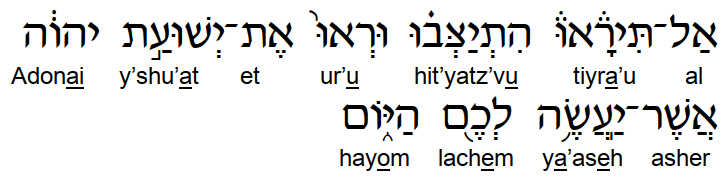
View whole verse and interlinear translation ...
In a final thrust of petulant madness, Pharaoh has decided to pursue
the Israelites that he had only so recently and so firmly expelled from
Egypt. He gathered over six hundred chariots and set off in hot pursuit; the
narrator tells us that "all the chariot horses of Pharaoh, his horsemen,
and his warriors overtook them encamped by the sea, near Pi-hahiroth, before
Baal-zephon" (Shemot 14:9, NJPS). As the Egyptians approached the
Israelites - perhaps they could hear the shouting of the officers or the drum
of the hooves on the ground - the Children of Israel lifted their eyes.
"Behold! Egypt נֹסֵעַ, 'noseya', marching after
them" (v. 10). The verb נֹסֵעַ is a Qal participle
ms, singular to show that the Egyptian army was advancing as one man, and the
Israelites were very fearful. In their fear they cried out to
The Name ...
HaShem: literally, Hebrew for 'The Name' - an allusion used to avoid pronouncing the Tetragrammaton, the so-called 'ineffable' name of G–d
HaShem and then turned on Moshe, accusing him of dragging
them out of Egypt against their will and better judgement, bringing them out
to certain death in the wilderness at the hand of the Egyptians where there
weren't even decent burial places (vv. 11-12).
Umberto Cassuto takes up the story: "Moshe is not dispirited, either by the danger or the censure of his people. He answers with courage and unmitigated faith in G-d's help: Fear not, stand firm and confident and see - you have nothing to do but to see - the salvation of the L-rd which He will work for you today - this very day, without your having to wait."1 Everett Fox explains that the word יְשׁוּעַת - which he translates as 'deliverance' - is "a word meaning 'rescue' but extending to circumstances that appear miraculous to those who experience them."2 Robert Alter provides a very typical Jewish analysis: "Moshe recognises that the complaint of the newly freed slaves stems from fear and so he reassures them."3 Moshe assures the people that the Egyptians that they currently see, they will never see again (v. 13b), that HaShem is going to fight for them (v. 14a) so they should pipe down and stop complaining (v. 14b). Then HaShem tells Moshe to stop talking and then move the people on (v. 15).
Thomas Dozeman lays this block of the narrative out as a
chiasm:4
A
The cry of the Israelites to Yahweh (v. 10)
B
The complaint of the Israelites to Moshe (vv. 11-12)
B'
The response of Moshe to the complaint (vv. 13-14)
A'
The response of Yahweh to the cry of Moshe (v. 15)
The structure helps us to see that HaShem's rebuke in A' - "Then the L-RD said to Moshe, 'Why do you cry out to Me? Tell the Israelites to go forward'" (v. 15, NJPS) - is probably a response to the cry of the Israelites in A - "Greatly frightened, the Israelites cried out to the L-RD" (v. 10) - not Moshe. Since Moshe is the intermediary between HaShem and the people, this accentuates the mediator role that will not be varied until HaShem speaks to the people directly from Mt. Sinai.
What exactly, then, is Moshe saying? Rabbi
Who Is ...
Hirsch: Rabbi Samson Raphael Hirsch (1808-1888 CE), German rabbi, author and educator; staunch opponent of the Reform movement in Germany and one of the fathers of Orthodox Judaism
Hirsch
suggests that "הִתְיַצְּבוּ וּרְאוּ here is probably used in the
same sense as וַתֵּתַצַּב אֲחֹתוֹ (his sister stood, 2:4), place
yourself expectantly there. And exactly as there, in the consciousness that
you can do nothing further, but to wait and trustfully expect the rescuing
Hand of G-d. The one and only activity that such a critical moment demands
of us is an internal one, to bring oneself to a state of calm and to the mood
of quietly standing and waiting."
Who Is ...
Abraham Ibn Ezra: (1089-1167 CE), born in Tudela, Spain; died in the South of France after wandering all around the shores of the Mediterranean and England; a philosopher, astronomer, doctor, poet and linguist; wrote a Hebrew grammar and a commentary on the Bible
Ibn Ezra, following the NJPS
translation of our text, "stand by and witness" adds, "For you will not be
making war; you will merely see the salvation which the L-rd will work for
you today." Jonathan Sacks too sees this as a zero participation event by
the Israelites: "The battle against the Egyptians, we are assured, was a
divine act, not a human one ... The people are [to be] passive at this
point; they are witnesses to a drama playing out between G-d and
Egypt."5
But is that all there is to it: sit down, stop whining and leave it to HaShem? Walter Brueggemann notes that "Moshe's response to the challenge, introduced by 'fear not', is a characteristic salvation oracle in which the voice of the gospel, rooted in G-d's own power and fidelity, is offered as a resolution to the voice of protest and trouble."6 Brevard Childs points out Moshe's words are structured, "by challenging Israel to respond to G-d's plan. His speech is directed to their initial reaction (v. 10) and not their verbal articulation. 'Do not fear' - they had feared. 'Stand and see' - they had seen only the Egyptians approaching'. The people had cried to Yahweh; now they are to be quiet."7 Let's take a closer look at the verbs in our text to see what they can tell us.8
Our text starts with אַל־תִּירָאוּ, a typical negative command constructed with the negative particle and a 2mp prefix form, the Qal stem of the root ירא, to fear. "Do not be afraid!" - for the people of G-d in one suffering situation after another this is a word of assurance. G-d is on their side, at work on their behalf. The second verb is הִתְיַצְּבוּ, the Hitpa'el mp imperative of the root נצב, to set, stand or place. "Stand firm!" - the people are not to flee but station themselves at the ready, but not to fight; they are to stand ready to observe the salvation that G-d at the divine initiative will work for them. Thirdly, וּרְאוּ, the Qal mp imperative form of the root ראה, to see. "See!" - the view on their horizon will take the shape of freedom wrought by G-d rather than bondage. Lastly, יַעֲשֶׂה, the Qal 3ms prefix form of the root ישׂה, to do or make. "He will do" - it is HaShem who is going to act, to do something, to bring about the salvation that He has promised. In particular the third verb, 'See!' is important because it shows where the people are looking: "With Pharaoh in hot pursuit, [the Israelites] do not give a second thought to the promise G-d made to the patriarchs. They still have not learned that G-d's purpose for bring them out of Egypt is not simply to save them, but to maintain His covenant tie to all His people, past, present and future. They have still not learned that their circumstances are not the final standard on which to view the work of G-d."9
Now we can see what Moshe is doing by this response. He refuses to accept the image projected by the people as an accurate picture of reality since it excludes HaShem as an active player in the unfolding drama: they can see only Moshe and themselves, a combination that can only lead to disaster. Moshe immediately counters by bringing HaShem front and centre into the scene. The Israelites need to stop panicking and pay attention to HaShem's presence in their dilemma, which they had forgotten or neglected, neither noticing or acknowledging Him. Moshe is re-framing the crisis in terms of HaShem and what He is going to do rather than what the Israelites cannot do.
This is not to say that the Children of Israel are simply passive spectators, however. On the contrary, they have a clearly defined role as witnesses. The prophet speaks clearly into this: "My witnesses are you -- declares the L-RD -- My servant, whom I have chosen. To the end that you may take thought, and believe in Me, and understand that I am He: Before Me no god was formed, and after Me none shall exist -- None but me, the L-RD; beside Me, none can grant triumph" (Isaiah 43:10-11, NJPS). Remember, HaShem goes on: "[I] made a road through the sea and a path through mighty waters, [I] destroyed chariots and horses, and all the mighty host -- they lay down to rise no more, they were extinguished, quenched like a wick" (vv. 16-17, NJPS). The Exodus from Egypt, the ten plagues, the parting of the Sea, the manna and water from the rock - these are all part of our story - and the story of the people of G-d as Rav Sh'aul declares: "For I want you to know, brothers, that our fathers were all under the cloud, and all passed through the sea ... and all ate the same spiritual food, and all drank the same spiritual drink. For they drank from the spiritual Rock that followed them, and the Rock was Messiah" (1 Corinthians 10:1-4, ESV).
On the third day after Yeshua was crucified, two of His disciples were walking from Jerusalem to a nearby village. As they walked, Yeshua Himself came up and joined them without them recognising Him. He asked them, "What is this conversation that you are holding with each other as you walk?" (Luke 24:17, ESV). Looking sad, they told Him about the events of the crucifixion, explaining that "we had hoped that He was the one to redeem Israel" (v. 21, ESV). "What?" says Yeshua, "O foolish ones, and slow of heart to believe all that the prophets have spoken!" (v. 25, ESV) and went on to explain how Moshe and Prophets had spoken about Him. Still they couldn't see Him until, having persuaded Him to stay with them, He broke bread and they recognised Him. Then, galvanised by their discovery, they immediately rush back to Jerusalem to share their news with the other disciples. Now they knew; now they were looking in the right direction in spite of all the evidence that just a few hours earlier had made them so sad and unable to see what G-d was doing.
Here's the challenge for us today: are we always ready to see and hear what HaShem is doing, what the Spirit is whispering in our hearts and take - if necessary - the appropriate action, even if that flies in the face of what we think we see in front of us? When contentious issues are reported, do we believe the reporting of the media - who all have their own agendas - or do we turn to Yeshua and ask Him what He is doing or thinking in those areas? When bad stuff happens - and, to be honest, it does seem to happen, all the time - do we simply accept that as the way the world works these days, or can we believe in Yeshua and His promises: "I am the resurrection and the life. Whoever believes in Me, though he die, yet shall he live, and everyone who lives and believes in Me shall never die" (John 11:25-26, ESV)? It is critical in these days that we are always ready to check facts, to refuse the dominant society narrative and hear the "still small voice" (1 Kings 19:12), knowing that the Spirit will always tell us the truth (John 16:13) from the Father. As Yeshua said: "He who has an ear, let him hear what the Ruach is saying to Messiah's communities. To the one who overcomes, I will grant the right to eat from the Tree of Life, which is in the Paradise of G-d" (Revelation 2:7, TLV). Now, there's a promise! Many more people need to hear it. What are you waiting for?
1. - Umberto Cassuto, A Commentary on the Book of Exodus, (Magnes Press, Jerusalem, 1983), page 164.
2. - Everett Fox, The Five Books of Moses The Schocken Bible Vol 1, (New York, NY: Schocken Books, 1995), page 332.
3. - Robert Alter, The Five Books of Moses, (New York, Norton, 2004), page 270.
4. - Thomas B. Dozeman, Exodus, Eerdmans Critical Commentaries, (Grand Rapids, MI: Eerdmanns, 2009), page 313.
5. - Rabbi Lord Jonathan Sacks, The Koren Humash, Conrad Morris Edition, (Jerusalem, Koren Publishers, 2025), page 459-458.
6. - Walter Brueggemann, "Exodus", in The New Interpreter's Bible Commentary Vol I, edited by Leander E. Keck, (Nashville, TN: Abingdon Press, 2015), page 368.
7. - Brevard S. Childs, The Book of Exodus: A Critical, Theological Commentary, The Old Testament Library, (Louisville, KY: Westminster John Knox Press, 2004), page 226.
8. - The following paragraph adapted and extended from Terence E. Fretheim, Exodus, Interpretation, (Louisville, KY: Westminster John Knox Press, 2010), page 127.
9. - Peter Enns, Exodus, The NIV Application Commentary, (Grand Rapids, MI: Zondervan, 2000), page 273.
Further Study: Psalm 25:5; Jeremiah 23:5-6; 2 Chronicles 20:15-17
Application: How good are you at seeing through the bad news and smoke that the enemy throws in our path and holding fast to the truths of Scripture and the word of the Spirit despite what the world may say? Ask the Father to send more of His Spirit so that you can hear Him more clearly and stake a claim for the truth in these last days before Yeshua returns.
Comment - 13:16 25Jan26 Rivkah: Excellent and applicable to our world today. Focus must be on what HaShem is doing, holding His WORD as our standard by which we can interpret the events happening in our lives and in our world. I appreciate the references given.
Buy your own copy of the Drash Book for Exodus/Shemot now at Amazon US or Amazon UK.
© Jonathan Allen, 2026
| Messianic Trust Home Page | Join Weekly Email | More Weekly Drashot |
| Last Week |
Support the work of producing this weekly commentary
|
Next Week |
| Last Year - 5785 | Scripture Index |
|
Your turn - what do you think of the ideas in this drash ? Like most print and online magazines, we reserve the right to edit or publish only those comments we feel are edifying in tone and content. |