

|
B'resheet (Gen 1:1 - 6:8) |

| Messianic Education Trust | ||||||
|
|
Always being Ready
|
|
||||
B'resheet/Genesis 2:15 And the L-rd G-d took the man and settled him in the Garden of Eden to work it and to guard it.
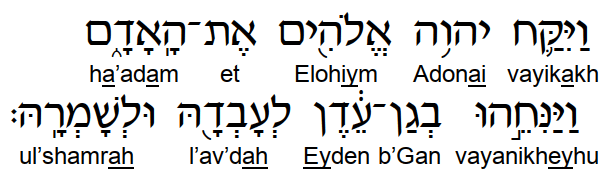
View whole verse and interlinear translation ...
Both halves of our verse open with verbs. In the first case -
וַיִּקַּח, the 3ms prefix form of the root לקח, to
take, with a vav-conversive, so here, "and he took" - the verb is
perhaps an unusual choice. The
What Is ...
Gur Aryeh: The Gur Aryeh (lit. 'Young Lion') is a super-commentary on Rashi's Torah Commentary, written by Rabbi Judah Loew ben Bezalel (1520-1609), widely known as the Maharal of Prague.
Gur Aryeh explains that "the
root לקח normally denotes taking in a physical way. If
applied to people, it would imply taking them and moving them bodily. When
the Torah uses it with reference to people, it means taking by means
of persuasion." This follows the Midrash: "Rabbi Nehemiah said: He
persuaded him to enter, as you read, 'Take words with you and return to
the L-RD' (Hosea 14:3, NJPS)" (B'resheet Rabbah 16;5).
Perhaps we might imagine
The Name ...
HaShem: literally, Hebrew for 'The Name' - an allusion used to avoid pronouncing the Tetragrammaton, the so-called 'ineffable' name of G–d
HaShem using pleasant words
(
Who Is ...
Rashi: Rabbi Shlomo Yitzchaki (1040-1105 CE), French rabbi who wrote commentaries on the Torah, the Prophets and the Talmud, lived in Troyes where he founded a yeshiva in 1067; focuses on the plain meaning (p'shat) of the text, although sometimes quite cryptic in his brevity
Rashi) or gently guiding the man to the garden.
What Is ...
Targum Onkelos: An early (1st-2nd Century CE) translation/paraphrase of the Torah into Aramaic; attributed to a Roman convert to Judaism, Onkelos; used in Babylonian synagogues during the Talmudic era
Targum Onkelos changes the Hebrew וַיִּקַּח, and he
took, to וְדַבָּר, which in Aramaic has the meaning "and he
led"1, to suggest that HaShem led the man to the garden.
The second half of the verse starts with the verb
וַיַּנִּחֵהוּ - the Hifil 3ms prefix form of the root
נוּח, to "rest, settle down, alight"
(Davidson), with a vav-conversive, so here "and he
settled him". The subject of the verb is carried forward from the first half
of the verse: HaShem, it was He who settled the man in the garden. Rabbi
Who Is ...
Hirsch: Rabbi Samson Raphael Hirsch (1808-1888 CE), German rabbi, author and educator; staunch opponent of the Reform movement in Germany and one of the fathers of Orthodox Judaism
Hirsch says that "וַיַּנִּחֵהוּ is not simply
placing, it always has the underlying idea of letting go, conceding, setting
free. G-d had formed him and after that he was still in G-d's hand; G-d let
him go, be free, trusted him to himself for the first time and gave him the
Garden of Eden to work and to guard." Bruce Waltke observes that "work is a
gift of G-d, not a punishment for sin. Even before the Fall, humanity has
duties to perform."2 Gerhard von Rad touches on the question of
vocation; why was man created and what is he to do: "That man was transferred
to the garden to guard it indicates that he was called to a state of service
and had to prove himself in a realm that was not his own
possession."3
Nahum Sarna makes an interesting point: "The man is not
indigenous to the garden. He is fashioned elsewhere and finds himself in it
solely by the grace of G-d." David
Who Is ...
The Radak: Rabbi David Kimḥi (1160-1235 CE), rabbi, biblical commentator, philosopher and grammarian; born in Narbonne, France; best known for his commentaries on the Prophets, he also wrote a philosphical commentary on Bresheet that makes extensive use of the Targum of Jonathan ben Uzziel; influenced by a strong supporter of Ibn Ezra and Maimonides
Kimchi turns that into a
question - "Why was the man not created in the garden to begin with?" - and
then provides an answer: "to give him a special affection for the garden; he
would understand G-d's moving him there as a special favour." HaShem wants
the man to know that this is a special place and that he has been chosen to
be there and to work in the garden. Neverthless, Sarna tells
us that "his life in the garden is not to be one of indolence. He has duties
to perform. It is his responsibility to nurture and conserve the pristine
perfection of the garden. This he must do by the labour of his hands." What
was the man to do? Again, Kimchi responds: "the man was to weed and hoe the
vegetables and trees for his food, and to 'keep it' protected from animals
and birds, as far as he was able."
Who Is ...
Abraham Ibn Ezra: (1089-1167 CE), born in Tudela, Spain; died in the South of France after wandering all around the shores of the Mediterranean and England; a philosopher, astronomer, doctor, poet and linguist; wrote a Hebrew grammar and a commentary on the Bible
Ibn Ezra also has an
answer: "to water it, so that it would sustain him." Gardens need water and,
as yet, "the L-RD G-d had not sent rain upon the earth" (B'resheet 2:5,
NJPS).
Coming from a traditional point of view,
Who Is ...
Chizkuni: Rabbi Hezekiah ben Manoah (13th century), French rabbi and exegete; his commentary on the Torah was written about 1240 in memory of his father, based principally on Rashi, but using about 20 other sources
Chizkuni
reports that the two last verbs in the verse - לְעָבְדָהּ וּלְשָׁמְרָהּ,
both Qal infinitives with a 3fs object pronoun - have a Torah
significant meaning: "to 'work' it for six days, 'six days you shall
labour' (D'varim 5:13) and to 'keep' it on Shabbat, 'observe
the sabbath day' (v. 12)." Jonathan Sacks suggests that
לְעָבְדָהּ, to work/serve it, tells us that "the human being is
thus both master and servant of nature", while observing that
לְשָׁמְרָהּ, to guard it, "is the verb used to describe the
responsibilities of a guardian of property that belongs to someone else:
'When a man gives to his neighbour an ass, an ox, a sheep or any other
animal לִשְׁמֹר to guard' (Shemot 22:9). This guardian must
exercise vigilance while protecting and is personally liable for losses that
occur through negligence." He observes that "We do not own nature -
'HaShem owns the earth and all it contains' (Psalm 24:1). We are its
stewards on behalf of G-d who created and owns everything. As guardians of
the earth, we are duty-bound to respect its integrity."4 Jacob
Benno reports that "Adam is put into the garden to work it and to care for
it. Production and preservation and the two complimentary sides of all human
activity. Man's duty to care for the garden indicates that it is not his
property. The garden belongs to G-d, not man."5
However, there is more to see in the use of the verbs עבד and שׁמר. Gordon Wenham writes that "it is striking that here and in the priestly law these two terms are juxtaposed." As an example, he cites the Torah's words about the Levites, "וְשָׁמְרוּ They shall perform duties for him and for the whole community before the Tent of Meeting, לַעֲבֹד doing the work of the Tabernacle" (B'Midbar 3:7, NJPS), claiming this is "another pointer to the interplay of tabernacle and Eden symbolism."6 Terence Fretheim points out that "this role involves not only simple maintenance or preservation, but a part of the creative process itself", so much so that "the role may be compared to the dominion/servant role"7 in the original creation mandate: "Be fertile and increase, fill the earth and subdue it; and rule the fish of the sea, the birds of the sky, and all the living things that creep on earth" (B'resheet 1:28). This very working and guarding of the garden, simple though it sounds, is a vital part of bringing the garden to its full potential, to seeing HaShem's design come to full flower and function. Ian Provan surmises that "the humans are not presented as kings, but as priests - set in G-d's garden 'to work it and take care of it' ... they are created in order to enable creation as a whole to function as G-d intended."8 Even the word choice is important as "this is religious language, which underlines the importance and sacred nature of the task."9
Returning to the question of vocation, Walter Brueggemann tells us that "the human creature is to care for and tend the garden. The word pair, 'till and keep', may suggest a gardener or a shepherd. In either case, work belongs to the garden. Work is good, surely, to enhance the garden. From the beginning of human destiny, G-d is prepared to entrust the garden to this special creature. From the beginning, the human creature is called, given a vocation and expected to share in G-d's work."1 James McKeown goes further, asserting that "G-d entered a partnership with human beings at creation and gave them responsibility to care for the land from which they were made ... Human beings are key members of this power-sharing arrangement. G-d reserves the most comprehensive and influential role for them and affords them a primary status in partnership with Him. Without them the garden will not reach its potential."11 The man was placed with purpose, to be ready to bring forth a crop, yield or harvest from the garden. He was critical to the work proceeding according to the divine intent. We could say that man was created to be ready.
The Haftarah portion for the week is taken from the book of Isaiah. In it, in the commentary following the first Servant Song, HaShem confirms the servant's task and calling: "Thus said G-d the L-RD, who is creating the heavens and stretching them out, spreading out the earth and what it brings forth, giving breath to the people upon it and life to those who walk upon it: I the L-RD, in My grace, have summoned you, and I have grasped you by the hand. I created you, and appointed you a covenant people, a light of nations -- opening eyes deprived of light, rescuing prisoners from confinement, from the dungeon those who sit in darkness" (Isaiah 42:5-7, NJPS). HaShem, whose work of creation is ongoing has prepared and called His servant - in this case, most probably, His people Israel - to be ready to join with Him and bring the creation to its fullness. "The power which called everything into being keeps it in being; He is constantly in attendance upon the earth in all its extent and productivity and ceaselessly ministers life itself (breath) and vitality (life/spirit) to humankind."12 Rav Sha'ul explains that this is fulfilled by Yeshua: "He is the image of the invisible G-d, the firstborn of all creation. For by Him all things were created, in heaven and on earth, visible and invisible, whether thrones or dominions or rulers or authorities -- all things were created through Him and for Him. And He is before all things, and in Him all things hold together>" (Colossians 1:15-17, ESV). Yeshua is always ready.
In turn, Yeshua tells the disciples that they must always be ready for His return, "Therefore you also must be ready, for the Son of Man is coming at an hour you do not expect" (Matthew 24:44, ESV). From them, the first generation, down to the current day as we wait eagerly for Yeshua to come, we too must always be ready and prepared to receive Yeshua and proclaim Him Lord and King. He warns us that "two men will be in the field; one will be taken and one left. Two women will be grinding at the mill; one will be taken and one left" (vv. 40-41, ESV). It's not a case of being left behind, but of being ready even if we don't know the day and hour: "Who then is the faithful and wise servant, whom his master has set over his household, to give them their food at the proper time? Blessed is that servant whom his master will find so doing when he comes" (vv. 45-46, ESV); it is a case of being faithful and obedient to the words of our Master!
1. - Michael Sokoloff, A Dictionary of Palestinian Aramaic, 2nd Ed., (Ramat-Gan, Israel: Bar Ilan University Press, 2002), page 138.
2. - Bruce K. Waltke with Cathi J. Fredricks, Genesis: A Commentary, (Grand Rapids, MI: Zondervan, 2001), page 87.
3. - Gerhard von Rad, Genesis Old Testament Library, (London, SCM Press, 1972), page 80.
4. - Rabbi Lord Jonathan Sacks, The Koren Humash, Conrad Morris Edition, (Jerusalem, Koren Publishers, 2025), pages 16-17.
5. - Benno Jacob, The First Book of the Bible - Genesis, Augmented Edition, eds. Ernest I. Jacob and Walter Jacob, (New York, Ktav, 2007), page 18.
6. - Gordon J. Wenham, Genesis 1-15, Word Biblical Commentary I, (Nashville, TN: Thomas Nelson, 1987), page 67.
7. - Terence Fretheim, "Genesis" in The New Interpreter's Bible Commentary, Vol I, edited by Leander E. Keck, (Nashville, TN: Abingdon Press, 2015), pages 42-43.
8. - Iain Provan, Discovering Genesis: Content, Interpretation, Reception (Grand Rapids, MI: Eerdmans, 2016), page 6.
9. - Provan, page 66.
10. - Walter Brueggemann, Genesis, Interpretation, (Atlanta, GA: John Knox Press, 1982), page 46.
11. - James McKeown, Genesis, Two Horizons Old Testament Commentary, (Grand Rapids, MI: Eerdmans, 2008), pages 333, 261.
12. - J. Alec Motyer, The Prophecy of Isaiah - An Introduction and Commentary (Downers Grove, IL: IVP Academic, 1993), page 321.
Further Study: B'resheet 2:7-9; Matthew 25:1-13; Titus 3:1-2
Application: How ready are you to receive Yeshua if He comes at a time you don't expect? Would you be ready if He came tonight or tomorrow? Ask the Spirit to help you prepare and be ready in the right way.
Buy your own copy of the Drash Book for Genesis/B'resheet now at Amazon US or Amazon UK.
© Jonathan Allen, 2025
| Messianic Trust Home Page | Join Weekly Email | More Weekly Drashot |
| Last Week |
Support the work of producing this weekly commentary
|
Next Week |
| Last Year - 5785 | Scripture Index | Next Year - 5787 |
|
Your turn - what do you think of the ideas in this drash ? Like most print and online magazines, we reserve the right to edit or publish only those comments we feel are edifying in tone and content. |