

|
Bo (Ex 10:1 - 13:16) |

| Messianic Education Trust | ||||||
|
|
Living in Exile
|
|
||||
Shemot/Exodus 12:17 And you shall keep the [festival of] unleavened bread, for on this very day I brought your hosts out of the land of Egypt; and you shall keep this day, for your generations [as] a statute for ever.
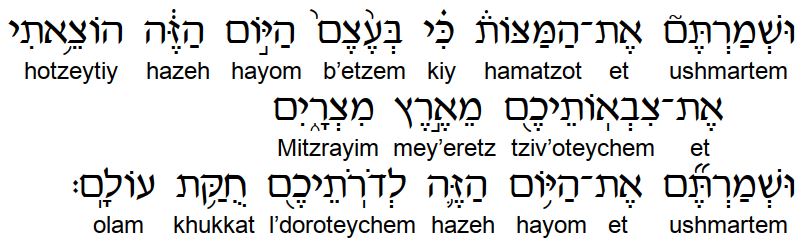
View whole verse and interlinear translation ...
The two halves of this verse, as laid out above, both start with the
verb וּשְׁמַרְתֶּם - the Qal 2mp affix form of the root
שָׁמַר, "to guard, keep, observe", with a vav-reversive
to turn a past event into a future instruction: and you shall keep. Many of
the Jewish commentators, ancient and modern, are fixated upon the object of
the first verb, הַמַּצּוֹת, literally "the unleavened breads" and
write at length about the need to watch and guard the matzah -
unleavened bread - that is eaten at the Pesach seder and for the
following seven days. Richard Elliott Friedman reports
that "the
What Is ...
Septuagint: Also known simply as LXX, the Septuagint is a translation of the whole of the Hebrew Scriptures into Greek, probably done during the 1st century BCE by the Jewish community in Alexandria to have the Scriptures in their "first" tongue; the quality is mixed - some parts, such as the Torah, were in frequent use and are quite well rendered, in other less used parts the translation is rather patchy and shows signs of haste; it was widely deprecated by the early rabbis
Septuagint and the Samaritan Pentateuch both have
'the commandment' (instead of 'unleavened bread'). The confusion may owe to
the fact that the words look the same in (unpointed) Hebrew consonants:
מצות."
Most English translations - including the NJPS version - ignore the Jewish commentators. Following the instructions given a few verses earlier - "This day shall be to you one of remembrance: you shall celebrate it as a festival to the L-RD throughout the ages; you shall celebrate it as an institution for all time" (Shemot 12:14, NJPS) - to celebrate the day as a festival, they insert the word 'feast' or 'festival' as we have done above. The ESV, for example, offers: "you shall observe the Feast of Unleavened Bread". This allows the "unleavened bread" to stand for the festival of unleavened bread starting the night of Pesach and lasting for seven days.
Curiously, at first glance our text seems to be a little confused
about its sense of time. The verb הוֹצֵאתִי - the Hifil
1cs affix form of the root יָצַה, to come out, so rendered here
as "I brought out" - is a past-tense, completed action form. But our text
comes in
The Name ...
HaShem: literally, Hebrew for 'The Name' - an allusion used to avoid pronouncing the Tetragrammaton, the so-called 'ineffable' name of G–d
HaShem's instructions to Moshe and Aharon that they
are to pass on to the Children of Israel while they are still in Egypt,
before the night of the tenth and last plague and Pharaoh commanding Israel
to leave his land immediately. We would therefore expect the verb, occurring
as it does in reported speech, to be a prefix, future-tense, incomplete
action form. At first glance, then, this appears to be an example of what
grammarians call the "affix of certainty": an action that is so certain to
happen that it can be spoken of as already completed.
Nahum Sarna adds a little theological top-spin and puts it this way: "the future is described as having already occurred because G-d's will inherently and ineluctably possesses the power of realisation so that the time factor is inconsequential." Another way of looking at it is to say that although this is spoken before it happened - in the hearing of the exit generation - so should have been future tense, but has been remembered by every subsequent generation - ever afterwards - as a past event. Brevard Childs says: "What happened 'that day' is to be remembered in Israel throughout all generations in the festival of unleavened bread."1
Coming back to the repeated verb, וּשְׁמַרְתֶּם, "and you
shall keep", the Torah makes a clear connection between the keeping of
the festival of Unleavened Bread and the keeping of the day. Rabbi
Who Is ...
Hirsch: Rabbi Samson Raphael Hirsch (1808-1888 CE), German rabbi, author and educator; staunch opponent of the Reform movement in Germany and one of the fathers of Orthodox Judaism
Hirsch points out that "this care which has to exercise our
minds already before the festival is at the same time taking care that the
day itself shall be kept, and ensures it against being forgotten or
neglected." The preparation for the festival - the clearing of our houses of
chametz, the clearing of our lives of sin - is not just for the day
itself, although that is what we actually observe, what we eat and drink, but
also for the keeping of the memory of which the day reminds us. And in the
keeping of the memory and the day, there is also a re-enactment of the
original event, a repetition of the salvation that G-d wrought for our
people, a bringing out of bondage into freedom.
Peter Enns comments: "This celebration is to be a lasting, eternal ordinance. Passover is not just an event, and it is not just for one night. The Israelites from now on are to remember this night, impress it on their collective consciousness and pass it on to their children. It is a reminder not just of what G-d has done but of what He continues to do."2 Just as we kept the festival of Matzah, Unleavened Bread, the first time and G-d brought us out of bondage/slavery, so each time we keep the festival - remembering the day and the miracle - so G-d brings us out afresh from the bondage/slavery we have acquired in our lives again each year. Hirsch again: "We are to meet the day of our exodus each time it recurs, with the presentation of carefully prepared unleavened bead." Terence Fretheim make the point that "in and through the celebration of the Passover G-d works salvation initially, and ever anew, in the lives of the participants, (re)constituting them as the redeemed exodus community."3
How many times, how many years, must the festival and the day be kept and remembered? The last phrase of our text tells us: "for your generations, a statute for ever." There is no limit and no count of years; this keeping is to be repeated without end, down through each generation and is to include teaching each generation to teach the next generation. The word לְדֹרֹתֵיכֶם, for your generations, compels us; simply keeping the festival and remembering the day in one generation is not enough - the memory and the practice must be passed on to the next generation. This is how we remember the key five 'w' words: who we are, what HaShem has done for us, why He did it, where we are going and when He will complete His promise. As exiles, we keep our festivals and days to remember both the memory of life before exile and the expectation of life after exile, the means and moment of redemption and how to recognise and anticipate our homecoming.
In her book about collective memory, Yael Zerubavel writes about the importance of repeated acts of commemoration that together build "a commemorative narrative, a story about a particular past that accounts for this ritualised remembrance and provides a moral message for the group members." Each act of commemoration "reconstructs a specific segment of the past" and these segments come together to create a master narrative that affirms group identity and preserves group memory of the group's shared past.4 "The holiday cycle, the annual calendar and the liturgical cycle typically disrupt the flow of time by highlighting recurrent patterns in the group's experiences."5 These repeated or rehearsed patterns build collective memories - "We did this ..." or "This happened ..." - which encourage the group's social identity and help to explain the distance between the group and others. In our context, keeping the festival keeps the memory; keeping the day for the generations to come makes it a part of our master narrative that tells us who we are.
As exiles we carry the burden of ensuring the survival not only of ourselves and this generation, but the survival and prospering of future generations of disciples of Yeshua. Certainly the initiative rests with our Father who calls, Yeshua who enables and the Spirit who empowers, but we must play our part in obedience to the Spirit and the words of Scripture to educate the next generation. We are to teach them the songs and stories of our shared past, to involve them in the commemorative acts and make sure that they understand our collective identity as the followers of Yeshua, His witnesses in this world in these days. As Leon Kass writes of the ancient Israelites: "The Children of Israel must leave Egypt already thinking about their children and their children's children, indeed, about their generations forever."6 So as we live in exile, as ambassadors and spokespeople for the kingdom of G-d, we must always be thinking about the next generations to come.
In this parasha, HaShem closes down Pharaoh's future - "Pharaoh will not heed you, in order that My marvels may be multiplied in the land of Egypt" (Shemot 11:9, NJPS), which ends in the next parasha, "Pharaoh's chariots and his army He has cast into the sea" (15:4, NJPS) - and teaches the Israelites to think about their future generations informed by their shared and taught memory of the past as a series of miracles wrought by Him. So Yeshua has closed down the enemy's future - "When He ascended on high He led a host of captives, and He gave gifts to men" (Ephesians 4:8, ESV) - and teaches us to think about the kingdom of G-d as "leaven that a woman took and hid in three measures of flour, until it was all leavened" (Luke 13:21, ESV). In part we do this by celebrating forever the event of our initial deliverance, waiting joyfully and expectantly for its fulfilment when Yeshua returns. Elsewhere, we live every day afresh to share and spread the good news with anybody and everybody who will listen - even, sometimes, those who won't but get to hear it anyway! - until Yeshua returns. That is what constitutes us as the redeemed exodus community.
1. - Brevard S. Childs, The Book of Exodus: A Critical, Theological Commentary, The Old Testament Library, (Louisville, KY: Westminster John Knox Press, 2004), page 199.
2. - Peter Enns, Exodus, The NIV Application Commentary, (Grand Rapids, MI: Zondervan, 2000), page 249.
3. - Terence E. Fretheim, Exodus, Interpretation, (Louisville, KY: Westminster John Knox Press, 2010), page 139.
4. - Yael Zerubavel, Recovered Roots - Collective Memory and the Making of Israeli National Tradition (Chicago, IL: Chicago University Press, 1995), page 6.
5. - Zerubavel, page 7. FootNoteRext(6) Leon R. Kass, Founding G-d's Nation - Reading Exodus (New Haven, Yale University Press, 2021), page 176.
Further Study: Shemot 10:1-2; Matthew 13:31-33; 1 Corinthians 5:6-8
Application: We live and move in the foreground of the kingdom, rejoicing always in Yeshua, to push the dysfunction of exile into the background. We choose the life of the kingdom over the life of the flesh and Yeshua makes us a part of His chosen and redeemed people - His exodus community in this generation. Make sure your choice is in the right place!
Comment - 10:51 31Jan25 HK: A wonderful educative drash as usual. The connection of the past, present and future for Jews and Gentiles as we await the coming of The Messiah.
Buy your own copy of the Drash Book for Exodus/Shemot now at Amazon US or Amazon UK.
© Jonathan Allen, 2025
| Messianic Trust Home Page | Join Weekly Email | More Weekly Drashot |
| Last Week |
Support the work of producing this weekly commentary
|
Next Week |
| Last Year - 5784 | Scripture Index | Next Year - 5786 |
|
Your turn - what do you think of the ideas in this drash ? Like most print and online magazines, we reserve the right to edit or publish only those comments we feel are edifying in tone and content. |