

|
Bo (Ex 10:1 - 13:16) |

| Messianic Education Trust | ||||||
|
|
|
|
||||
Shemot/Exodus 13:3 Remember this day when you came out from Egypt, from the house of slaves, because with strength of hand the L-rd brought you out from that

View whole verse and interlinear translation ...
Moshe says these words to the Israelites just after they have left
Egypt. Although
Who Is ...
Abraham Ibn Ezra: (1089-1167 CE), born in Tudela, Spain; died in the South of France after wandering all around the shores of the Mediterranean and England; a philosopher, astronomer, doctor, poet and linguist; wrote a Hebrew grammar and a commentary on the Bible
Ibn Ezra is quire definite that "Moshe said
this on the fifteenth day Nisan", during the day-light hours that immediately
followed the Israelite offering of the Pesach sacrifice in Egypt,
The Name ...
HaShem: literally, Hebrew for 'The Name' - an allusion used to avoid pronouncing the Tetragrammaton, the so-called 'ineffable' name of G–d
HaShem going through the land of Egypt killing all the
first-born and the Israelite departure from Egypt taking "their dough
before it was leavened, their kneading bowls wrapped in their cloaks upon
their shoulders" (Shemot 12:34, NJPS), the text is less clear
about the exact timing. Chapter twelve has already told us that "the
Israelites journeyed from Raamses to Succoth" (v. 37, NJPS),
something over a hundred miles which with "six hundred thousand men on
foot, aside from children ... and very much livestock, both flocks and herds"
(vv. 37-38, NJPS) must have been several days travelling, at the
very least. On the other hand, the narrator may have been giving us the
outline of the first few days of the journey before stepping back into the
detail. We'll come back and have another look at this later.
Moshe's first word,  , is an odd
linguistic choice for this position. Grammatically, it is a Qal
infinitive absolute, which should usually be coupled with another form of the
same root - in this case
 , the Qal
imperative of the root
 , would seem the most
appropriate, to match the plural 'you' if the following words - giving the
sense of "remember, to remember", giving the idea of continual remembering.
This idea seems to have been picked up by
Who Is ...
Rashi: Rabbi Shlomo Yitzchaki (1040-1105 CE), French rabbi who wrote commentaries on the Torah, the Prophets and the Talmud, lived in Troyes where he founded a yeshiva in 1067; focuses on the plain meaning (p'shat) of the text, although sometimes quite cryptic in his brevity
Rashi, who reports
that, "this teaches us that we should mention the exodus from Egypt every
day." The
What Is ...
The Mekhilta: The earliest known halakhic midrash or commentary on (parts of) the book of Exodus; formally named for Rabbi Ishmael and therefore set around 100-135CE, it was redacted some years after his time; quoted many times in the Bavli Talmud as "Rabbi Ishmael taught ..."
Mekhilta too seems to suggest that this means that
"the exodus should be mentioned in the daytime." The
Who Is ...
Gersonides: Rabbi Levi ben Gershom, Gersonides or Ralbag (1288-1344 CE); famous rabbi, philosopher, mathematician and astronomer/astrologer; born at Bagnols in Languedock, France; wrote a commentary on the Torah and a parallel to Maimonides' Guide For The Perplexed
Ralbag
comments that "remembering something means to mention it out loud."
Davidson gives the meaning of
as "to remember, recollect, call to mind." David Clines adds "to be faithful
to" someone or something or "to take into consideration" and "to make mention
of" something.1Nahum Sarna writes that "the
Hebrew root connotes much more than the recall
of things past. It means, rather, to be mindful, to pay heed, signifying a
sharp focusing of attention upon someone or something. It embraces concern
and involvement and is active not passive, so that it eventuates in action.
As b. Menakhot 43b has it: 'Looking upon leads to remembering,
and remembering leads to action.'" The Israelites are expected to do more
than simply remember the exodus from Egypt; the memory is to galvanise them
into action: they have to do something as well as remembering.
The phrase 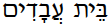 , literally "house of
slaves", describes Egypt, from where the Israelites have been brought.
Sarna connects the phrase to archaeological evidence from the
Valley of the Kings: "the Egyptian practice of settling the labour gangs in
workmen's villages in proximity to the site of the project for which they
were conscripted. These villages were wholly enclosed by walls." Gersonides
thinks of this too, as a reference to the country as a whole: "the land in
which you were shut up, as slaves are locked into a house to keep them from
fleeing." Rabbi
Who Is ...
Hirsch: Rabbi Samson Raphael Hirsch (1808-1888 CE), German rabbi, author and educator; staunch opponent of the Reform movement in Germany and one of the fathers of Orthodox Judaism
Hirsch explains that "Egypt was for the whole
nation a house of slaves; they were all born slaves. The strong hand of G-d
alone saved them out of it. At the recurrence of the date of the day of
deliverance, this fact was for ever to be brought to their minds." Now
coming back to the command to remember, Umberto Cassuto adds: "Remember - for
all generations to come - this day, in which you came out - and remember that
you succeeded in coming out only on account of the fact that by strength of
hand the L-rd brought you out."2
In the second phrase, the words  form a
construct, "with strength of hand". This phrase occurs another twice in the
same aliyah, in verses 14 and 16, in both cases translated "with a
mighty hand" (NJPS) or "with a strong hand" (ESV). There is another close
Hebrew equivalent,
 , in verse 9, that is
translated the same way. Why does HaShem's strong hand get so much
attention? Because as Cassuto has just told us, it was entirely and only the
strength of HaShem's hand that rescued our people from slavery in Egypt. We
are not just to remember that we were brought out of slavery, but how and by
whom. We did nothing; He did everything. The agency is His alone.
Perhaps the meaning of Moshe's words depends on where you place the commas. Is it "remember, this day, when ...", where "this day" means today, the present day in each generation, and when refers to the day we were brought out of Egypt? This is what Rashi and the Ralbag are saying: there is an obligation upon the Jewish people to remember and - even if only briefly - mention the exodus out loud to one another each and every day. Or should it be "remember this day when ..." where "this day" is the anniversary of the day when we were brought out of Egypt? This is the position taken by many other commentators and the Pesach Hagaddah when it recounts that Rabbi Eliezer, Rabbi Yehoshua, Rabbi Elazar ben Azaryah, Rabbi Akiva and Rabbi Tarfon shared a seder one year in B'nei Brak and "discussed the Exodus from Egypt all that night, until their students came and said to them: 'Our teachers, it is time for the reading of the morning Sh'ma.'"
All this in turn leads us on to the deeper meaning of Moshe's instructions. Why the constant repetition? Why stay up all night? Terence Fretheim answers that "this is not simply the means by which Israel engages in the recollection of the past; the memory language has a deeper significance. As with Passover, the concrete and replicative nature of each of the rituals indicates that they are vehicles in and through which G-d effects salvation for each new generation. ... The concern is that the redemptive experience be a living reality for each Israelite in every age."3 By telling the story, by keeping it fresh in our minds, the redeeming power of G-d is constantly refreshed in us as we remember not only that we were brought out of Egypt, but that it was exclusively done by G-d's strong hand. He, our great G-d, rescued us, His people; He took us into the wilderness, gave us His Torah and provided not only our food, but the very clothing on our backs and the sandals on our feet (D'varim 29:5), until He brought us to the Promised Land, His Land, which He gave to us. In the process He forged our identity as a people, as Peter Enns notes: "Israel's identity is a function of what G-d has done for them."4
Today, as the people of G-d called in Yeshua the Messiah - both Jews and Gentiles, called from around the world and from the nations as well as Israel - we have the responsibility to continue to tell the story. Of course, we are charged with telling the story to other people, people who do not yet know Yeshua, so they too may may become part of the kingdom of G-d, that they may be reconciled with G-d in Yeshua. That goes without saying as our primary command from the mouth of Yeshua Himself: "Go and make disciples ..." (Matthew 28:20). We all do that every day, right? But how do we know what to say others if we do not tell the story to ourselves? I don't mean how can we expect to be fluent with our script and our testimony unless we rehearse it lots of times. The best script in the world, a perfect delivery and the most amazing testimony under heaven are just empty words unless the story they tell is real and alive; unless we are real and alive. Otherwise we are just parrots or old, stale recordings.
Our story is this: we were blind and deaf, bound in sin and dead to our Father in heaven. But Yeshua heard our cries and our misery and, remembering His covenant - that "everyone who calls on the name of the Lord will be saved" (Romans 10:13, ESV) - reached out to us, opened our ears and invited us into His kingdom; He made a way, through His cross, death and resurrection, for us to be forgiven, redeemed and healed; He gave us His Spirit that we might live in Him and He in us and He will "raise [us] up on the last day" (John 6:54) so that we might be with Him for ever. Of course, you know all that: Basic Gospel 101. Just suck here, Granny! But do we remind each other of these truths? Do we let them soak in and become every day reality in our lives? Peter Enns again: "Repetition and familiarity work. What is repeated becomes familiar and this becomes a part of us."5 Then the story that we tell becomes our story, it becomes alive and vibrant - it forms our identity and Yeshua is our story. Then the script, overcoming objections and 'closing' become irrelevant as the Spirit tells the story and invites people to connect with Yeshua. He has become us! It is the strength of His hand at work!
1. - David J. A. Clines (ed.) The Concise Dictionary of Classical Hebrew, (Sheffield: Sheffield Phoenix Press, 2009), page 100.
2. - Umberto Cassuto, A Commentary on the Book of Exodus, (Magnes Press, Jerusalem, 1983), page 151.
3. - Terence E. Fretheim, Exodus, Interpretation, (Louisville, KY: Westminster John Knox Press, 2010), page 147.
4. - Peter Enns, Exodus, The NIV Application Commentary, (Grand Rapids, MI: Zondervan, 2000), page 252.
5. - Enns, page 262.
Further Study: Psalm 78:1-7; Joel 1:1-3; Colossians 1:11-14
Application: Do you tell the story in some way every day? Do you regularly share the exciting things that Yeshua has done - and is still doing! - to bless and encourage others: family, friends and fellow disciples? Start today and develop the habit. Invite the Holy Spirit to speak through you and bring your words to life - to make your words His words. See the might hand of Yeshua at work today!
Buy your own copy of the Drash Book for Exodus/Shemot now at Amazon US or Amazon UK.
© Jonathan Allen, 2024
| Messianic Trust Home Page | Join Weekly Email | More Weekly Drashot |
| Last Week |
Support the work of producing this weekly commentary
|
Next Week |
| Last Year - 5783 | Scripture Index | Next Year - 5785 |
|
Your turn - what do you think of the ideas in this drash ? Like most print and online magazines, we reserve the right to edit or publish only those comments we feel are edifying in tone and content. |