

|
B'Midbar (Num 1:1 - 4:20) |

| Messianic Education Trust | ||||||
|
|
Always Being Ready
|
|
||||
B'Midbar/Numbers 4:2 Take a census of the sons of K'hat from among the sons of Levi, according to their clans, to the house of their fathers.
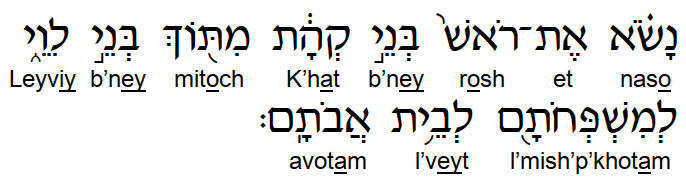
View whole verse and interlinear translation ...
This is only the second time the phrase "take a census" has been used in the Torah; it only occurs as a command five times, plus once more as a negative instruction, "you shall not take a census", all in B'Midbar, the fourth division of the Torah. The first is the main census that Moshe and Aharon are instructed to take of the Israelites who can go out to war at the beginning of the parasha: "Take a census of the whole Israelite community by the clans of its ancestral houses, listing the names, every male, head by head. You and Aharon shall record them by their groups, from the age of twenty years up, all those in Israel who are able to bear arms" (B'Midbar 1:2-3, NJPS). Although all the male Levites have just been counted in the fifth aliyah, "Record the Levites by ancestral house and by clan; record every male among them from the age of one month up" (3:15. NJPS), and the first-born males of Israel have been counted at the beginning of the sixth aliyah, "Record every first-born male of the Israelite people from the age of one month up" (v. 40, NJPS), both of these used the verb פְּקֹד - the Qal ms imperative from the root פקד, to visit, punish, count, record, muster, etc.
Our text is the second time נָשֹׂא אֶת־רֹאשׁ is used,
counting the Levite clan of Kohath; the third will be the parallel count of
the clan of Gershon, but the count of the third Levite clan, Merari, goes
back to פקד. The last two instances are used thirty-eight
years later by
The Name ...
HaShem: literally, Hebrew for 'The Name' - an allusion used to avoid pronouncing the Tetragrammaton, the so-called 'ineffable' name of G–d
HaShem to Moshe and Elazar, the son of Aharon,
after the plague that followed the sin of Pe'or, when Israel are numbered for
a second time before they enter the Land. Our English phrase "take a census"
is an idiomatic translation of the Hebrew נָשֹׂא אֶת-רֹאשׁ, which
actually means "lift the head"; the verb נָשֹׂא is the
Qal infinitive form of the root נשׂא, to lift or carry,
and represents the action of making individual contact with each and every
man being counted. This is an important act of statement: you matter!
Rather than simply being counted in lines, ranks or squares, every single man is to be counted and acknowledged by lifting their head and looking them in the eye. One can see the importance of this for those serving in the army; you don't send a man out to die for you without looking him in the eye and making sure that he knows that you care and that his life is important. Similarly, the members of the Kohathite clan will be carrying the holiest items of the whole Tabernacle: the ark, the altars, the menorah, the shewbread and all their jugs, tools and equipment. This is not a risk-free occupation: "Since Kohathies will transport sacred vessels for which they have not been sanctified, the priests need to be especially vigilant in their supervision"1 so that the Kohathites "do not come in contact with the sacred objects and die" (4:15, NJPS). One slip and, like Uzzah - the son of Abinadab, who is often taken, although not explicitly stated, to be a Levite - who put out his hand to stop the Ark falling off its cart when the oxen stumbled at the threshing floor of Nacon and "the L-RD was incensed at Uzzah. And G-d struck him down on the spot for his indiscretion, and he died there beside the Ark of G-d" (2 Samuel 6:7, NJPS), judgement may strike.
After the incident with Uzzah, King David became frightened of having the Ark among the people, it was just too dangerous: "David was afraid of the L-RD that day; he said, 'How can I let the Ark of the LORD come to me?'" (v. 9, NJPS). The narrator tells us that "David would not bring the Ark of the L-RD to his place in the City of David" (v. 10, NJPS) and instead arranged for it to be held at "the house of Obed-edom the Gittite" (ibid.). Nevertheless, because of the blessing that was poured out on Obed-edom and his household over the following months, David reconsidered: "David went and brought up the Ark of God from the house of Obed-edom to the City of David, amid rejoicing" (v. 12, NJPS). As Dennis Olson points out, "It is only with G-d's presence among them, dangerous as that may be, that Israel has a future. Without G-d in their midst, G-d's people will be lost."2
Just as the first census recorded those who were physically fit for
battle, "all those in Israel who are able to bear arms" (B'Midbar 1:3,
NJPS), the second census records those who "are subject to
service, to perform tasks for the Tent of Meeting ... the most sacred
objects" (4:3-4, NJPS).
Who Is ...
Rashi: Rabbi Shlomo Yitzchaki (1040-1105 CE), French rabbi who wrote commentaries on the Torah, the Prophets and the Talmud, lived in Troyes where he founded a yeshiva in 1067; focuses on the plain meaning (p'shat) of the text, although sometimes quite cryptic in his brevity
Rashi says this means,
"Count from among them those who are fit for the work of carrying." Although
not obviously couched in those terms, this too is part of warfare; the Hebrew
text in both 1:3 and 4:3 uses the word צַבַא, usually
translated 'host' or 'army' and one of Tanakh's names for HaShem
Himself is יהוה צְבָאוֹת, the L-rd of Hosts. Both the physical
army and the ritual or liturgical army are engaged in warfare and HaShem is
Lord of both. In the case of the priests and Levites, they are engage in
spiritual warfare, to ensure the correct separation of the holy and the
profane, protecting both the holiness of the ritual objects and the lives of
the people as Torah has already told us: they "must distinguish
between the sacred and the profane, and between the unclean and the clean;
and must teach the Israelites all the laws which the L-RD has imparted to
them through Moshe" (Vayikra 10:10-11).
The consensus of Tanakh is against taking a census unless divinely instructed - as these in B'Midbar are. HaShem tells Moshe, "When you take a census of the Israelite people according to their enrollment, each shall pay the L-RD a ransom for himself on being enrolled, that no plague may come upon them through their being enrolled" (Shemot 30:12, NJPS), specifying a ransom payment that each man must pay to avoid a plague. This is exactly what happens when David insisted on taking a census of Israel: "The L-RD sent a pestilence upon Israel from morning until the set time; and 70000 of the people died, from Dan to Beer-sheba" (2 Samuel 24:15, NJPS). However, in one of His teachings, Yeshua seems to suggest that evaluating one's resources - both financial and military - is not only a common-place but a necessary part of being a disciple: "Which of you, desiring to build a tower, does not first sit down and count the cost, whether he has enough to complete it?" (Luke 14:28, ESV and "What king, going out to encounter another king in war, will not sit down first and deliberate whether he is able with ten thousand to meet him who comes against him with twenty thousand?" (v. 31, ESV).
Given that the followers of Yeshua are clearly involved in many forms of spiritual warfare - holding ground that He gives us, pushing back against the onslaught of the enemy against our people, speaking against anti-Semitism and defending the people of Israel, declaring the good news of the kingdom of G-d, releasing captives and announcing freedom for prisoners, not to mention healing the sick and raising the dead, as well as apparently more mundane activities such teaching, praying for and encouraging each other - warfare and conflict are inevitable. Believers are often asked to undertake jobs and assignments that may include a measure of risk - being a missionary in most Middle-eastern countries, for example, or providing door security at Jewish events - and it is essential that people understand the risks to which they are being exposed. We should always be ready to look people straight in the eye, particularly those for whom we have a measure of responsibility, tell them the truth and let them know that they are important, that we care and - as far as possible - will protect them.
The principle of eye contact is critical in the way we engage in all our relationships. Mark reports an occasion when Yeshua interacts with a man who came to ask Him about inheriting eternal life. Mark says that “Yeshua, looking at him, loved him” (Mark 10:21), The Greek text uses a participle form of the verb evmble,pw, to look at or fix one’s eyes upon, and gives us a clue to the intensity of Yeshua’s concern for the man. Not only did He grant him explicit attention, continuing to look him straight in the eye, but He reached out to him with love and concern - the text uses a form of the verb avgapa,w, to love or cherish, to show great solicitude for - providing a real, if difficult for him to accept, answer to his question: "You lack one thing: go, sell all that you have and give to the poor, and you will have treasure in heaven; and come, follow Me" (ibid.). Here was no small talk; no sidling up to it in soft words. Yeshua could see and hear the seriousness in the man’s tone and read it in his eyes; he was really searching. He got a straight answer!
We can see the struggle and disappointment in the questioner as Mark tells us what happened next: "Disheartened by the saying, he went away sorrowful, for he had great possessions" (v. 22, ESV); the man was distressed and sad, for the price seemed just too high. Perhaps we can hear Yeshua's disappointment too in His comment to the disciples: "How difficult it will be for those who have wealth to enter the kingdom of God!" (v. 23, ESV); surely there is a sigh that comes straight from Yeshua's heart to accompany His words - He is grieved and saddened that the man found it impossible to engage and continue the conversation. Would that the man could have stayed and hear Yeshua say, "All things are possible with God" (v. 27, ESV). That would have given him hope and perhaps even courage to take the step of becoming a disciple. It would be nice to think that the man came back later and was able to take Yeshua up on His offer, but Mark doesn't provide any clues, so we just don't know.
What does matter is that we make eye contact with the folk that Yeshua brings into our path, that we emphasise our words - our love and concern for them - by looking them straight in the eye as we speak. This lets them know that we are genuine and mean what we say, that we care for them and that we have taken them seriously. That is what Yeshua did and we must follow His example. Lives depend upon it!
1. - L. Michael Morales, Numbers 1-19, Apollos Old Testament Commentary, (London, Apollos, 2024), page 130.
2. - Dennis T. Olson, Numbers, Interpretation, (Louisville, KY: Westminster John Knox Press, 2012), page 30.
Further Study: Luke 22:61; John 1:40-42; 1 Timothy 6:17-19
Application: Ask the Master to teach you to make eye contact as He did; not to dominate or stare people out, not to embarrass or mock, but to show friendship, concern, appreciation and integrity. It may take a little practice, but His love in our eyes will open the door of the kingdom to those who are seeking.
Comment - 16:16 10May23 FB: Valid point here expressed: to look into the eyes in concern for their welfare. However this varies from culture to culture. It can appear to be intimidating or even threatening and challenging; much depends on status and relational standing.
Reply - This is such a useful observation, thank you. We must be careful not to express our concern and commitment is a way that is inappropriate in a culture or relational context, that could end up conveying the opposite of what we intended. Most of us, in our home culture, would be on fairly safe ground making that expression in a way that would be correctly received and understood by those around us. Extra care and thought will be needed to communicate our genuine intent in a culture that is not our own and with whose social etiquette we are less familiar.
Buy your own copy of the Drash Book for Numbers/B'Midbar now at Amazon US or Amazon UK.
© Jonathan Allen, 2026
| Messianic Trust Home Page | Join Weekly Email | More Weekly Drashot |
| Last Week |
Support the work of producing this weekly commentary
|
Next Week |
| Last Year - 5785 | Scripture Index |
|
Your turn - what do you think of the ideas in this drash ? Like most print and online magazines, we reserve the right to edit or publish only those comments we feel are edifying in tone and content. |