

|
B'har (Lev 25:1 - 26:2) |

| Messianic Education Trust | ||||||
|
|
|
|
||||
Vayikra/Leviticus 25:55 For the Children of Israel are slaves to Me; they are My slaves, whom I brought out from the land of Egypt
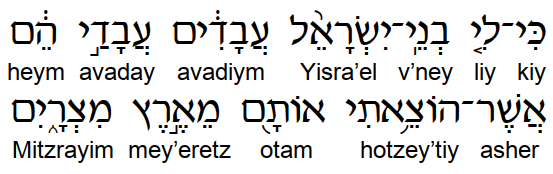
View whole verse and interlinear translation ...
In a world where the word 'slavery' or its base noun 'slave' carries
much - and, often, heated - political, social and emotional baggage, these
words of
The Name ...
HaShem: literally, Hebrew for 'The Name' - an allusion used to avoid pronouncing the Tetragrammaton, the so-called 'ineffable' name of G–d
HaShem, spoken through Moshe some three and a half
thousand years ago, are liable to cause embarrassment or at least a certain
amount of confusion. To churches currently locked in uncommonly agonised or
acrimonious debate over their responsibility for past slavery, the
practicality or meaning of financial reparations, or the possibility of
remaining residual attitudes resembling those of the past, these words are
unwelcome and - if read at all - are at the same time condemned and dismissed
as an archaic human product of their age rather that anything that G-d could
possibly say today.
Surprisingly, though, both Tanakh and the Apostolic Writings make significant use of the term 'slave' and, rather than shying away from its dark side, redeem it by using it to describe the position of a faithful follower of G-d of Israel and a genuine disciple of Yeshua. Yet the word goes much further than the mild and seemingly innocuous 'disciple' - someone who learns from a teacher - to describe a deep and rich relationship based on the fundamental premise of ownership. Time and again, from our text above from the Torah, through the prophets, writings and letters, to the words of Yeshua recorded in the gospels, Scripture does not flinch from proclaiming G-d's ownership over His creatures and the role of the follower as a slave.
Biblical Hebrew has a linguistic ambiguity: the original language word for 'slave' is also used for 'servant'. The root עָבַד - used some 290 times in Tanakh - means to work or labour, to serve or worship.1 It is applied to tilling the ground, cultivating a garden or a vineyard, performing work or service, serving G-d or idols. The derivative noun עֶבֶד appears over 800 times, both as servant or slave; for rulers as a vassal to a superior, as loyal subjects of a king, officials and courtiers.2 HaShem refers to Moshe as "His servant Moses" (Shemot 14:31), David as "My servant David" (2 Samuel 3:18) and Avraham as "My servant Abraham" (B'resheet 26:24) as His servants. Job too falls into this category as HaShem asks the adversary, "Have you noticed My servant Job?" (Job 1:8). Avraham has a faithful steward whom he trusts to find a wife of Yitz'khak - "Avraham said to his servant, the oldest of his household, who had charge of all that he had ..." (B'resheet 24.2, NJPS) - while Potiphar's wife makes accusations of Yosef: "The Hebrew slave whom you brought into our house came to me to dally with me" (39:17, NJPS).
Which meaning should we read in our text? Jewish tradition is very
clear that 'slave' is the correct meaning, here and in similar texts. The
relationship between HaShem and the Israelites is consistently portrayed as
that of master and slave rather than employer and servant; ownership is the
essence of the matter. Moshe, for example, reminds the Israelites:
"Remember that you were a slave in the land of Egypt and the L-RD your G-d
freed you from there with a mighty hand and an outstretched arm" (D'varim
5:15, ESV). In a typically pithy comment to our text,
Who Is ...
Rashi: Rabbi Shlomo Yitzchaki (1040-1105 CE), French rabbi who wrote commentaries on the Torah, the Prophets and the Talmud, lived in Troyes where he founded a yeshiva in 1067; focuses on the plain meaning (p'shat) of the text, although sometimes quite cryptic in his brevity
Rashi puts these words in HaShem's mouth: "My contract comes
first." Baruch Levine explains that "G-d acquired the
Israelites as His 'slaves,' by redeeming them from Egyptian bondage. His
claim has priority." This is as if HaShem bought - or, perhaps more
correctly, repossessed - the Israelites from Egyptian ownership and slavery.
Rabbi
Who Is ...
Hirsch: Rabbi Samson Raphael Hirsch (1808-1888 CE), German rabbi, author and educator; staunch opponent of the Reform movement in Germany and one of the fathers of Orthodox Judaism
Hirsch provides more words for HaShem: "Every fibre of
your being, every fraction of your strengths and powers belong to Me, you
cannot transfer it to the binding ownership of another." Put simply, "G-d
redeemed His people from Egyptian slavery, to become His
slaves."3
Being HaShem's slave has advantages: knowing who is in charge and
where the next meal is coming from. Those Israelites who tried to forget
these facts of life found themselves on the rough side of the relationship,
experiencing discipline to bring them back into line and the place of
blessing. The Chronicler reports that an army of Arameans came against King
Joash and took great spoil from Jerusalem after he had turned away from
HaShem: "Indeed the army of the Arameans came with a small number of men;
yet the L-RD delivered a very great army into their hands, because they had
forsaken the L-RD, the G-d of their fathers. Thus they executed judgment on
Joash" (2 Chronicles 24:24, NASB). The
Who Is ...
Bekhor Shor: Joseph ben Isaac Bekhor Shor; a twelfth century French tosafist, commentator and poet; he lived in Orleans and was a pupil of the Rashbam and Rabbenu Tam; wrote a commentary to the Torah and made contributions to the Talmud commentaries; followed the p'shat method of interpretation in the style of Rashi, to the extent of rationalising many miracles
Bekhor Shor
would have HaShem say, "I keep you and your land free," thus making His
ownership of His people on a par with His irrevocable ownership of the Land
itself.
It is therefore inconceivable that Israelites should become slaves of other nations or peoples, taking them away from serving HaShem as their top priority. Even if they were to be sold as slaves to foreigners - the context of our text - they are still expected, and their owners are expected to allow them, to observe shabbat and keep all the feasts. Rabbinic Judaism interprets Hebrew slavery to a Hebrew owner as indentured service, almost akin to being a hired servant. Hirsch tells us that "the fact that G-d is the Master raises His slaves above all other slavery and makes them unable to allow themselves to be bound in the bonds of any other master." Gordon Wenham agrees: "It is unfitting, therefore, that an Israelite should be resold into slavery, especially to a foreigner."4
In today's modern world, there is a significant reluctance to accept that followers of Yeshua - whether Jew or Gentile - belong to Him. Surely, Yeshua himself taught that is was all about knowing the truth: "you shall know the truth, and the truth shall make you free" (John 8:32, NASB). There it is: if we know the truth then we shall be free - and freedom is the opposite of slavery, right? No, not quite. We need to see the rest of the sentence: "If you abide in My word, then you are truly disciples of Mine; and you shall know the truth, and the truth shall make you free" (John 8:31-32, NASB). Knowing the truth is a consequence of being a disciple of Yeshua, and in order to be a disciple we have to abide in His word - that means consistently doing what He says, obeying Him, following His directions and instructions: every time, every day. As Mark Rooker puts it: "It is the believer's responsibility to trust, be obedient and seek the rule of G-d in every arena of life."5 Just a couple of verses later, Yeshua makes it plain that what we do shows whose slave we are: "Truly, truly, I say to you, everyone who commits sin is a slave to sin" (v. 34, NASB).
Rav Sha'ul is very clear where the lines are drawn: "Or do you not know that your body is a temple of the Holy Spirit within you, whom you have from G-d? You are not your own, for you were bought with a price. So glorify G-d in your body" (1 Corinthians 6:19-20, ESV). He uses the same words again in the next chapter: "You were bought with a price; do not become slaves of men" (7:23, ESV). There's that ownership theme again; we belong to Yeshua because He has bought us. In fact, Peter tells us that "you were ransomed from the futile ways inherited from your forefathers, not with perishable things such as silver or gold, but with the precious blood of Messiah, like that of a lamb without blemish or spot" (1 Peter 1:18-19, ESV). John echoes that in his apocalyptic vision where Yeshua is acclaimed: "Worthy are you to take the scroll and to open its seals, for you were slain, and by your blood you ransomed people for God from every tribe and language and people and nation" (Revelation 5:9, ESV).
Let's go back to Sha'ul's argument and see how it applies to us. He starts with a question: "Do you not know that if you present yourselves to anyone as obedient slaves, you are slaves of the one whom you obey, either of sin, which leads to death, or of obedience, which leads to righteousness?" (Romans 6:16, ESV), then explains that "you who were once slaves of sin have become obedient ... and, having been set free from sin, have become slaves of righteousness" (vv. 17-18, ESV). When we come to faith in Yeshua, we are transferred - that is, set free - from the ownership of sin and death to the ownership and command of Yeshua. He paid the ransom price to release from slavery to sin, leading to death, that we might - like the Israelites - become the slaves of G-d, bound to obey Him and carry out His commands. We are free, yes, but free to obey Yeshua - and that leads to holiness and eternal life. This is what Yeshua expects: "If you keep My commandments, you will abide in My love; just as I have kept My Father's commandments, and abide in His love" (John 15:10, NASB) - that we should keep His commandments with the same level of commitment and purpose as He does.
Yeshua calls us His friends if we do as He has commanded us (John 15:14); friends rather than slaves. We are to be free from and separate from the world, free from its lies and delusions, its jealousies and addictions, its tawdry false values and behaviour, so that as friends to Yeshua we can represent Him faithfully in the world and proclaim His invitation for others to join Him in that freedom for ever!
1. - David J. A. Clines (ed.) The Concise Dictionary of Classical Hebrew, (Sheffield: Sheffield Phoenix Press, 2009), pages 305-306.
2. - Clines, page 306.
3. - Gordon J. Wenham, The Book of Leviticus, NICOT, (Grand Rapids, MI: Eerdmans, 1979), page 322.
4. - Wenham, page 323.
5. - Mark F. Rooker, Leviticus, The New American Commentary, (Nashville, TN: B&H Publishing Group, 2000), page 312.
Further Study: Matthew 12:50; Luke 12:4; John 14:13-15; Galatians 5:1
Application: Do you serve the L-rd in freedom or from a sense of obligation? Do you think of Yeshua as your colleague and co-worker (1 Corinthians 3:9) or your taskmaster? Check in with Yeshua today and let His freedom be your watchword from now on.
Buy your own copy of the Drash Book for Leviticus/Vayikra now at Amazon US or Amazon UK.
© Jonathan Allen, 2024
| Messianic Trust Home Page | Join Weekly Email | More Weekly Drashot |
| Last Week |
Support the work of producing this weekly commentary
|
Next Week |
| Last Year - 5783 | Scripture Index | Next Year - 5785 |
|
Your turn - what do you think of the ideas in this drash ? Like most print and online magazines, we reserve the right to edit or publish only those comments we feel are edifying in tone and content. |