

|
Acharei Mot (Lev 16:1 - 18:30) |

| Messianic Education Trust | ||||||
|
|
|
|
||||
Vayikra/Leviticus 18:28 Do not let the land vomit you out when you have defiled it, just as it vomited out the nation that was before you.
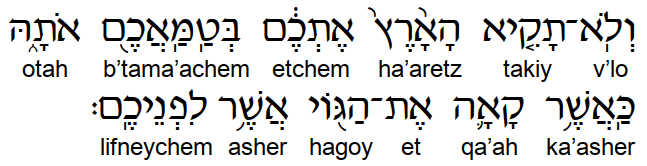
View whole verse and interlinear translation ...
After a whole chapter of forbidden sexual activity, Moshe delivers
The Name ...
HaShem: literally, Hebrew for 'The Name' - an allusion used to avoid pronouncing the Tetragrammaton, the so-called 'ineffable' name of G–d
HaShem's verdict that such practices are incompatible with
being part of His people and dwelling in His land. To make the point clear,
Moshe ascribes a physical human action - vomiting - to the land to indicate
the level of revulsion HaShem feels about these things and the consequences,
almost as if they are automatic and cannot be stopped: "vomiting is probably
the most violent of all bodily reactions."1 The verb
קוֹא, "to vomit, spew out" (Davidson) appears
twice in the verse, describing the reflexive nature of the reaction of the
land to being defiled: the people will be ejected or expelled from the land.
The land cannot - and will not - tolerate sexual sin and perversion. Tamar
Kamionkowski observes that "the land has no Day of Atonement for an annual
cleansing of the sanctuary, so its only avenue for cleansing is
vomiting."2
What Is ...
Targum Onkelos: An early (1st-2nd Century CE) translation/paraphrase of the Torah into Aramaic; attributed to a Roman convert to Judaism, Onkelos; used in Babylonian synagogues during the Talmudic era
Targum Onkelos changes both instances of the Hebrew verb
קוֹא to the Aramaic רוֹקֵן, "to empty or drain"
(Jastrow) - תָקִיא, the Qal 3fs prefix,
becomes תְרוֹקֵן and קָאָה, the the Qal 3fs
affix, becomes דְרוֹקֵינַת - to be more delicate and to show the
completeness of the action: nothing and nobody will remain. As Mark Rooker
reports, "this imagery indicates that nature itself takes vengeance upon
crass moral deviation."3 The Torah goes on to make sure
that the personal consequences of forbidden sexual activity are also
understood: "All who do any of those abhorrent things -- such persons
shall be cut off from their people" (Vayikra 18:29, NJPS). Walter
Kaiser explains that "just as the Canaanites had been expelled from the very
same territory prior to the coming of Israel for disobeying the very same
principles of a holy G-d, so it would happen to Israel for the same
reasons."4
We can see that the creation narrative shows from the beginning how human sin defiles the land. At the end of a very full day of creating all the creatures on the earth - cattle, wild beasts, creeping things (B'resheet 1:25) - culminating in the creation of mankind "in His image, in the image of G-d" (v. 27), the narrator tells us that "G-d saw everything that He had made, and behold, it was very good" (v. 31). Yet just two chapters later, after Adam and Eve have sinned by disobeying G-d's order not to eat the fruit of the "tree of the knowledge of good and evil" (2:17, 3:6), HaShem tells Adam, "Cursed be the ground because of you; by toil shall you eat of it all the days of your life" (3:17). Because of their sin, the ground is cursed. Following the killing of Abel by his brother Cain, the Torah reports that G-d can hear the ground crying out for justice (4:10-11).
Isaiah the prophet confirms that link between sin and the cursing of the land: "The earth lies defiled under its inhabitants; for they have transgressed the laws, violated the statutes, broken the everlasting covenant. Therefore a curse devours the earth, and its inhabitants suffer for their guilt; therefore the inhabitants of the earth are scorched, and few men are left" (Isaiah 24:5-6, ESV). Rav Sha'ul explains that "the whole creation has been groaning together in the pains of childbirth until now" (Romans 8:22, ESV), waiting for G-d's children to be revealed - when Yeshua returns - so that "creation itself will be set free from its bondage to corruption and obtain the freedom of the glory of the children of G-d" (v. 21, ESV). Creation itself will be restored to its full glory as the work of G-d's hands - when Yeshua returns and takes His rightful place as the King of Israel: the "king of kings and lord of lords" (Revelation 19:16).
In the Haftarah portion for this parasha, the prophet Ezekiel arraigns the city of Jerusalem - perhaps as metonymy for the whole kingdom of Judah - for the blood that has been shed in her midst: "Fathers and mothers have been humiliated within you; strangers have been cheated in your midst; orphans and widows have been wronged within you. You have despised My holy things and profaned My sabbaths" (Ezekiel 22:7-8, NJPS). Not only have the men of the city participated in many of the forbidden sexual activities of Vayikra 18 - "they have uncovered their fathers' nakedness; in you they have ravished women during their impurity. They have committed abhorrent acts with other men's wives; in their depravity they have defiled their own daughters-in-law; in you they have ravished their own sisters, daughters of their fathers" (v. 10-11, NJPS) - but "they have taken bribes within you to shed blood. You have taken advance and accrued interest; you have defrauded your countrymen to your profit. You have forgotten Me -- declares the L-rd G-D" (v. 12, NJPS). Because of these sins, HaShem declares, "I will scatter you among the nations and disperse you through the lands" (v. 15, NJPS). Ezekiel has broadened the list of bad behaviour beyond that given in Vayikra 18, but the consequences are the same: exile - the land will vomit them out.
Rav Sha'ul clearly does the same thing. To the Corinthians he writes, "Do you not know that the unrighteous will not inherit the kingdom of G-d? Do not be deceived: neither the sexually immoral, nor idolaters, nor adulterers, nor men who practice homosexuality, nor thieves, nor the greedy, nor drunkards, nor revilers, nor swindlers will inherit the kingdom of G-d" (1 Corinthians 6:9-10, ESV). By this, those practices are mutually incompatible with life - now and into eternity - in the kingdom of G-d. The Galatians are sent a slightly different list - "Now the works of the flesh are evident: sexual immorality, impurity, sensuality, idolatry, sorcery, enmity, strife, jealousy, fits of anger, rivalries, dissensions, divisions, envy, drunkenness, orgies, and things like these. I warn you, as I warned you before, that those who do such things will not inherit the kingdom of G-d" (Galatians 5:19-21, ESV) - but with a very similar core and outcome. It is as if the kingdom of G-d cannot tolerate those things, so ejects or vomits out those who do them. Lastly, Sha'ul warns the Colossians, "Put to death therefore what is earthly in you: sexual immorality, impurity, passion, evil desire, and covetousness, which is idolatry. On account of these the wrath of G-d is coming" (Colossians 3:5-6, ESV). Here the consequences - in real time, no less - is the wrath of G-d being poured out upon those who claim to be His people.
Here are three comments by modern commentators to the Torah's list of forbidden sexual activities that we need to compare with the conduct of those calling themselves the church in these days. First, Samuel Balentine, who writes that "moral impurities, principally the sexual abominations listed in these chapters, pollute the land with consequences that are even more serious that ritual transgressions."5 If we take the land as a 'type' for the church, we can see that these activities pollute the church with serious consequences for both the individuals concerned and the church body as a whole. Balentine goes on: "Unethical and immoral human conduct outside the sanctuary defiles the world with consequences no less catastrophic than religious infidelity. In point of fact, unethical behaviour is more serious than religious transgression, because it wounds the land in ways that no ritual can repair."6 Bad behaviour, "those who call evil good and good evil" (Isaiah 5:20), behaviour which - claimed as love in the name of Yeshua - is described and named in all too realistic detail in the Torah and the Apostolic Writings, wounds the church, its reputation and its Master, Yeshua Himself, in permanent and irreparable ways.
Lastly, Tamar Kamionkowski writes: "Just as cultic impurities could threaten the sanctuary, so moral impurities could threaten the land. As such, all of the people throughout the land must maintain holiness and purity, to allow for the holy community and the land to coexist."7 Bad and improper moral behaviour defiles the sanctuary of G-d. Improper behaviour, particularly perpetrated by those represented to be carrying the authority of Yeshua, desecrates His name, bringing dishonour and disrepute upon themselves, the church and the kingdom of G-d. Such behaviour cannot coexist with the righteousness of G-d and will, sooner or later - be exposed, expelled and judged.
While clearly warning us, "Judge not, that you be not judged" (Matthew 7:1), Yeshua alerts us to the existence of false prophets: "You will recognize them by their fruits. Are grapes gathered from thornbushes, or figs from thistles?" (v. 16, ESV). We do not judge, but we all have the responsibility to be fruit inspectors and to take decisions for ourselves, our families and - where appropriate - for our fellowships and congregations: who we follow, where we go and what we approve or condone by our support. Bringing that down to a personal level, while we can see human greed and abuse of the land and each other leading to illness, infertility, poisoning and extinction, the larger threat is to the kingdom of G-d: will the kingdom expel us for our lifestyle practices and choices? Borrowing the vocabulary of the Torah, Yeshua says, "I know your works: you are neither cold nor hot. Would that you were either cold or hot! So, because you are lukewarm, and neither hot nor cold, I will spit you out of my mouth" (Revelation 3:15-16, ESV).
1. - Mark F. Rooker, Leviticus, The New American Commentary, (Nashville, TN: B&H Publishing Group, 2000), page 248.
2. - S. Tamar Kamionkowski, Leviticus, Wisdom Commentaries, (Collegeville, MN: Liturgical Press, 2018), page 199.
3. - Rooker, page 248.
4. - Walter C. Kaiser, "Leviticus" in The New Interpreter's Bible Commentary Vol I, edited by Leander E. Keck, (Nashville, TN: Abingdon Press, 2015), page 615.
5. - Samuel E. Balentine, Leviticus, Interpretation, (Louisville, KY: Westminster John Knox Press, 2002), pages 152-153.
6. - Balentine, page 153.
7. - Kamionkowski, page 199.
Further Study: B'Midbar 35:33; Zechariah 5:3-4; Luke 6:43-44; 2 Peter 2:1-3
Application: Are you sitting on the fence, not making a fuss, waiting to see what happens and hoping that it won't get any worse? Too late; the train has already left the station and its destination is the city of destruction. Now is the moment of decision: will you wake up and follow the voice of the Master, or will you follow the siren voices that lead to ejection from the kingdom of G-d?
Buy your own copy of the Drash Book for Leviticus/Vayikra now at Amazon US or Amazon UK.
© Jonathan Allen, 2024
| Messianic Trust Home Page | Join Weekly Email | More Weekly Drashot |
| Last Week |
Support the work of producing this weekly commentary
|
Next Week |
| Last Year - 5783 | Scripture Index | Next Year - 5785 |
|
Your turn - what do you think of the ideas in this drash ? Like most print and online magazines, we reserve the right to edit or publish only those comments we feel are edifying in tone and content. |